Facebook
 Google
 GitHub
 Linkedin
Old Salt To Deliver Nuclear Power for Modular Reactors
Natura’s molten-salt nuclear reactors will use the same coolant salt used in a historic experiment from the 1960s.
Natura’s molten-salt nuclear reactors will soon be using coolant salt recovered from an Oak Ridge National Laboratory (ORNL) project in the 1960s.
Check out this 1969 film about molten-salt reactors. Video used courtesy of Oak Ridge National Laboratory
The U.S. Department of Energy (DOE) selected Natura to receive the salt once used in the historic Molten Salt Reactor Experiment, which ORNL ran from 1965 to 1969. This experiment first demonstrated that liquid-fuelled reactor technology is commercially feasible.
DOT’s Nuclear Reactor Pilot Program is allocating the salt, known as FLiBE, as a critical milestone in the deployment of Generation IV nuclear technology. FLiBe contains contains 99.99% enriched lithium-7 (Li-7) and will be an essential part of Natura’s 1-MW reactor if it is to achieve criticality next year. If it does, it will be the first generation IV nuclear reactor in the U.S.

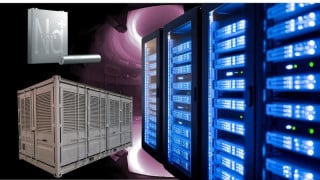
Natura’s advanced nuclear reactors use molten salt. Image used courtesy of Natura
What Are Molten Salt Reactors?
Molten salt reactors (MSRs) are a specific type of nuclear fission reactor in which the fuel and/or coolant are molten salts. Molten salts liquify at high temperatures and can store a vast amount of energy without needing high pressure.
When molten salt is used as fuel, fissile material is dissolved in the salt, and the reaction directly heats the salt. Some key examples of fissile material are thorium-232, uranium-235, plutonium-239, and mixtures of uranium-233 and uranium-238.
After the fissile products dissolve, the fuel circulates around the reactor core, undergoes fission, and generates heat. This heat then transfers to a turbine loop that generates electricity.
This differs from conventional light water reactors (LWRs), where a solid fuel rod generates heat that is carried away by a neutron-moderating fluid, such as water, to a secondary circuit at low pressure to generate steam with a turbine. However, in LWRs, the reactor must be highly pressurized to carry the heat to the turbine.
As a coolant, fluoride or chloride molten salts can be used instead of water. Using molten salts as the coolant allows the reactor to operate at higher temperatures and at ambient pressure (the same as household pipes) than conventional LWRs, which use water under high pressure. When molten salts are used as the coolant, the fuel can be liquid- or solid-fueled, as in other reactors (using rods).
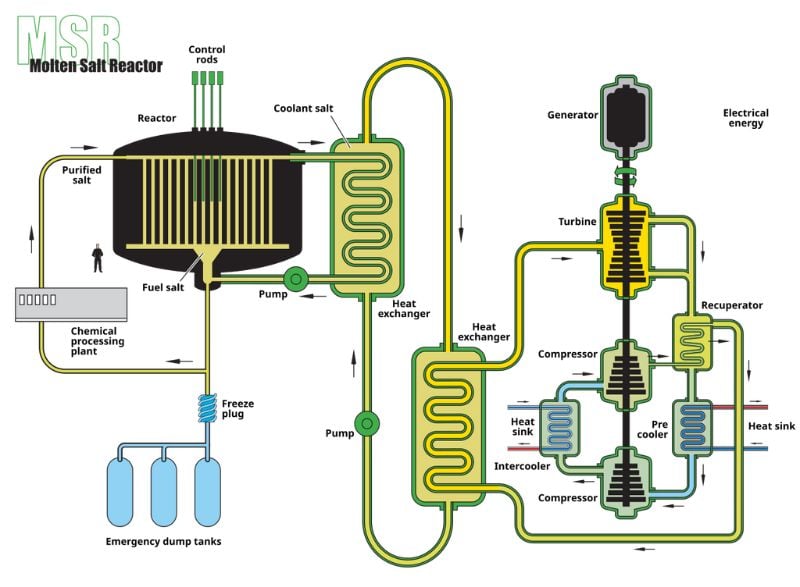
Typical MSR process. Image used courtesy of Wikimedia Commons
MSRs use less fuel and produce radioactive waste with shorter half-lives than other reactor types, and fresh fuel can be added and waste taken away without lengthy reactor outages. Compared to solid-fuel LWRs, MSRs contain lower fissile inventories (amount of fissile material in the core) and have a greater number of preventative passive safety features (compared to active safety features that are response-based safety features).
Advantages and Challenges of MSRs
While MSRs are still in relative infancy compared to other reactor technologies, they offer some inherent design advantages:
- Decarbonization: Molten salts can absorb large amounts of heat, opening up the potential for many secondary heat applications. For decarbonizing industrial processes, the energy can be reused rather than released.
- Low nuclear waste footprint: Most recent MSR designs use liquid fuels, so disposing of spent solid fuel rods isn’t necessary. This can lead to less nuclear waste, since liquid fuels have a higher burn-up limit (90% compared to less than 5% for solid fuel).
- Passive safety features: MSRs are designed with built-in safety features rather than as reactive measures in the event of an issue. For example, if the reactor reaches too high a temperature, the salt expands, leaks neutrons from the reactor core, and can no longer cause fission. Some MSRs also have a drain tank below the reactor, where the plug melts if the temperature gets too high, and the molten salt is removed from the reactor under gravity, without human intervention.
- Sustainable fuel cycles: Uranium, plutonium, and thorium can all be dissolved into salts, allowing the reactors to adapt to different nuclear fuel cycles and making the process more sustainable based on what is available.
However, as with any technology on the way to commercial viability, developers must address technical and design challenges. For MSRs, this includes:
- Design safety and salt transportation standards have yet to be developed.
- The industry needs a more robust supply chain for MSR-specific reactor components.
- Accident scenarios for MSRs are less well known, so more safety experiments and tests are needed.
- The changes in fuel-salt chemistry and radionuclide retention under both normal and accident conditions require further study.
Natura’s Nuclear Reactor Is Liquid-Fueled
Natura is building a small modular reactor (SMR) that uses liquid fuel dissolved in a molten salt. The MSR has been designed to use UF4, but Natura has said that several fuel types—including thorium and uranium mixtures—will be suitable with the MSR.
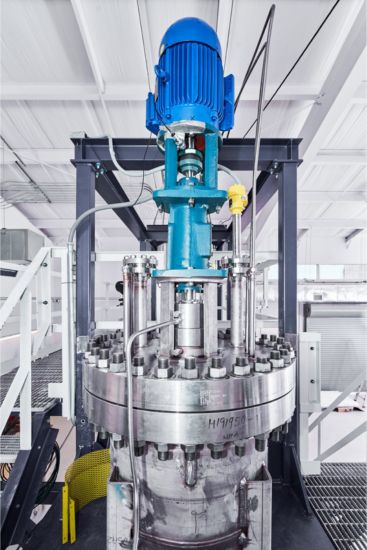
Natura’s SMR. Image used courtesy of Natura
Other features of Natura’s MSR design include the ability to recycle waste fuel and to operate at high temperatures (above 600 °C) and under atmospheric conditions. The reactor has also been developed with walk-away safety shutdown features, including a drain tank below the reactor core.
Natura has also indicated secondary plans for the reactor, including medical isotope production for cancer treatment and secondary heat applications. In medical isotope production, uranium fission yields molybdenum-99, a fission product used for medical diagnostic and treatment applications. These fission products are present in molten salt as both liquid and gas phases and can be extracted from it.
For secondary heat applications, the reactor includes a secondary heat removal system that can transfer heat up to 600 °C for electricity generation, green hydrogen production, steel production, and water desalination.
Plans for Natura’s MSR
Natura has already constructed its MSR-1 reactor. The engineering and design are complete, and the company is now in the procurement phase, with the DOE conditionally committing to supply high-assay low-enriched uranium for the reactor.
Natura’s molten salt reactors are modular and can be shipped anywhere via rail or truck. They can be deployed in many different configurations to meet the varied on-site demands of data centers and desalination plants, as well as the grid. The company expects to scale up the reactors in the coming years, with plans to deploy the first 100-MW reactor by 2029.