Facebook
 Google
 GitHub
 Linkedin
Bill Gates-Backed TerraPower Plans Unusual Nuclear Reactor
The Bill Gates-founded company plans to start early design work on its advanced nuclear reactor in Wyoming this summer.
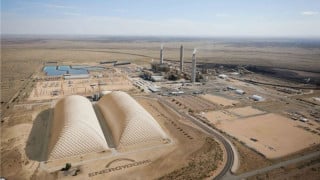
Bill Gates’ TerraPower has filed a permit application with the Nuclear Regulatory Commission (NRC) to build an advanced nuclear reactor demonstration near a former coal plant in Wyoming. The 345 MW sodium-cooled reactor will be connected to a molten salt energy storage system to supply 500 MW for 5.5 hours before needing to be recharged. It’s enough to power up to 400,000 homes.
TerraPower and GE Hitachi co-developed the technology. The latter contributed its Power Reactor Innovative Small Modular (PRISM) reactor, a Generation IV design cooled with sodium instead of water. Compared to other Generation IV reactors, Natrium brings higher fuel utilization, enhanced safety, and a simplified layout demanding fewer materials. TerraPower claims the reactor is four times more fuel efficient than conventional light-water reactors.
_and_power_and_storage_facility_(left).jpg)
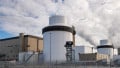
The plant’s reactor building (right) and power and storage facility (left). Image used courtesy of TerraPower
Like other advanced reactors, Natrium is designed to maintain constant thermal power throughout operation, optimizing the plant’s capacity factor. This advantage comes as the U.S. needs dispatchable resources to lend stable baseload energy and flexible storage to balance supply and demand amid the increasing renewable energy use.
The reactor will run on high-assay low-enriched uranium (HALEU), a nuclear fuel class providing improved reactor performance and efficiency with 5% to 20% uranium-235 isotope content. As Natrium moves to the pre-construction stage, TerraPower is in talks with industry partners to secure domestic HALEU metallic fuel and equipment.
After obtaining the permit, TerraPower expects to begin construction in 2025. TerraPower plans to file an operating license application with the NRC in 2026 and enter commercial operation within the next decade. This would mark a pivotal milestone for the Washington-based company, formed in 2006 by Microsoft co-founder Bill Gates. Natrium is part of the Department of Energy (DOE)’s Advanced Reactor Demonstration Program, which authorized up to $2 billion in 2020 with cost-matching from TerraPower and its partners.
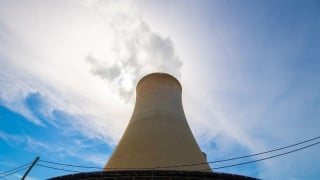
The 44-acre site will reuse some infrastructure, including the cooling tower, from the coal-fired Naughton Power Plant. PacifiCorp, a subsidiary of Warren Buffett-owned Berkshire Hathaway Energy, will own and operate the facility through its Rocky Mountain Power division.
Why Use Sodium as a Coolant?
Advanced reactors build upon the proven capabilities of conventional nuclear plants. However, they incur lower construction costs because of their scaled-down size, less than the 1 GW average capacity of existing nuclear facilities. Natrium’s use of liquid sodium as a primary coolant stands out from traditional reactors cooled with water. The reactor combines molten salt energy storage techniques with TerraPower’s traveling wave reactor design and GE Hitachi’s PRISM technologies.
The pair chose sodium as the coolant for several reasons. As a liquid metal, sodium provides superior heat transfer capabilities. According to the DOE, sodium coolants are 100 times more effective at transferring heat than water.
Video used courtesy of TerraPower
Sodium delivers the high power density needed to generate substantial heat at a low footprint. TerraPower claims the coolant’s thermal conductivity is three times higher than stainless steel, the reactor’s structural material. This feature, plus the inertia of the sodium pool system, requires less heat supply and removal equipment, as the coolant can be removed from the vessel’s surface via air.
Sodium offers high thermal conductivity and efficiency, with a boiling point (1,621°F) nearly eight times that of water, allowing reactors to operate near 0.1 MPa pressures. TerraPower says Natrium will operate near atmospheric pressure, with the reactor heating at 662°F lower than sodium’s boiling point. The high temperature also supports other process-heat applications such as refining/petrochemical operations and other sectors otherwise fueled by natural gas.

Plant layout from a 2022 presentation. Image used courtesy of TerraPower
Since sodium is highly reactive, accommodations are required to safely cool the reactor. Natrium’s plant design uses a secondary loop as a buffer between the steam power cycle and the radioactive sodium.
Plant Design: How Natrium Works
The Natrium plant will include two subdivisions, a 16-acre nuclear island opposite a separate power block. The latter encompasses the most space and can be built and operated without nuclear-grade equipment since safety functions are hosted outside that block. TerraPower claims the plant uses 80% less nuclear-grade concrete per MW than other large reactors. The separation of the two facilities also curbs the radiation footprint.
In the reactor building, uranium fuel is inserted into a container and covered in liquid sodium. The uranium atoms split and release neutrons to warm up the coolant. Liquid sodium metal then covers the core and transfers heat to produce power.
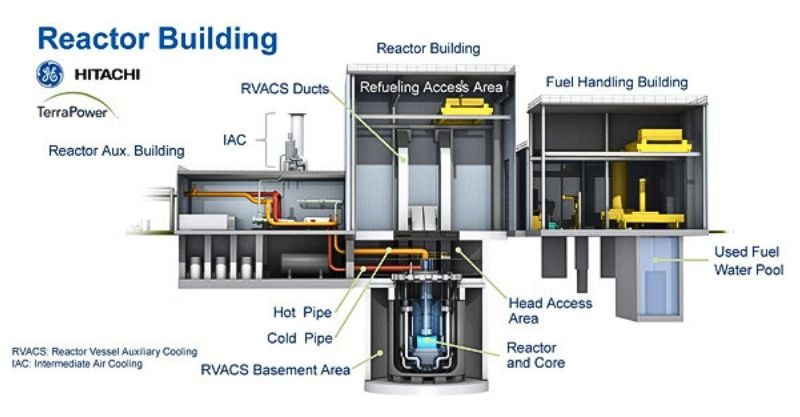
The nuclear island layout. Image used courtesy of TerraPower
Once the liquid sodium is heated, thermal energy moves from the nuclear island to pipes containing molten salt. It’s then deposited into a storage tank serving as the thermal battery. California-based Thermal Engineering International will design and fabricate the sodium-salt heat exchanger used to move the thermal output through an intermediate heat transport system. U.K.-headquartered Hayward Tyler will supply the primary and intermediary sodium pumps.
Next, the molten salt travels via water-filled tubes, boiling the water while passing to produce steam. The resulting pressure spins a turbine to generate electricity. The plant’s operator, Rocky Mountain Power, can raise or lower the output of molten salt released from the storage tank based on demand. Finally, after the heat is released, the salt moves to a cold tank before returning to the nuclear island.
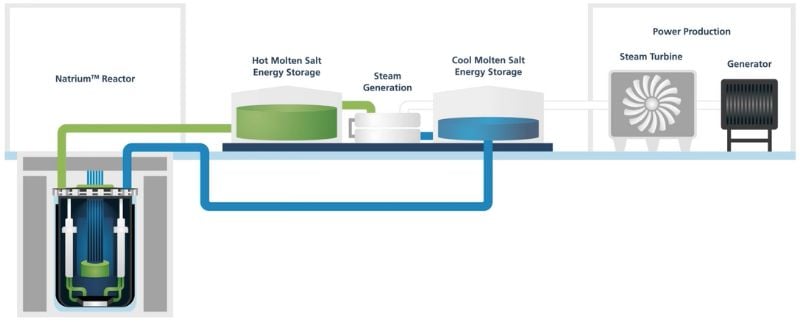
The Natrium heat exchange process. Image used courtesy of TerraPower
Several companies are contributing technology to the project. TerraPower recently closed a second round of contracts for five long-lead suppliers, including seismic isolation equipment and ex- and in-vessel fuel handling and transfer machines. Open requests for proposals include a rotating plug drive, a nuclear instrumentation system, radiation monitoring, pool racks and handling machines, and sodium level instruments, among other categories.
Nuclear Industry Challenges
Several advanced reactor demonstration plants are in various stages of development across the U.S. Like TerraPower, Maryland-based X-energy received billions in funding through the DOE’s Advanced Reactor Demonstration Program to deliver an 80 MW high-temperature gas-cooled reactor. The DOE has also supported small modular reactor (SMR) technology from NuScale Power, Holotec, and GE Hitachi.
However, increased interest rates and material costs remain significant barriers to advanced reactor development. In one high-profile project cancellation, NuScale and Utah Associated Municipal Power Systems nixed their 462 MW SMR project due to inflationary price hikes across the energy supply chain, including carbon steel piping, fabricated structural steel and plates, and other materials.
TerraPower estimates that the Natrium demonstration will cost about $4 billion. However, it expects to reduce the outlay for subsequent plants to $1 billion, with overnight construction costs of $2,080–$3,000 per kW and a levelized cost of electricity from $50 to $60 per MWh.