Facebook
 Google
 GitHub
 Linkedin
AI Secures Grid Ops and Improves Resilience
Artificial intelligence in cybersecurity, advanced management systems, and vegetation management could help service providers anticipate grid failures.
Utilities today face numerous challenges that threaten grid stability. Aging infrastructure struggles with distributed generation and modern energy needs. Conventional cybersecurity measures are inadequate against increasingly sophisticated digital threats targeting essential grid components. Moreover, traditional vegetation management further complicates the problem, as uncontrolled growth can lead to outages and hazards.
Many in the industry have turned to artificial intelligence as a solution. AI can overcome modern-day power grid challenges and streamline energy management.

Grid modernization and cybersecurity. Adapted from images used courtesy of Canva
AI to Protect Smart Grids From Cyberattacks
Smart grids with internet-connected components have made infrastructure more vulnerable to cyberattacks. Grid cybersecurity relying on only firewalls and antivirus software is no longer a good strategy against sophisticated cyberattacks.
In response, researchers at the University of Missouri’s College of Engineering have devised CIBR-Fort, a cloud-based cybersecurity framework designed specifically for inverter-based resources. The system employs advanced large language models and dynamic knowledge graphs to monitor data flows and predict potential cyberattacks with an accuracy of 91.88%.
Architecturally, CIBR-Fort integrates multiple defense layers that address network, communication, and hardware vulnerabilities. It can respond to threats in real time with a 40 millisecond average response time per data flow. The framework can also reroute malicious traffic and analyze attacker behaviors to delay adversarial actions while safeguarding grid operations. The scalable system can update its knowledge base with emerging attack vectors to adapt to evolving threats.
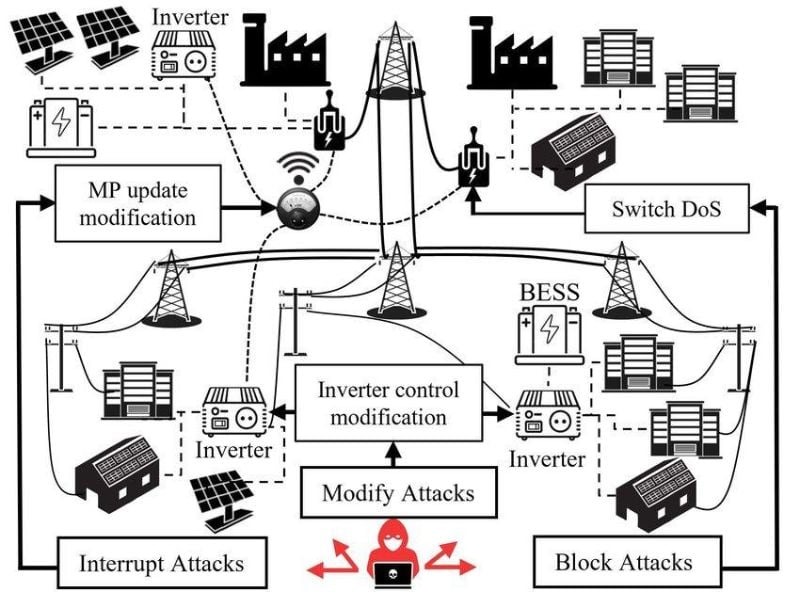
Cyberattack scenarios in power grid. Image used courtesy of Zografopoulos et al.
AI in Next-Gen AMI
Advanced metering infrastructure (AMI) is an integrated system enabling two-way communication between smart meters and central systems for real-time energy management. Limited data accuracy and reduced reliability due to outdated hardware and communication protocols have necessitated upgrades to new AMI versions.
The AMI 3.0 system leverages cloud computing, edge processing, and AI-driven analytics to enhance real-time monitoring and control of power distribution networks. Engineered to support high-resolution data acquisition and peer-to-peer communication, AMI 3.0 features embedded computing capabilities within smart meters to enable automatic firmware updates. Many AMI meters are also equipped with GPS, which AI-powered AMI 3.0 employs to precisely locate faults, isolate problematic areas, and automatically dispatch maintenance crews.
The AMI 3.0 architecture improves grid resilience by fusing dynamic data from weather, consumption, and sensor networks. By replacing obsolete AMI systems with an AI-powered platform, utilities can better mitigate risk. Extensive independent testing confirms its capability under diverse conditions.
AI for Vegetation Management
Challenges in vegetation management have compelled utilities to address power outages and infrastructure damage caused by uncontrolled vegetation growth.
Catalyst has developed INSIGHTS Vegetation Management, a satellite-based monitoring service that enhances grid resilience by optimizing vegetation oversight. The system, which was developed using advanced Earth observation analytics and a robust library of processing algorithms, integrates high-resolution satellite imagery with environmental and utility data to enable precise identification of high-risk vegetation areas. It quantitatively assesses risk by measuring both fall-in and grow-in potential through transparent algorithms.
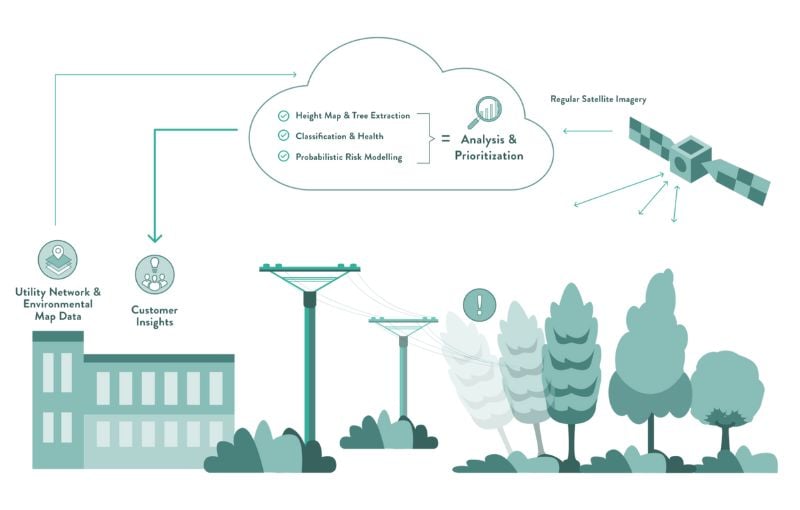
Satellite-based vegetation monitoring. Image used courtesy of Catalyst
Architecturally, the platform operates as a data-as-a-service solution that integrates with geographic information systems, enterprise resource planning platforms, and field management tools. Performance specifications include near-real-time analysis with frequent updates reflecting current vegetation conditions and post-maintenance verification to confirm operational effectiveness. The team believes the system can reduce operational costs by guiding over $100 million in annual utility expenditures toward targeted risk mitigation rather than considering the complete vegetation area.
Future Outlook
The convergence of AI-driven grid solutions offers promising prospects for energy management. Advanced data integration and real-time analytics allow utilities to evolve operational strategies to meet future demands. Continued development will drive more adaptive, efficient, and resilient networks.