Facebook
 Google
 GitHub
 Linkedin
3 Solar Innovations Tackle Efficiency, Durability, and Storage
Studies advance perovskite manufacturing, solar cell durability, and energy storage through a solar-hydrogen combination.
Solar energy research continues to push beyond small efficiency gains, with scientists now tackling deeper technical barriers that have limited how, where, and when solar power can be used. They want to build solar power systems that are scalable, resilient, and reliable.
In three studies, researchers focused on manufacturing perovskite cells, making solar cells more durable, and storing solar energy for long-term use.

Solar panels in sunlight. Image used courtesy of Adobe Stock
Solving the Buried Interface Problem in Perovskite Solar Cells
A persistent obstacle in next-generation solar development has been the "buried interface,” a microscopic layer deep within inverted perovskite solar cells where electronic defects accumulate, leading to premature degradation.
Researchers at China's Qingdao Institute of Bioenergy and Bioprocess Technology have proposed a solution using a crystal-solvate pre-seeding method using specialized nanocrystals. The nanocrystals guide uniform crystal growth from the bottom up, while a built-in annealing effect heals interface defects during production.
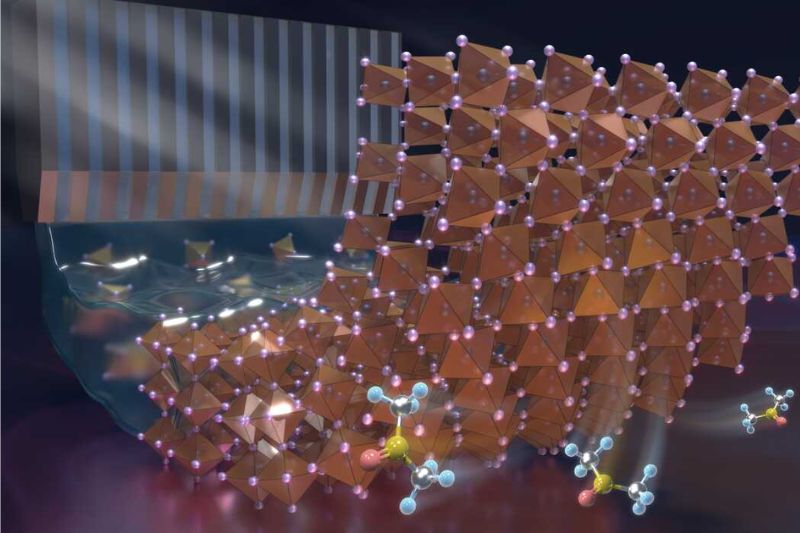
Crystal seeds in the buried interface. Image used courtesy of Chinese Academy of Sciences/Sun Xiuhong
The team created a large-area module measuring nearly 50 cm on a side, achieving a power conversion efficiency of 23.15%. The efficiency loss between the small test cell and the larger module was less than 3%
That gap between lab performance and scaled-up production has been an ongoing challenge, preventing promising perovskite cells from reaching commercial scale. By demonstrating that high performance holds as cell size grows, the team has brought large-scale perovskite manufacturing meaningfully closer to reality.
Flexible Polymer Cells That Prove Their Staying Power
Researchers at Wuhan University of Technology tackled a different but equally critical problem: why polymer solar cells—which are lightweight, flexible, and relatively cheap to produce—have struggled to maintain performance under real-world conditions.
Their study identified specific molecular weak points in polymer acceptor materials that cause degradation under sustained light and heat. They then developed a remedy by blending small-molecule acceptors into the polymer matrix to improve molecular packing and charge transport.
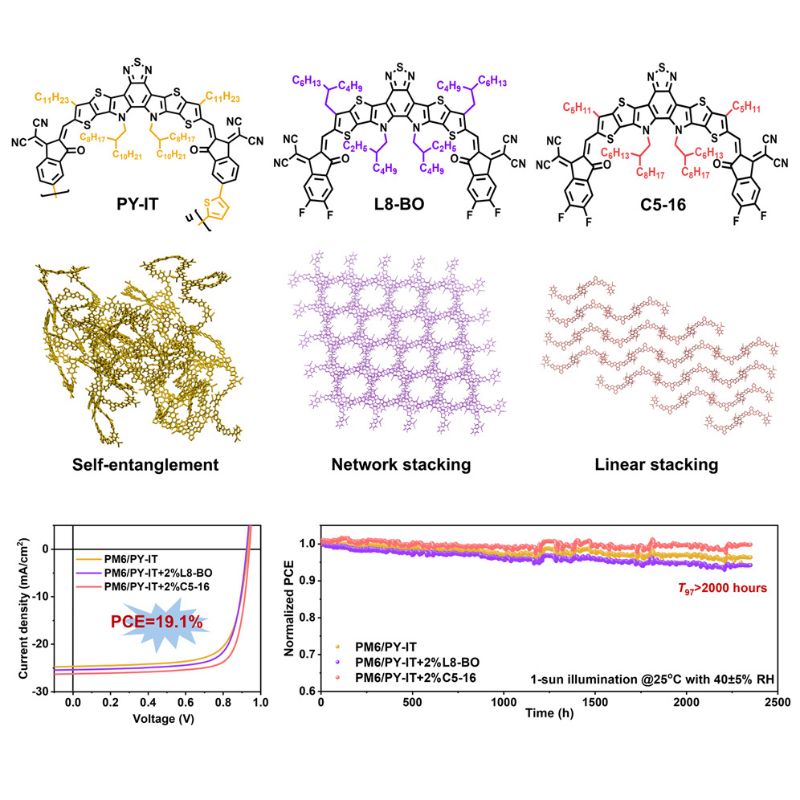
Abstract showing solar cell structure and efficiency. Image used courtesy of Cheng et al.
The resulting devices achieved a power conversion efficiency of 19.1% while retaining 97% of their initial performance after more than 2,000 hours of operation in open air. The team predicted that this result indicated the cells might exceed 100,000 hours of operational lifetime. If that figure holds up under broader testing, it would represent a major commercial threshold crossed.
Flexible polymer cells could unlock solar installations that rigid silicon panels simply cannot reach. They could be applied to curved building facades, portable devices, and remote infrastructure. The technology has always had that promise, but this study makes the strongest case yet that it can deliver on it.
A Solar ‘Battery’ That Stores Sunlight and Releases Hydrogen on Demand
The third breakthrough comes from a collaboration between Germany's University of Ulm and Friedrich Schiller University Jena. This advancement differs from the first two, as it is not a direct advancement in solar technology but rather addresses a major limitation in all solar advances: the sun doesn't always shine when energy is needed.
The team developed a molecular system that absorbs sunlight, stores energy, and releases it as hydrogen days later, even in complete darkness. It functions, in effect, as a solar collector and battery rolled into one.
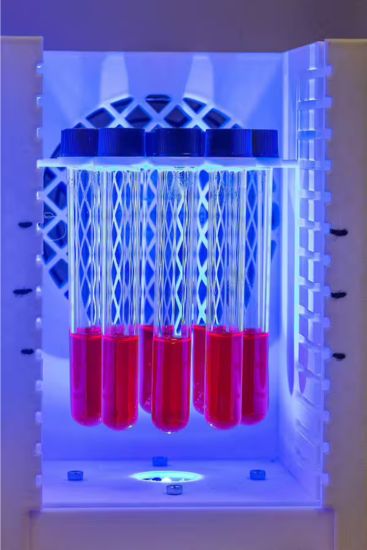
The ruthenium dye irradiated with visible light in the reactor. Image used courtesy of Frederick Schiller University Jena/Elvira Eberhardt
The system is built around a specially engineered polymer that absorbs and holds an electrical charge when exposed to sunlight. The key innovation is that this molecule has been tuned to be exceptionally good at gaining and releasing electrons, which allows it to act as a temporary store of solar energy. Once charged, it can hold that energy stably for several days at an efficiency of over 80% until hydrogen release is triggered.
The practical implications are considerable. Rather than forcing power grids to consume solar power the instant it's generated, this kind of molecular storage could decouple production from consumption entirely. It can capture energy on clear days and release clean hydrogen fuel on demand, on cloudy days, overnight, or wherever it's needed most.
For a world still searching for scalable ways to store renewable energy, a fully rechargeable system that operates at the molecular level and produces hydrogen as its output represents a genuinely new direction worth watching.