Facebook
 Google
 GitHub
 Linkedin
Briefs: Innovations in Cybercabs, Battery Tech, and Solar
Tesla, Ampere, Basquevolt, OCI Energy, Arava Power, NTS, and Inlyte Energy are shaping the future with technology.
Companies continue to innovate and push boundaries to meet future demands for reliable, efficient electronics. Tesla is refining its Cybercab and wireless charging technology to bolster its Robotaxi network. In battery advances, Ampere and Basquevolt are partnering for lithium metal batteries for electric vehicles, while NTS Colocation and Inlyte Energy are piloting an iron-sodium battery storage system for data center backup. In Texas, OCI Energy and Arava Power are collaborating on a massive solar farm.
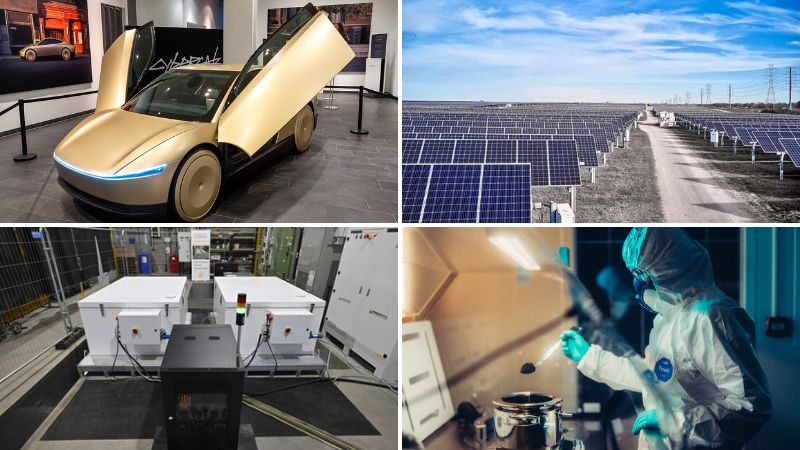
![]() The Cybercab, battery technology, and solar energy.
The Cybercab, battery technology, and solar energy.
Tesla’s Driverless Cybercab Gets Ready To Roll
Tesla’s autonomous vehicle, the Cybercab, has begun production at the company’s Texas Gigafactory. The vehicles could join its Robotaxi service by summer.
The two-seat coupe has no steering wheel or pedals and is designed for unsupervised Level 4-5 autonomous driving using Tesla’s “vision-only” AI system, which relies solely on cameras (no LiDAR). It has no manual controls. Featuring butterfly doors and a large rear trunk, the vehicle has no physical charging port but relies on wireless inductive charging.

Cybercab. Image used courtesy of Wikimedia Commons
Tesla recently received FCC approval for its wireless charging system, which uses ultra-wideband (UWB) radio technology. The FCC usually restricts UWB from use on outdoor poles and limits it to handheld devices to prevent signal interference. However, Tesla uses a fixed ground-mounted charging pad. During charging, the car’s metal body shields the UWB signal.
The on-demand Robotaxi service began operations in June 2025 in Austin. Tesla plans expansions in Houston, Miami, Phoenix, and Las Vegas.
The long-term vision for the Robotaxi network is to enable all Tesla owners to connect their vehicles and offer them as ride-share-like autonomous taxis.
Ampere and Basquevolt Partner for Lithium-Metal EV Batteries
Ampere, a division of Renault Group, has signed a joint development agreement with Spain-based Basquevolt to accelerate the development and validation of lithium metal-based battery technologies for electric vehicles. The venture aims to produce Pre-A sample prototypes and test them under real-world driving conditions.
Lithium metal batteries use a polymer electrolyte, which has higher energy density and better thermal stability than the liquid electrolyte in conventional lithium-ion batteries. The batteries can charge faster and save space and weight in EV battery packs.

A battery scientist. Image used courtesy of Renault Group
Basquevolt claims its efficient manufacturing process can save up to 30% per GWh and use 30% less energy during production.
Swiss Data Center Owner To Pilot Iron-Sodium Battery Storage System
Swiss data center NTS Colocation AG is partnering with battery startup Inlyte Energy to pilot an iron-sodium battery storage system. The companies plan to deploy up to 2 MW of iron-sodium battery capacity at NTS facilities by 2028.
Inlyte’s iron-sodium battery technology has several advantages over lithium-ion batteries, which are the standard for battery storage systems. It is nonflammable and less expensive, using abundant, natural materials such as iron and salt rather than scarce metals like lithium and cobalt.
The project will begin with a 600 kWh installation at NTS’s center in Bern, Switzerland. It is expected to come online by the end of 2026.
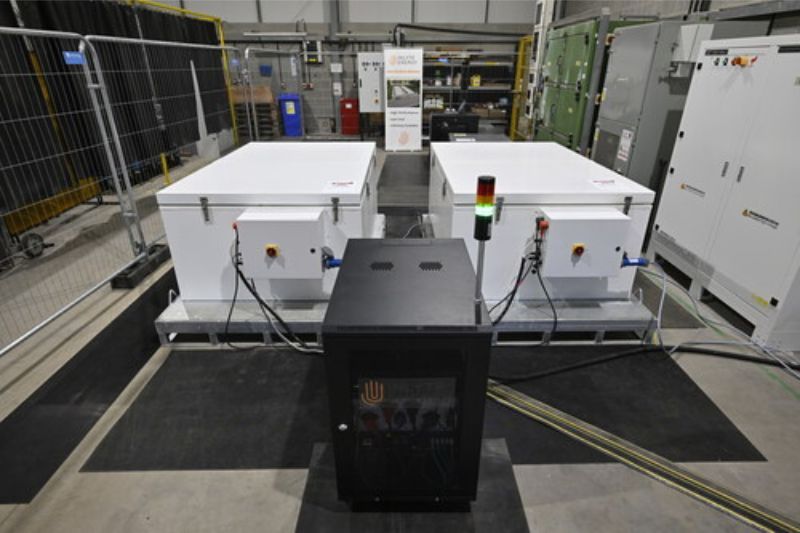
Inlyte’s iron-sodium batteries undergoing testing. Image used courtesy of Inlyte
The pilot will help NTS comply with the updated EU Energy Efficiency Directives, which require data centers to report and reduce fossil fuel use.
After a successful pilot, the two companies plan to expand to an NTS data center under development, with a 2028 opening.
OCI Energy and Arava Power To Build $394M Solar Farm in Texas
OCI Energy and Arava Power have secured funding for the construction of Project SunRoper, a 347 MWdc solar power plant in Wharton County, Texas, about 60 miles south of Houston. Total construction costs are expected to run about $394 million.
ING Capital underwrote the latest funding and will act as the sole coordinating lead arranger and bookrunner. The deal includes a construction-to-term loan, a tax equity bridge loan, and letters of credit. WHC, LLC will serve as the EPC contractor, with Black & Veatch as technical adviser.
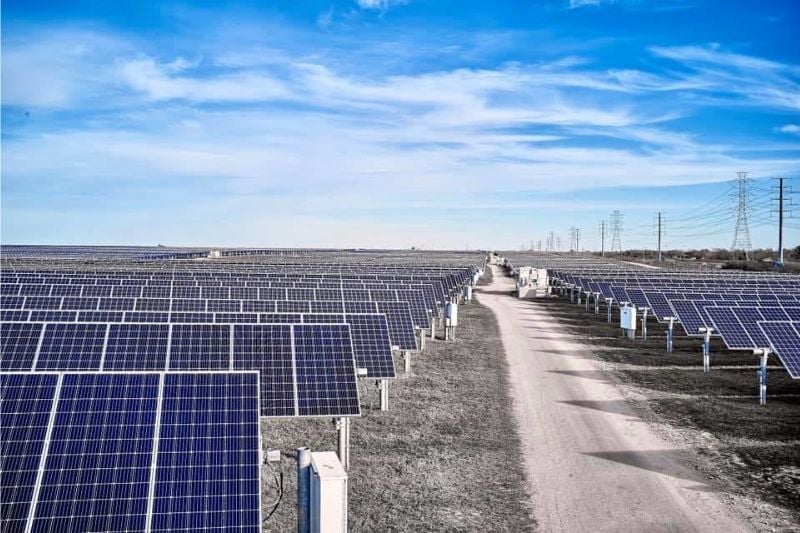
The Alamo I solar farm, operated by OCI Energy. Image used courtesy of OCI Energy
Project developers have signed a power purchase agreement with an undisclosed Fortune 100 company. They anticipate the project will begin commercial operations late in 2027.
OCI Energy operates eight solar facilities in Texas.