Facebook
 Google
 GitHub
 Linkedin
NREL Sets Record With 294 Patents for Renewable Energy
Inventions in 2024 included flexible wave energy converters, a contactless characterization tool for solar materials, and a grid system that responds to threats in real time
A surge in energy tech emerged from the U.S. Department of Energy’s National Renewable Energy Laboratory (NREL) last year, culminating in 46 patents. The organization submitted a record 294 inventions and software tools in 2024, supporting a dozen new startups.
Among these innovations were significant advancements in solar manufacturing, grid security, and wave energy conversion.
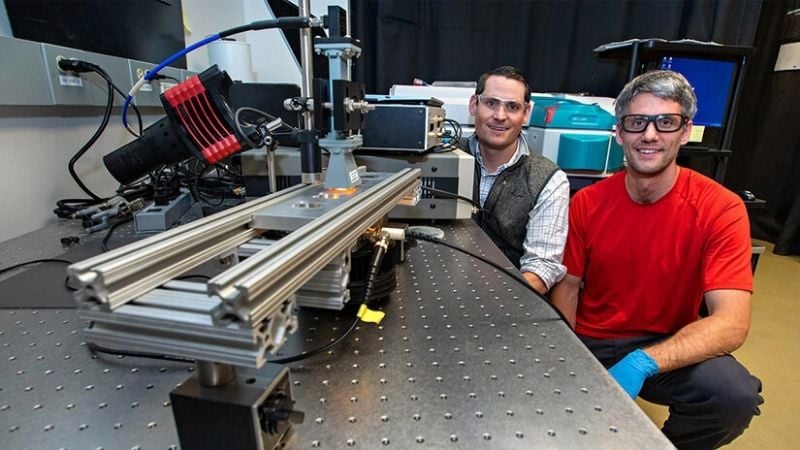
NREL researchers developed a microwave spectrometer that characterizes solar materials in real time. Image used courtesy of NREL
Microwave Spectrometer Boosts Solar Production
Most of NREL’s inventions were solar-related, reflecting the resource’s growing share of the U.S. power mix. According to the Energy Information Administration (EIA), utility- and small-scale solar facilities generated about 7% of the nation’s electricity last year. Utility-scale solar alone added a record 30 GW to the grid—nearly two-thirds of all new generating capacity in 2024. The EIA projects that an additional 32.5 GW will come online in 2025.
NREL’s microwave photoconductance spectrometer makes it easier for solar manufacturers to perform real-time quality control on production lines. It also supports research into next-gen photovoltaic materials like perovskites, an increasingly viable competitor to conventional silicon-based modules used in over 90% of all solar systems sold today.
The device uses a contactless method, pointing microwaves at a semiconducting film to assess its quality and conductivity. It was designed to be compatible with roll-to-roll manufacturing, a continuous production method beneficial for flexible solar panels, where solar materials are deposited on a moving substrate.
The device can be configured for two measurement methods: one is ideal for measuring small samples in research settings, while the larger-scale setup uses the device as an in-line characterization tool during roll-to-roll solar cell production.
Tau Science, an Oregon-based company that makes solar inspection systems, teamed up with NREL to develop and test a compact version for both perovskites and cadmium telluride modules. According to NREL, the original device was 1,000 times more sensitive than conventional methods. After several years of testing and refining the sensitivity to common processing problems, the latest prototype offers even more precision and supports research into additional advanced materials.
Grid Security Tool
NREL Cybersecurity Research Center researchers patented a network visualization and healing system designed to defend the power grid against increasingly complex threats. The platform integrates a SCADA network monitor, event manager, and mitigation system.
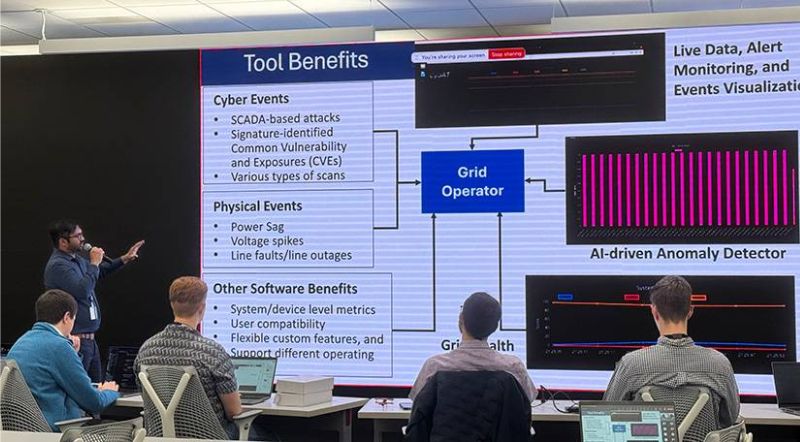
NREL researchers present their grid security tool. Image used courtesy of NREL/by Vivek Kumar Singh
It continuously monitors power system data via SCADA and synchrophasor network interfaces. Upon detecting an anomaly consistent with an intrusion or operational fault, the event manager evaluates the alert and, if warranted, triggers a mitigation sequence. This involves issuing control signals to isolate the compromised elements, reconfigure network pathways, and deploy new operational parameters—all without disrupting grid stability.
Flexible Wave Energy Converters
Two of NREL’s innovations focus on making wave energy more adaptable in harsh ocean conditions.
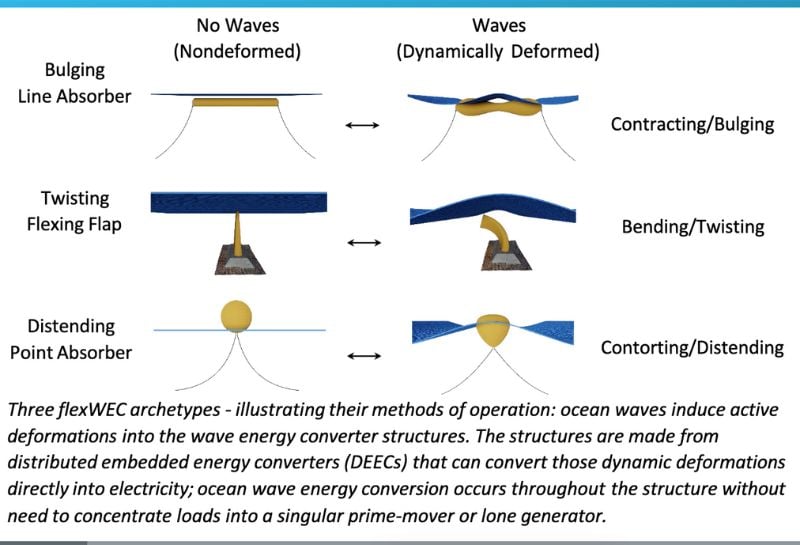
FlexWEC archetypes. Image used courtesy of NREL/by Blake Boren
NREL’s flexible wave energy converter (flexWEC) can twist and stretch to generate energy within a wider range of motion than conventional rigid devices, which are often limited to a single degree of movement. This flexibility allows it to interact with a broad range of wave frequencies and periods. The device is embedded with several small energy transducers to adapt to different wave conditions and continue functioning even if some transducers fail.
FlexWEC builds on NREL’s distributed embedded energy converter technology (DEEC-Tec), a new category of inventions first patented in 2022 by the same NREL researchers named in the latest patent. A DEEC-Tec setup integrates small individual converters into large, flexible structures that capture wave motion across the entire system. This distributes mechanical stress and avoids overloading any single component, unlike conventional systems that concentrate energy onto pistons, gearboxes, or driveshafts.
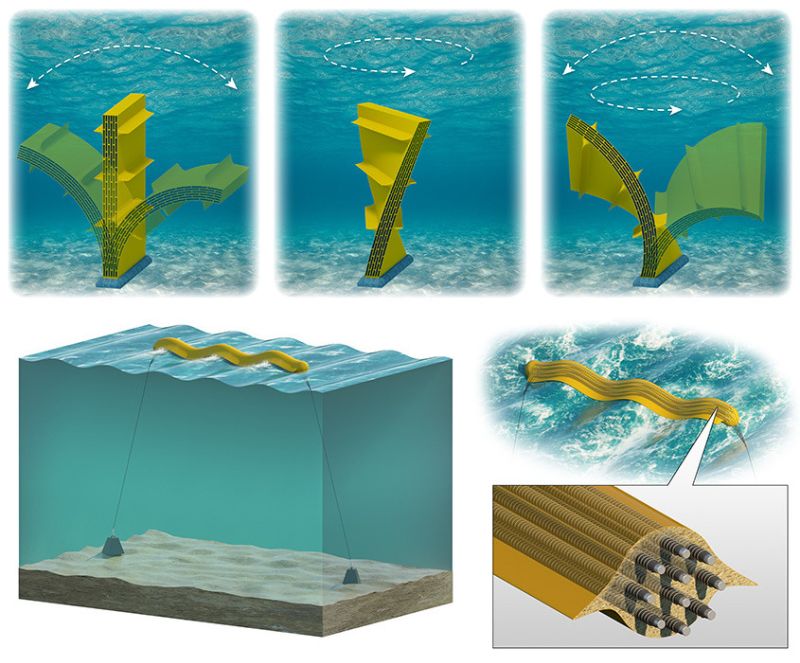
DEEC-Tec devices can bend into different shapes to draw energy from various wave conditions. Images used courtesy of NREL/by Besiki Kazaishvili
In addition to flexWEC, NREL also patented an inflatable pressure absorption pump, offering an alternative to traditional leak-prone hydraulic systems. Rather than relying on rigid components like pistons or motors, the system uses a flexible diaphragm pump to harness kinetic wave energy. As waves squeeze an internal bag, pressurized air is pushed through a column to generate electricity.
This design eliminates rigid moving parts, reducing the risk of mechanical failure. It’s also suitable for high-pressure applications like seawater desalination.