Facebook
 Google
 GitHub
 Linkedin
Challenges of Bare Chip Dynamic Characterization
Power semiconductors contain bare chips that must be characterized before being placed in a package or power module but several challenges must first be overcome.
This article is published by EEPower as part of an exclusive digital content partnership with Bodo’s Power Systems.
Power semiconductor devices are used in various forms—packaged in Surface Mount Devices (SMD) or power modules—across a range of applications. Power semiconductors contain bare chips that must be characterized before being placed in a package or power module to expedite development. However, the small size, fragile structure, and parasitic effects caused by probing create multiple challenges that must be overcome.
Power semiconductor devices are initially fabricated on a wafer, followed by dicing and packaging before being used in actual power electronics circuits. Characterization in the early phases of the manufacturing process helps expedite device development. For power module development engineers, understanding the behavior of power semiconductor bare chips is beneficial for accelerating development and aiding in troubleshooting.
Challenges of Dynamic Characterization of Power Semiconductor Bare Chips
Static characterization of power semiconductor bare chips is not too difficult. The chip is physically fixed tightly on an electrically conductive stage for drain contact, and the source and gate are probed using needles from the top side of the chip. Parasitics associated with the fixturing do not significantly deteriorate measurement performance. Instruments such as curve tracers or impedance analyzers can be used for static characterization.
On the other hand, dynamic characterization of power semiconductor bare chips is extremely difficult. First, parasitics in the test circuit significantly deteriorate dynamic characterization, especially for wide bandgap power semiconductors due to their fast speed. For instance, probe needles introduce additional parasitics, causing oscillation, and ringing, resulting in distorted measurement waveforms. These probe needles can risk arcing due to the high voltage signals used in testing.
SiC MOSFETs, vertical GaN devices, Si MOSFETs, and IGBTs have a vertical device structure where the current flows from the top of the chip to the bottom. Probing a chip from both the top and bottom is extremely challenging. Therefore, one side of the chip must be soldered. However, soldering and unsoldering the chip to a PCA is inconvenient and accelerates board wear, making it less than ideal for testing.
Bare chips are physically fragile. Unbalanced forces during fixturing can easily cause cracks or chipping. Additionally, the small size of the chip—often less than 5mm on one side—makes handling even more difficult. In addition, bare chips can break due to voltage surges caused by the fast di/dt (rate of change of current) of the test signal, coupled with surrounding parasitic inductance.
The only method currently used to characterize a bare chip is to create a complete Double Pulse Test (DPT) board for the chip. This board includes an integrated PCA with gate drivers, bank capacitors, isolation components, and other necessary elements. The chip is soldered to the PCA on the drain side, and wire bonding is used to establish connections to the source and gate. Often, the chip is coated with insulating material.
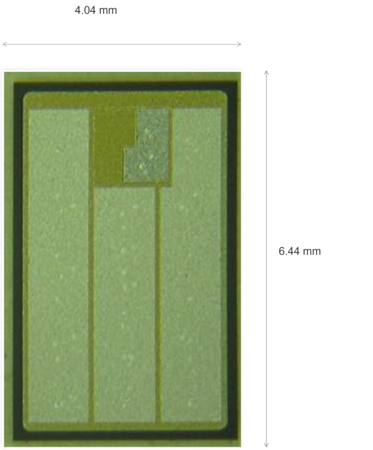
Figure 1. Example bare chip. Image used courtesy of Bodo’s Power Systems [PDF] and Wolfspeed.
However, this setup is employed only once for chip characterization because the PCB cannot be reused. The associated costs, time, effort, and lack of reusability discourage engineers from using it frequently.
Technology Enabling Bare Chip Dynamic Characterization
There are a few key technologies and techniques necessary to enable the dynamic characterization of a bare chip. Creating a special fixture for a bare die is the most important aspect of the solution. This special fixture must meet the following requirements:
- No probing needle to avoid extra parasitic effects and the risk of arcing
- The fixture must make contact with the vertical structure of the bare chip
- Contact with the bare chip must be tight enough to ensure electrical conductivity but not too tight to avoid physical cracks or chipping
- Solderless contact
- A mechanism to align a small bare chip with the electrodes on the test fixture
- Minimize parasitic effects in the test fixture (e.g., < a few nH)
- The fixture should have high voltage and high current capabilities (e.g., 600V and 40A)
- Handling a bare chip gently is essential to avoid physical damage
The solution described below utilizes newly developed technologies for chip dynamic testing and is realized for discrete device double pulse tester. The DUT board is rather simple, as shown in Figure 2. The same technology can be leveraged for the power module double pulse testers, allowing power module engineers to use it for characterizing bare chips and power modules with this new solution.
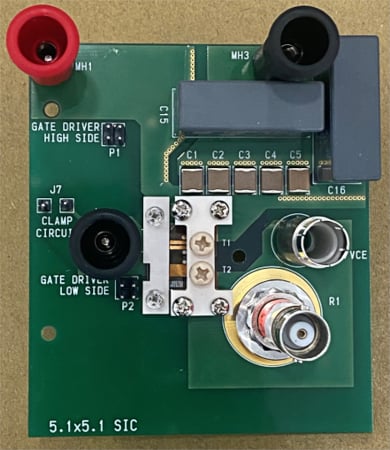
Figure 2. Example PD1500A DUT board for dynamic characterization of a bare chip. Image used courtesy of Bodo’s Power Systems [PDF]
In the DUT board, special treatments are applied to the electrodes on the PCB to allow solderless contact. A flexible PCB with a similar electrode treatment is also used for top-side connections. By placing a chip between the main PCB and the flexible PCB, it becomes possible to flow current from the top of the chip to the bottom, enabling current measurements for vertical structure devices.
The PCB design aims to minimize parasitic inductance in both the power loop and gate loop. The fixture features carefully designed multiple pins protruding from the PCA, which align a bare chip precisely for optimal contact with the electrodes. The absence of probe needles further reduces parasitic inductance in the test circuit.
For Si and SiC devices, a coaxial shunt resistor can be used, even with its several nanohenry (nH) range of extra insertion inductance. In the case of GaN (gallium nitride) bare chips, a patented current sensor [1] provides an additional means to minimize parasitic inductance. Power semiconductor bare chips typically exhibit different form factors. Therefore, our strategy involves creating a customized DUT board for both the Keysight PD1500A and PD1550A, as illustrated in Figure 3.
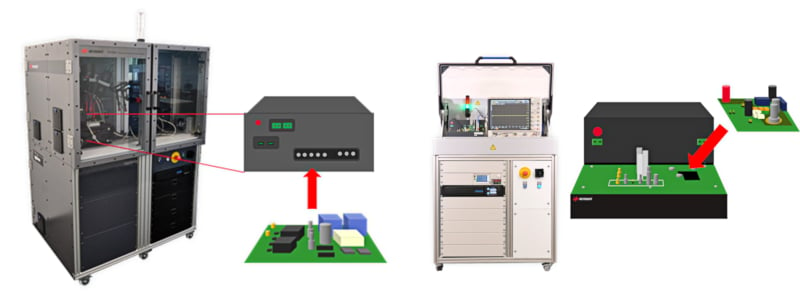
Figure 3. Tailored bare chip DUT fixture for PD1500A/PD1550A. Image used courtesy of Bodo’s Power Systems [PDF]
Figure 4 shows example measurement results taken for a 1.2 kVrated SiC MOSFET bare chip. The test is performed at 800 V and 40 A, demonstrating that the fixture provides sufficient voltage and current capability for the 1.2 kV-rated SiC MOSFET. The waveforms are very clean, with a small Vds overshoot at turn-off. The calculated power loop inductance from the turn-on waveform is only 8.3 nH.
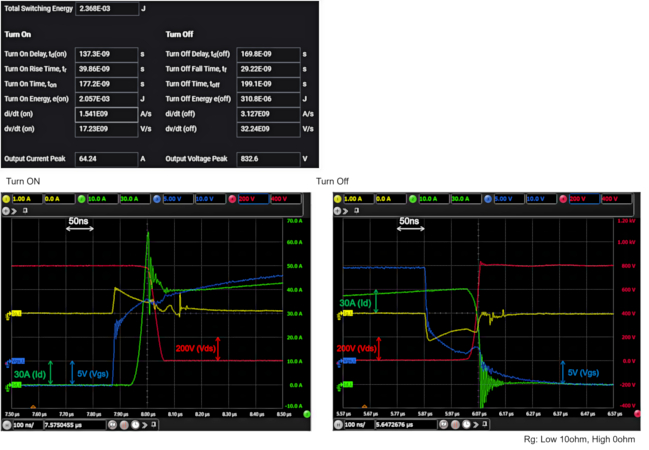
Figure 4. Test results (turn-on & turn-off) for a SiC MOSFET. Image used courtesy of Bodo’s Power Systems [PDF]
The fixture for bare chips can be easily used with curve tracers, eliminating the need for a wafer prober for bare chip static measurements and greatly improving productivity.
Bare chip dynamic characterization, once regarded as challenging and almost impossible to do, is now available through newly developed solutions for Keysight PD1500 series double pulse testers as a tailor-made solution for a bare chip.
This article originally appeared in Bodo’s Power Systems [PDF] magazine and is co-authored by Ryo Takeda, Yu Watanabe, and Takamasa Arai of Keysight Technologies.