Facebook
 Google
 GitHub
 Linkedin
Scientists Tackle Electrolytes, Electrodes, and Battery Management
Recent discoveries could help engineers increase capacity, efficiency, and safety in batteries for electric vehicles and energy storage systems.
Researchers worldwide are continuing to refine technologies to create safer, better-performing, and longer-lasting batteries. Recent breakthroughs include innovations in solid-state electrolytes, lithium-sulfur batteries, dry-processed electrodes, and battery management systems.
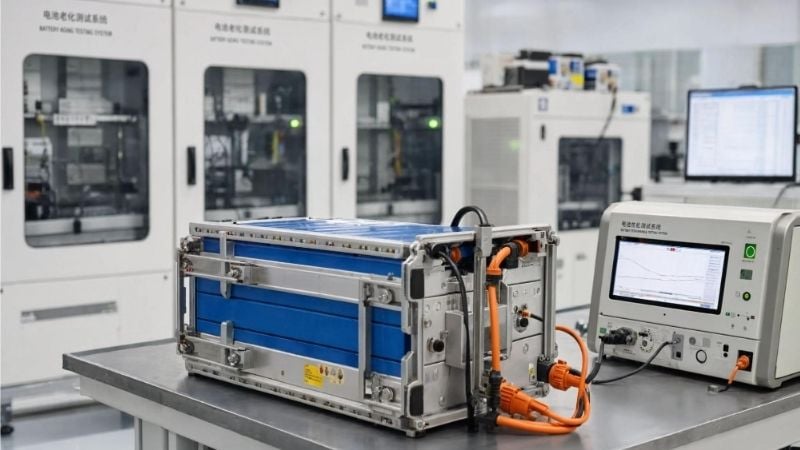
A battery in a laboratory. Image used courtesy of Adobe Stock
Researchers Use Neutrons To Peek at Solid-State Battery Electrolytes
In the quest for better-performing solid-state batteries, scientists have used neutron pellets to examine electrolyte behavior. The research could lead to a better understanding of how solid-state batteries can survive repeated electrical cycling without breaking down.
The Institut Laue-Langevin led researchers in using operando neutron powder diffraction to look inside a thick, 2.5-millimeter. Neutrons can penetrate deep into materials and are highly sensitive to light elements like lithium, which comprise almost all solid-state batteries. The team used a specialized battery with an advanced argyrodite electrolyte six times the conductivity of conventional materials.
The experiment allowed scientists to track lithium movement in real time inside the working solid-state battery. The results showed that while the solid electrolyte remained structurally stable, the lithium extraction from the electrode was unexpectedly uneven. The solid electrolyte suffered no structural changes during the first charge-discharge cycle.
Solid-state battery. Image used courtesy of Adobe Stock
However, the measurements revealed that lithium extraction was not uniform at room temperature, causing two distinct structural phases to coexist in the positive electrode. Testing the battery at 100°C resolved this issue, yielding a uniform reaction and demonstrating that temperature directly controls the smoothness of the charge.
Improving Storage Capacity in Lithium-Sulfur Batteries
Researchers from Tohoku University have developed a covalent organic framework and graphene hybrid interlayer to address the notorious polysulfide shuttle effect in lithium-sulfur batteries. This critical breakthrough prevents dissolved sulfur compounds from degrading the battery cell, unlocking the potential for high-capacity energy storage.
By acting as both a chemical trap and an electrocatalytic accelerator, the hybrid material extends battery lifespan while maintaining high energy output. The design allows these next-generation batteries to charge rapidly without suffering performance decay.
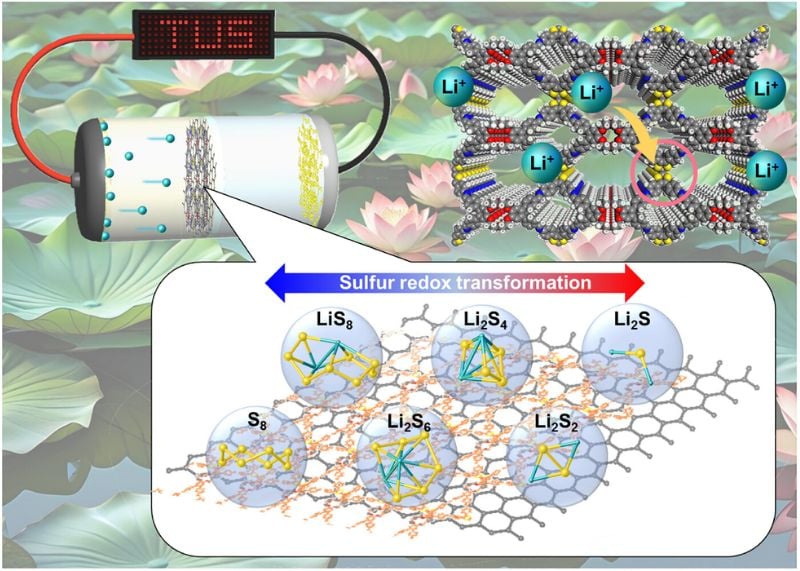
The researchers’ concept for the Li-sulfur battery. Image used courtesy of Sun et al.
The researchers synthesized a highly porous, crystalline framework called TUS-44 and integrated it with conductive graphene sheets. They applied this hybrid mixture as a coating on the battery's internal separator. The TUS-44 framework chemically binds migrating lithium polysulfides, while the graphene network provides a rapid pathway for electron transport.
The hybrid interlayer retained nearly all of its capacity over 1,000 cycles with a degradation rate of just 0.034% per cycle. A prototype pouch cell achieved a massive energy density of 674 Wh/kg. The research could demonstrate a viable path toward the commercial production of lightweight, high-capacity lithium-sulfur batteries.
Researchers Engineer Durable Dry-Processed Electrodes Without PTFE Binders
Scientists from the Korea Institute of Materials Science and the Korea Electrotechnology Research Institute have designed a manufacturing process that creates durable dry electrodes without using any polytetrafluoroethylene (PTFE). Their discovery could lead to electric vehicle batteries that increase range and charge faster.
Dry-processed battery electrodes eliminate toxic solvents and the need for massive drying ovens. Current dry methods rely on a PTFE plastic binder. This binder chemically degrades at low anode voltages, ruining battery lifespan and halting cleaner production.
The researchers engineered isotropic, spherical graphite granules bound by carboxymethyl cellulose and styrene-butadiene rubber. They compressed this dry powder mixture directly onto the metal current collector to form the anode.
During testing, the PTFE-free dry anode retained 81.8% of its capacity after 200 cycles. Conventional wet-slurry electrodes retained only 71.5% under identical high-capacity conditions. The rounded granule shape provides multidirectional pathways for lithium ions, significantly increasing charging speeds under high current loads.
Scientists Simplify Battery Management with Wireless Data Transmission
Scientists at Kiel University have developed a communication principle that enables battery cells to transmit internal temperature data without additional wires. Their findings may pave the way for significantly simpler, cheaper, and safer battery management systems.

EV battery pack. Image used courtesy of Adobe Stock
Dangerous heat often starts deep inside a battery cell and goes undetected by conventional surface-mounted sensors. While internal sensors can prevent this, they usually require extra data cables that crowd the limited space inside a battery pack.
To address the space crunch, the researchers integrated a miniature electronic circuit directly into the battery cell to digitize internal sensor readings. This circuit transmits the data outward through the existing positive and negative power terminals already used for charging. By eliminating dedicated communication wiring, this dual-use setup simplifies the overall hardware.
Initial cost assessments show the wireless transmission method could reduce battery sensor costs by approximately 35%. The prototype remained fully functional while transmitting temperature data through the active power lines. The researchers plan to downscale the circuitry further and adapt the communication method to transmit internal pressure or gas levels.