Facebook
 Google
 GitHub
 Linkedin
Supercapacitor Graphene Discovery Closes Gap With Batteries
The carbon architecture delivered both high energy and power density, overcoming a longstanding trade-off in supercapacitor design.
The carbon architecture delivered both high energy and power density, overcoming a longstanding trade-off in supercapacitor design.
Monash University researchers have engineered a novel graphene-based material that allows supercapacitors to rival batteries in energy storage, while outperforming them in power delivery.
The study in Nature Communications presented “multiscale reduced graphene oxide” (M-rGO) as a transformative architecture for volumetrically efficient energy storage. The team reported volumetric energy densities up to 99.5 Wh/L, on par with lead-acid batteries, and power densities exceeding 69.2 kW/L, marking a new benchmark for carbon-based supercapacitors.
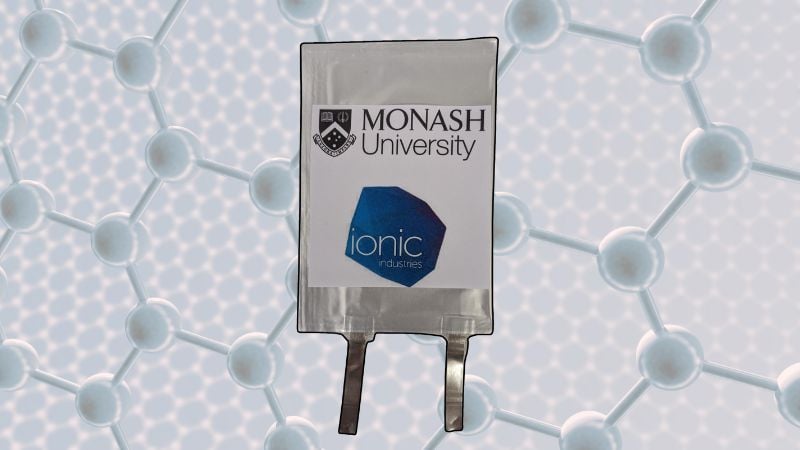
The pouch cell prototype. Image used courtesy of Monash University
The Volumetric Density Challenge
Supercapacitors are known for their rapid charge/discharge capability, but their low volumetric energy density has hindered broader adoption in space-constrained applications. Most carbon-based supercapacitors offer <10 Wh/L, compared to 50-90 Wh/L for traditional lead-acid batteries. The key limitation stems from the electrode material’s architecture, which results in poor ion transport in densely packed structures and low density in highly porous ones.
The Monash team’s M-rGO resolves this by integrating curved turbostratic graphene crystallites with disordered domains in micron-sized particles. This “multiscale” configuration provides efficient ion transport pathways and abundant capacitive sites without sacrificing electrode density. Unlike typical lamellar graphene structures that suffer from re-stacking and inaccessible interlayers, M-rGO’s curved domains support operando electrochemical interlayer expansion (e-IE), allowing ions to enter previously inaccessible regions.
High-Surface Capacitance, High Power Output
The M-rGO material achieves a Brunauer-Emmett-Teller (BET) surface area-normalized capacitance of 85 μF/cm² in organic electrolytes and up to 135 μF/cm² in ionic liquids, among the highest ever recorded. This is attributed to partial charge transfer, pore-ion matching, and nanoconfinement effects, which enhance charge storage beyond classical electric double-layer mechanisms.
_compared_to_other_architectures.jpg)
Ion transport in the M-rGO (right) compared to other architectures. Image used courtesy of Jovanović et al.
The devices maintained high capacitance at extreme charge/discharge rates of up to 200 A/g with excellent rate capability. Electrochemical impedance spectroscopy confirmed minimal resistance and efficient ion diffusion, key contributors to the observed power density of 69.2 kW/L at an energy density of 9.6 Wh/L. When using ionic liquids with a 4 V window, the energy density surged to 99.5 Wh/L.
Beyond performance, the material and fabrication process are engineered for scalability. The graphene is synthesized from natural graphite via a two-step thermal process at relatively low temperatures (700°C). This preserves structural defects that promote crystallite formation without needing ultra-high-temperature graphitization. The M-rGO is then roll-milled into dense, plate-like particles and cast onto aluminum current collectors using minimal binder.
The resulting pouch cell prototypes, with electrode densities approaching 1.42 g/cm3, are compatible with standard form factors used in commercial energy storage. This aligns with the needs of industries focused on electrified transportation, grid stabilization, and consumer electronics, where fast power delivery and compact energy storage are both needed.
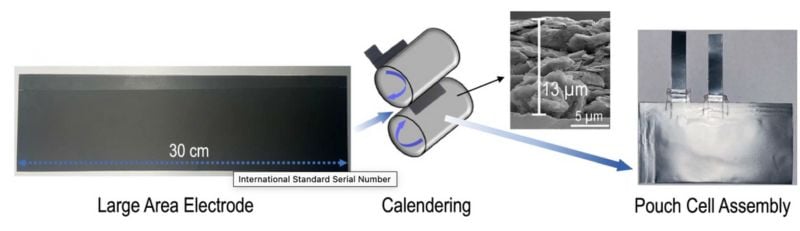
Pouch cell assembly. Image used courtesy of Jovanović et al.
According to the researchers, the M-rGO architecture challenges prevailing assumptions about carbon electrode materials, particularly the role of crystalline domains in energy storage. Traditionally viewed as electrochemically inactive, these domains contributed significantly to capacitance when engineered with controlled curvature and disorder.
By fine-tuning the morphology and crystallite structure during synthesis, the team enabled ion-accessible turbostratic regions to participate in charge storage, rather than obstruct it. This finding suggests a new design strategy for high-performance supercapacitors, where microstructural tuning can drive energy and power density.