Facebook
 Google
 GitHub
 Linkedin
What a Particle Accelerator Revealed in Solid-State Batteries
Fast-moving X-ray beams offer a window into solid-state battery failure mechanisms.
Oak Ridge National Laboratory (ORNL) is testing a solid-state battery formulation by running it through a high-energy particle accelerator to reveal potential failure mechanisms. These insights will inform the development of longer-lasting sodium electrolytes to support the renewable energy transition.
ORNL’s battery transfers sodium ions through a compact solid electrolyte, unlike conventional lithium-ion batteries that store and discharge energy with a liquid or gel electrolyte.
Sodium-metal solid-state batteries offer higher energy density, safer thermal management, and a longer cycle life than their lithium-based counterparts. Sodium (Na) electrolytes also unlock 15% higher conductivity and 14% higher diffusivity, with better ion transport properties.
The ORNL researchers selected Na superionic conductor (NaSICON) materials for their solid-state battery. NaSICONs have a crystalline structure with two Na sites for efficient ion transport. These materials offer increased room-temperature ionic conductivity and electrochemical stability—two essential advantages for energy storage applications.
Experiments at Argonne National Laboratory’s Illinois-based Advanced Photon Source facility unlocked an atomic-level view of the battery’s internal mechanics. The facility hosts X-ray light sources that send electrons through a storage ring traveling near the speed of light.
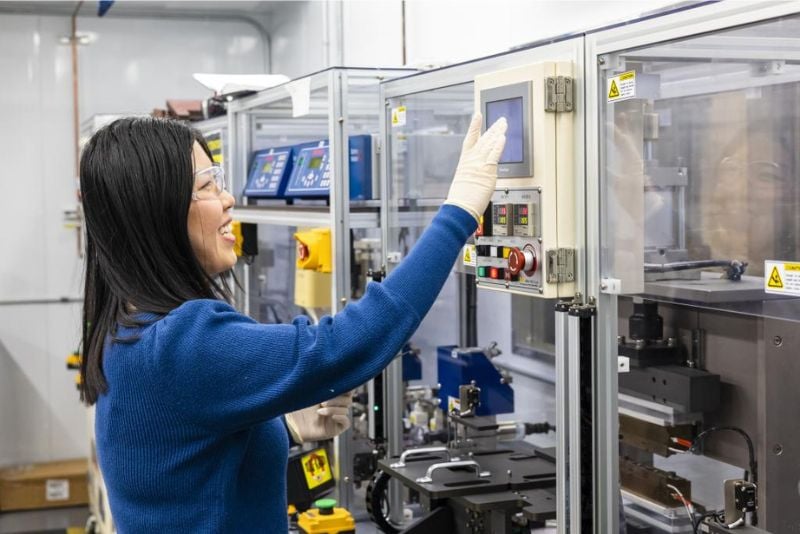
ORNL’s battery manufacturing facility. Image used courtesy of ORNL
A Highly Conductive Solid-State Battery
In previous research, the ORNL team aimed to boost NaSICON materials’ ionic stability and conductivity through doping, composite anode design, and interface regulation. They developed a Na symmetric cell featuring a titanium-doped Na3Zr2Si2PO12 (Ti-NZSP) solid electrolyte. An Advanced Science study last year demonstrated the battery’s improved surface stability, ionic conductivity, and critical current density.
The team selected a Na hard carbon configuration for the battery’s anode compartment, introducing tailored dopants into the NaSICON-type NZSP solid electrolyte membrane. TiO2 doping provided a more densely packed pellet with a distributed porous structure to support improved ionic conductivity and critical current density. Tests also demonstrated stable cycling performance, offering reversible capacities based on various Na storage mechanisms.
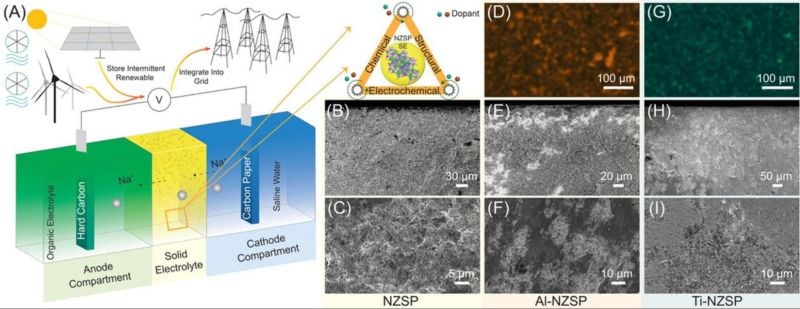
“A” illustrates dopants’ role in ORNL’s sodium battery. “B” and “C” show top-down and cross-sectional views of the NZSP pellet. “D” shows aluminum distribution within the Al-NZSP structure. “E” and “F” depict the pristine aluminum-NZSP. “G” maps Ti distribution within the Ti-NZSP, while “H” and “I” display the pristine Ti-NZSP material. Image used courtesy of Li et al. (Figure 1)
For the next research phase, the team needed to understand how their solid electrolyte might fail in high-demand conditions, such as aggravated plating/stripping. This required inducing high currents and voltages under an X-ray beam using Advanced Photon Source’s synchrotron tomography tools.
Failure Mechanisms in Solid-State Electrolytes
The ORNL researchers wanted to study the inner workings of their battery to identify solutions for limiting Na dendrite formation and integrity issues.

The Advanced Photon Source particle accelerator. Image used courtesy of Argonne National Laboratory
Argonne’s Advanced Photon Source is equipped with operando synchrotron X-ray imaging systems that monitor phase changes during heating, giving researchers a unique window into potential failure mechanisms, dendrite growth, and pore-filling issues in solid-state electrolytes.
Experiments under demanding operational conditions revealed ions depositing in pores on the Ti-NZSP-doped electrolyte, forming structures that could cause short circuits. More specifically, the cell failure mechanism involves a less reversible Na pore filling that generates dead deposits and, thus, cell shorting.
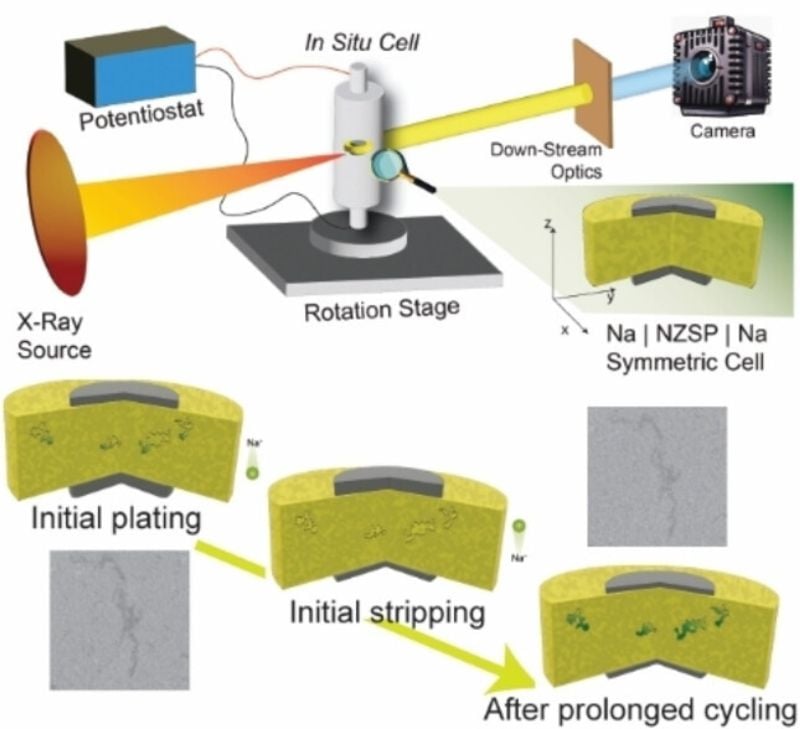
ORNL researchers uncover solid-state electrolyte failure mechanisms. Image used courtesy of ORNL
One researcher observed that Na filaments grow within the solid electrolyte, unlike lithium-based materials.
The team detailed their findings in a Batteries & Supercaps paper. Future studies will tweak the electrolyte to support longer storage durations.