Facebook
 Google
 GitHub
 Linkedin
Battery Tech Tackles EV Range, Charging and Recycling
Charging speed, cold-weather performance, and battery longevity top recent battery advancements.
Electric vehicle battery materials and technology are advancing to increase charging speed and range. Latest developments include a niche battery that recharges in just 18 seconds, a liquid electrolyte promising a 900+ mile range, a 2D superlattice technology that can boost zinc-ion performance, and nanotechnology to aid battery recycling.
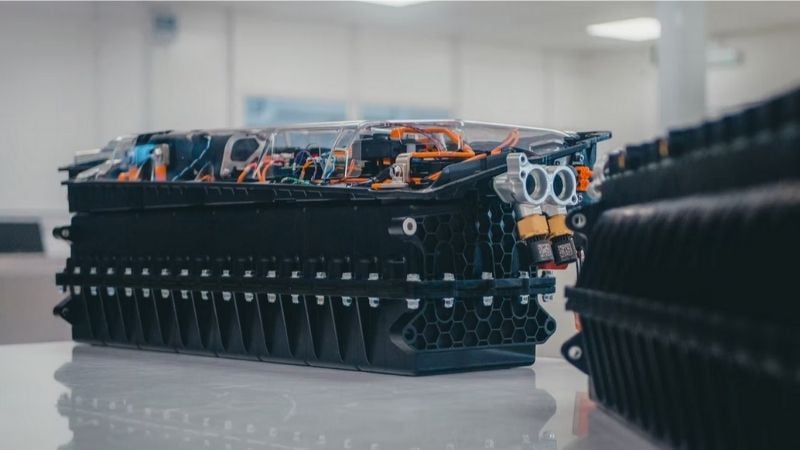
RML Group's VarEVolt battery pack. Image used courtesy of RML Group
Eternalyte Unlocks 3x Ionic Conductivity of Conventional Electrolytes
24M Technologies has introduced Eternalyte, a liquid electrolyte engineered to overcome two persistent problems with lithium-ion batteries: slow charge rates and poor cold-weather performance. The technology supports next-gen cell designs, positioning the market for lithium-metal EV batteries with a projected range of 1,600 kilometers (994 miles) and extended lifetime durability.
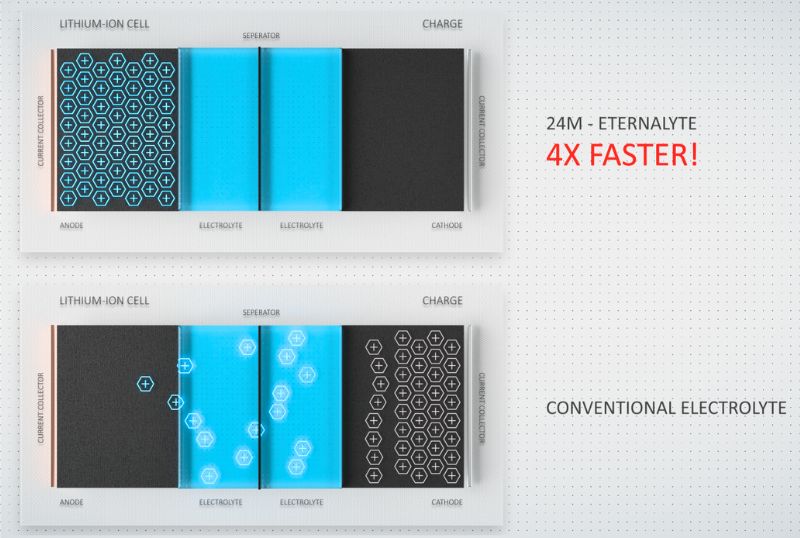
24M Technologies unveiled Eternalyte, a next-gen electrolyte delivering higher conductivity. Image used courtesy of 24M
Eternalyte delivers up to three times the ionic conductivity of conventional lithium-ion electrolytes, enabling EVs to add over 186 miles of range in less than four minutes (15% to 80% state of charge), without relying on megawatt-scale infrastructure.
Eternalyte maintains high electrochemical stability and transport properties across a wide thermal window, retaining over 80% capacity at -40°C, a significant improvement from many conventional batteries, which lose 25% of their capacity at 0°C (32 °F) and substantially more in colder temperatures.
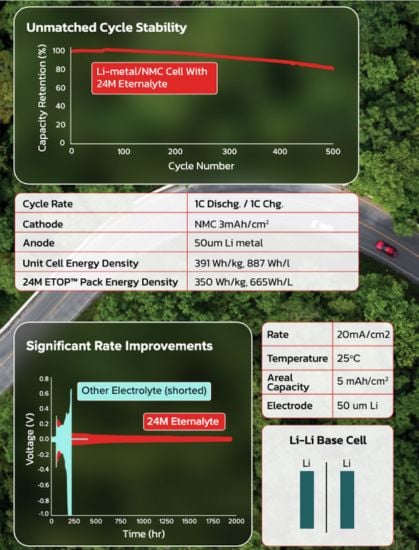
Eternalyte performance data. Image used courtesy of 24M
Although initially developed for lithium-metal anodes, the electrolyte offers flexibility across cell chemistries to support graphite- and silicon-based batteries. It's ideal for vehicles demanding high power and low-temperature performance and can be integrated into existing production workflows.
24M also reports that Eternalyte can charge up to 90% in 16 minutes with conventional graphite electrodes. With lithium-metal electrodes, the charging time to 80% is 11 minutes.
VarEVolt Offers an 18-Second Charge for Niche EV Markets
U.K.-based RML Group secured mass production approval for its ultra-high power density EV battery pack, boasting a full charge in 18 seconds. The modular VarEVolt is designed for short high-power applications in hypercars and specialty vehicles, like the Czinger 21C. The system optimizes for power density rather than energy storage, thus serving high-power and low-capacity configurations.
The battery can supply 6 kW per kilogram and has a 200 C rating. (Typical EV batteries are designed around a 1 C discharge rate, with some able to briefly sustain 2 to 3 C under peak loads.)
VarEVolt is now certified under Conformity of Production requirements, ensuring compliance with United Nations Regulation 100 safety standards for electric and hybrid vehicles.
2D Lattice Engineering Boosts Zinc-Ion Battery Life
Researchers from the University of Manchester and the University of Technology Sydney have found a way to extend the life of zinc-ion batteries. They developed a two-dimensional manganese-oxide/graphene superlattice cathode with enhanced structural stability for aqueous zinc-ion batteries.
Central to the researchers' work is a controlled lattice distortion stemming from an increased concentration of Mn3⁺ ions in the lattice. This induces a Cooperative Jahn-Teller Effect, generating a long-range, uniform strain field across the 2D lattice. This engineered strain mitigates Zn²⁺-induced structural degradation, enabling over 5,000 stable cycles at 5 C. That's about 50% longer than typical zinc-ion systems.
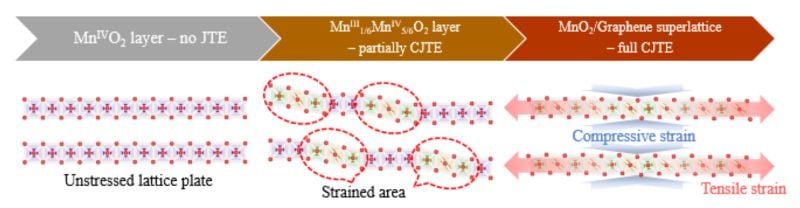
Researchers unveil an induced strain mechanism for zinc-ion batteries. Image used courtesy of the University of Manchester
According to the researchers, the synthesis process uses water-based, solvent-free methods and avoids high-temperature processing. The study was published in Nature Communications.
Nano-CT Reveals Hidden Cracks in End-of-Life Battery Materials
National Renewable Energy Laboratory researchers are using nano-CT imaging to reveal microscopic damage in lithium-ion battery cathodes. NREL's 50-nanometer-resolution nano-CT system enables nondestructive imaging of end-of-life batteries. It's combined with AI-driven analysis and NREL's MATBOX tool.
NREL linked performance loss to microstructural cracks that can impact impedance and rate capabilities, indicating that direct recycling techniques must address severe cracks in cathode active materials.
To recover high-performance cathode materials from end-of-life batteries, processing methods must account for internal structural damage. Material quality can't be assumed from surface metrics alone. The findings appeared in Advanced Energy Materials.