Facebook
 Google
 GitHub
 Linkedin
Anode-Free Battery Nearly Doubles Energy Density for EVs
Korean researchers report 1,270 Wh/L cell-level performance using an anode-free lithium metal design.
South Korean scientists have demonstrated an anode-free lithium metal battery (LMB) with a reported volumetric energy density of 1,270 Wh/L, approaching roughly double that of today’s lithium-ion cells used in electric vehicles. The work, led by teams from POSTECH, KAIST, and Gyeongsang National University, addresses a central challenge facing next-generation EV batteries: increasing energy density without significantly increasing pack size.
The study focuses on an anode-free lithium metal architecture, a configuration that removes the traditional graphite or silicon anode entirely. Instead, lithium is plated directly onto a current collector during charging, eliminating the volume and mass normally reserved for the anode.
While the concept has been studied for years, practical implementation has been limited by rapid capacity loss, lithium dendrite growth, and poor cycle stability. The South Korean work proposes a materials and interface strategy intended to overcome several of these long-standing barriers.
_and_diagram_of_the_stacked,_anode-free_fuel_cell.jpg)
Photo of the pouch cell (left) and diagram of the stacked, anode-free fuel cell. Image used courtesy of Han et al.
Why Anode-Free Designs Matter
Conventional lithium-ion batteries allocate a substantial portion of their internal volume to the anode, which does not store lithium itself but serves as a host structure. Even advanced silicon-rich anodes still consume space that could otherwise be used for active cathode material. An anode-free cell removes that constraint, enabling a much higher fraction of the cell volume to contribute directly to energy storage.
The research team achieved a volumetric energy density of 1,270 Wh/L at the cell level. For context, commercial EV cells typically sit around 600-700 Wh/L, depending on chemistry and packaging. The gain comes primarily from removing the anode and increasing the effective cathode loading, rather than from incremental improvements to cathode chemistry alone.
However, anode-free designs introduce severe technical challenges. Because lithium metal is deposited and stripped repeatedly during cycling, the interface between the lithium and the current collector becomes unstable. Uneven lithium plating leads to dendrites, dead lithium formation, and rapid capacity fade. These effects have historically limited anode-free cells to low cycle counts or laboratory-scale demonstrations with impractical operating conditions.
_and_graphical_representations_of_RH_at_pristine,_charging,_and_discharging_(b).jpg)
A schematic illustration of anode-free LMBs, showing three different anode-free LMBs after cycles (a) and graphical representations of RH at pristine, charging, and discharging (b). Image used courtesy of Han et al.
Interface Engineering to Stabilize Lithium Plating And Stripping
The Korean team’s approach centers on controlling lithium deposition at the anode-free interface through electrolyte and interphase design. Rather than relying solely on a conventional copper current collector, the researchers engineered a surface and electrolyte environment that promotes uniform lithium nucleation and suppresses dendritic growth during repeated charge and discharge cycles.
A key element of the work is the formation of a stable, inorganic-rich solid electrolyte interphase that remains mechanically robust during lithium plating and stripping. By tailoring electrolyte composition and additives, the team aimed to reduce parasitic side reactions and prevent the continuous breakdown and reformation of the interphase, a major driver of lithium consumption in metal-based cells.
The scientists report that this interfacial strategy enables dense, uniform lithium layers to form during charging, rather than the porous or filament-like structures that typically emerge in anode-free systems. This uniformity is critical for safety and for maintaining high coulombic efficiency over repeated cycles.
While the study does not claim parity with commercial lithium-ion lifetimes, it demonstrates substantially improved stability compared with prior anode-free lithium metal designs operating at similar energy densities.
Implications and Remaining Hurdles For EV Deployment
From an EV perspective, volumetric energy density is often as important as gravimetric energy density. Vehicle packaging constraints and thermal systems both limit how much physical space can be devoted to batteries. A near-doubling of Wh/L at the cell level could translate into either significantly longer driving range or smaller, lighter battery packs for the same range.
Several hurdles remain before anode-free lithium metal batteries can be considered viable for production vehicles. Cycle life remains a central concern. Even with improved interfacial stability, lithium metal systems generally lag behind today’s lithium-ion cells in terms of thousands of deep cycles under automotive duty profiles. Thermal stability and abuse tolerance are also unresolved questions, particularly under fast-charging conditions and wide temperature ranges.
From the manufacturing side, anode-free cells simplify some aspects of electrode fabrication by eliminating anode-coating steps, but they demand extremely tight control over electrolyte purity, interfacial chemistry, and cell assembly. Any variability in lithium plating behavior can quickly lead to performance divergence across cells, which is unacceptable in large EV packs.
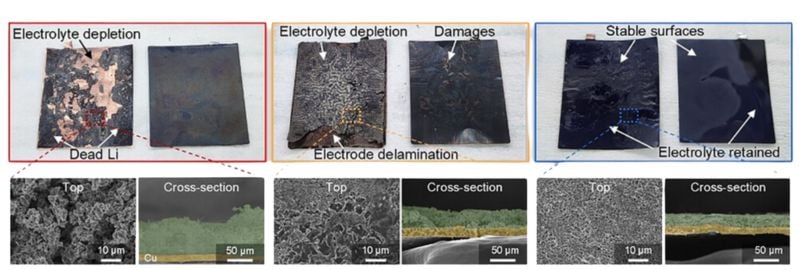
Digital photographs of the disassembled anode-free fuel stack pouch after 30 charge/discharge cycles. Image used courtesy of Han et al.
The researchers say their work is a proof-of-concept that anode-free lithium metal batteries can reach energy densities far beyond today’s commercial cells while operating under more realistic conditions than earlier demonstrations. The results suggest that interface engineering, rather than entirely new cathode chemistries, may unlock some of the largest remaining gains in battery energy density.
As automakers and battery suppliers continue to search for post-lithium-ion pathways that do not require radical changes to vehicle architecture, anode-free lithium metal designs remain one of the most technically challenging, and potentially most rewarding, options under investigation.