Facebook
 Google
 GitHub
 Linkedin
Offshore Wind Platform Designs Tackle Tallest Turbines
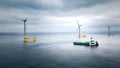
Principle Power’s center-column WindFloat design can support larger wind turbine deployments.
Principle Power, a floating wind platform technology developer, has released two semisubmersible wind turbine platform designs as part of the company’s WindFloat portfolio. The offshore wind platforms will employ tubular center column (WindFloat TC) and flat panel center column (WindFloat FC) designs to accommodate larger turbines in varying water depths.
The floating platforms are designed to complement the existing portfolio of perimeter column models (WindFloat T and WindFloat F) with a design that mounts the turbine on columns at the platform center. Center mounting makes larger mass towers more resistant to dynamic oscillations and supports larger, higher-power turbines.
The wind turbine platforms will incorporate the latest technology from the existing perimeter mount WindFloat options, including the Smart Hull Trim system for improved energy production, a fatigue-resilient architecture, and a modular design that facilitates supply chain sourcing and assembly.

Center column semisubmersible wind turbine platforms. Image used courtesy of Principle Power
Designing an Offshore Wind Turbine Platform for Stability
Principle’s WindFloat turbine platforms achieve stability through a combination of water plane area (footprint), draft, and column diameter and are designed to accommodate the largest available offshore wind turbines.
The Smart Hull Trim System is a robust and fully redundant ballast (weight) system that transfers water between platform columns to compensate for fluctuations in metocean (weather and ocean) conditions and keeps the wind towers vertically positioned with little or no pitch.
The ballast system is fully enclosed and employs ballast at the bottom of the platform, allowing for a shallower draft design in ports and more stability in open ocean when using deeper draft configurations.
For added stability, the tube panel models (perimeter and center mount) use patented damping plates fitted at each column’s bottom to reduce wave and turbine-induced motion. This approach allows the platform to remain light while retaining the stability characteristics of a heavier mass platform. The flat panel models use pontoon structures between the columns to achieve a similar stability level.
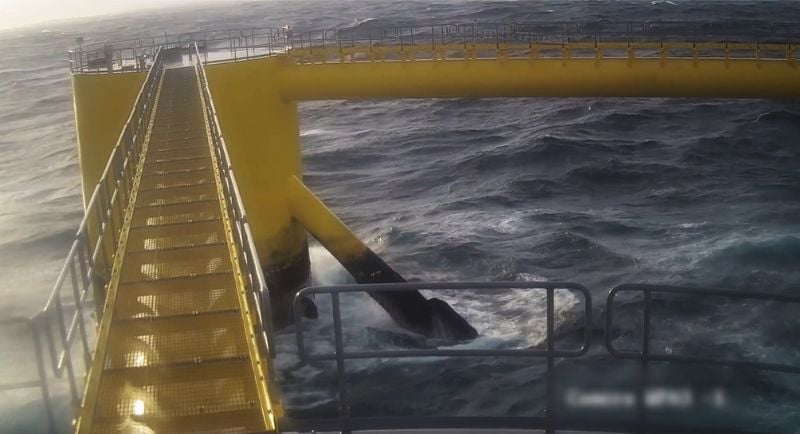
Perimeter-mounted tube platform in high sea state conditions. Image used courtesy of Principle Power
Perimeter Vs. Center Column Mounting
Perimeter-mounted designs (WindFloat T and WindFloat F) are optimized for wind turbines that use soft-stiff towers, while center-mounted columns are designed for wind turbines using stiff-stiff towers.
Stiff-stiff towers are towers with a resonant frequency above the rotational frequencies of the turbine (P) and the passing blades (3P for three blades). Stiff-stiff towers will not be affected by dynamic loads from the rotor or blades that might induce oscillations; however, they require a bigger mass and can be more expensive.
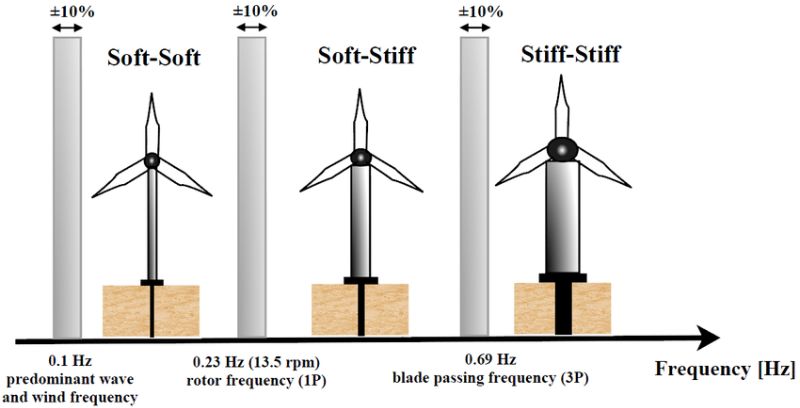
Tower style comparison. Image used courtesy of Lombardi
Soft-stiff towers have a natural resonant frequency above the rotational frequency, but below the blade frequency, so more thought is required in managing dynamic loads to prevent oscillations.
The new WindFloat center column platforms are designed for turbines with stiff towers and power ratings of 15 MW and above. According to Principle Power, the center column platforms are “bankable” (easier to secure funding) and well suited to commercial scale projects since most of the technical features of the platforms have been “de-risked.”
Designing for Manufacturability and Deployment
The energy in offshore winds can power the entire planet 18 times over, according to the International Renewable Energy Agency.
To help harness this energy, Principle Power has set the ambitious goal of deploying 300 offshore wind platforms by 2030. To achieve this goal, the company’s “300 x 30” industrialization program employs a design that uses standardized modules produced with factory-style techniques. The program also allows for high levels of flexibility in the transport and assembly of the subcomponents used to construct the platforms.

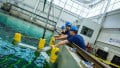
On-site platform assembly. Image used courtesy of Principle Power
Once sub-modules arrive onsite at the port facility, components can be assembled quickly using local marine equipment, such as cranes and ships.
Principle Power has been manufacturing floating platforms for wind turbines for 13 years, with designs leveraging existing supply chains and infrastructure to support rapid scaling.