Facebook
 Google
 GitHub
 Linkedin
Pushing Boundaries in Batteries, Hydrogen and Solar Materials
New research in battery disassembly, hydrogen storage, and perovskite engineering reveals scalable, low-impact solutions for future electrification and energy resilience.
From self-breaking battery electrolyte chemistry to solid-state hydrogen carriers made from Styrofoam, materials science is producing a new class of technologies designed for performance and recovery, reuse, and integration into decarbonized infrastructure.
In three recent studies, researchers tackle core energy challenges with scalable approaches. MIT engineers introduced a self-assembling, recyclable electrolyte for lithium-ion cells. A Ulsan National Institute of Science and Technology team unveiled a low-temperature method to embed hydrogen into polystyrene for reversible storage. Finally, scientists at Nanyang Technological University report a growth strategy for perovskite solar cells that achieves high conversion efficiency and long-term stability by templating chemically inert interfaces.
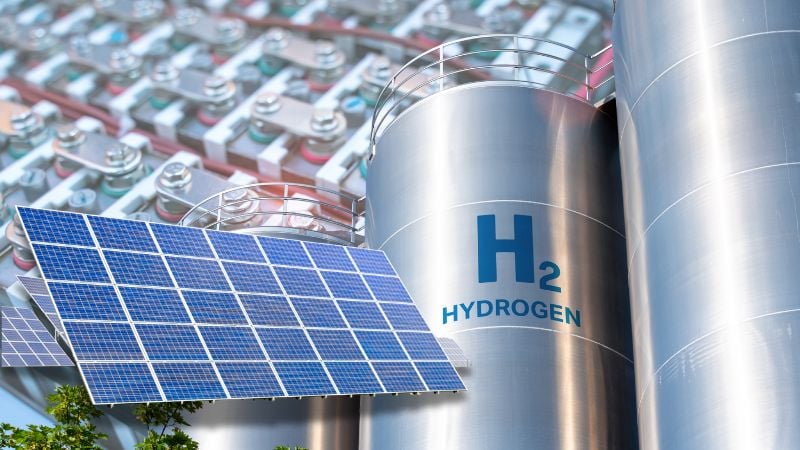
The latest research could impact electric vehicle batteries, hydrogen storage, and solar efficiency. Image used courtesy of Canva
Self-assembling Material Could Aid Recyclable EV Batteries
MIT researchers reported a “recycle-first” solid-state electrolyte built from aramid amphiphiles, Kevlar-like organic molecules that self-assemble in water into ion-conducting nanoribbons. They then hot-press into a mechanically robust separator that bonds the electrodes in service. At the end of life, the electrolyte rapidly dissolves in a simple organic solvent, letting the cell “fall apart” so cathode and anode foils can be recycled.
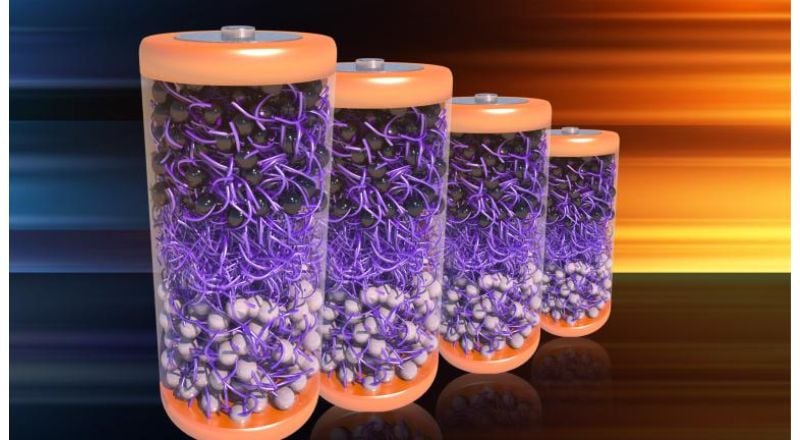
Concept of the self-assembly nanoribbons. Image used courtesy of MIT/Zach Winn
Early cells demonstrate functional lithium-ion transport through the nanoribbon network, but polarization limits at high C-rates, attributed to sluggish ion transfer between the nanoribbons and metal-oxide particles. This is a key optimization target as the concept moves beyond proof-of-concept. The team positions the approach as compatible with future EV chemistries and manufacturing, arguing that engineered “self-breaking” electrolytes could localize and simplify materials recovery within the next 5-10 years once interfacial kinetics and processing are tuned.
Styrofoam-Based Hydrogen Storage Offers Safe, Reusable Solution
Researchers at the Ulsan National Institute of Science and Technology have developed a novel hydrogen storage method that transforms polystyrene foam (Styrofoam) into a solid-state hydrogen carrier using simple, reversible chemistry. The process involves first embedding an organic boron compound (9-BBN) into the foam, then reacting it with hydrogen gas under mild conditions (below 80°C and atmospheric pressure). The resulting material stores hydrogen safely and densely in a chemically stable form. Hydrogen can be released on demand by heating the foam, and the material can be recharged and reused multiple times without significant performance loss.
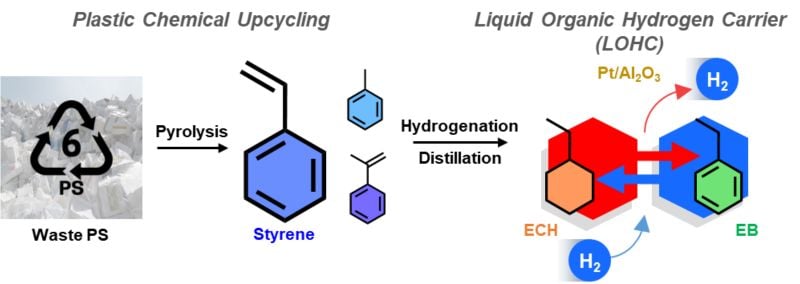
An illustrative overview of the researchers’ work. Image used courtesy of the Ulsan National Institute of Science and Technology
The approach stands out for its lightweight, low cost, and benign reaction conditions, making it suitable for distributed energy systems, portable power, or green hydrogen transport. Unlike compressed gas or cryogenic liquid hydrogen, this polystyrene-based storage doesn’t require tanks, insulation, or high energy input. While still in the early research phase, the team envisions applications in off-grid environments, industrial backup systems, and future hydrogen-fueled devices where safe, compact, and reversible storage is a critical bottleneck.
Growth Strategy Enhances Efficiency and Stability of Perovskite Solar Cells
Researchers at Nanyang Technological University have developed a growth method for perovskite solar cells (PSCs) that resolves a long-standing trade-off between efficiency and long-term stability. Presenting their work in Nature Energy, the team focused on improving chemically inert low-dimensional (CI LD) halogenometallate interfaces, protective boundary layers that can prevent perovskite degradation.
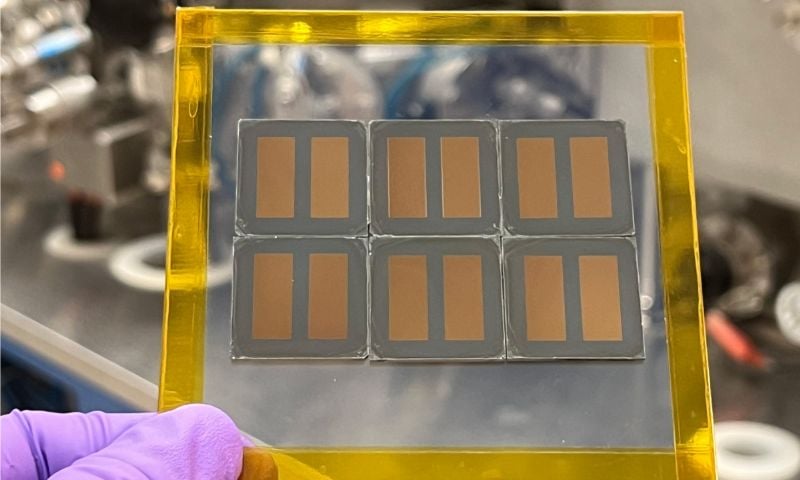
Researchers created 1 cm2 prototype solar cells. Image used courtesy of Nanyang Technological University
Their method introduces a selective templating strategy that first forms a metastable LD interface and then replaces its cations through an organic cation exchange process to yield a more robust, low-reactivity structure. This approach overcomes solubility and reactivity issues that previously hindered CI LD layer formation.
When integrated into PSCs, the strategy delivered power conversion efficiencies of 25.1% over an active area of 1.235 cm2. Just as significantly, the cells retained over 93% efficiency after 1,000 hours of operation and 98% after 1,100 hours of thermal aging at 85°C, representing a rare combination of performance and durability in lab-scale perovskites. The researchers suggest this versatile interface engineering technique could accelerate commercial deployment by extending the operational lifespan of PSCs while preserving high efficiency.