Facebook
 Google
 GitHub
 Linkedin
Oil and Water Don’t Mix, Except in EV Battery Recycling
Researchers have used ultrasound to stabilize an oil-water mixture to extract valuable metals from used lithium-ion batteries.
Discarded lithium-ion batteries are piling up, and the problem is expected to worsen. Recycling can’t keep up with demand because conventional recycling processes are expensive, and profit margins are slim.
In the U.S., only 5% of end-of-life batteries from EVs and energy storage systems are recycled. In the U.K., as many as 100,000 EV batteries are waiting to be recycled. The backlog of used batteries could reach 16,650 tonnes by 2028.
However, University of Leicester researchers say they have found a sustainable and cost-effective recycling method using cooking oil and water. They claim the technique can retrieve 96% of usable metals from recycled lithium-ion batteries while using only 1% of the energy of conventional methods.
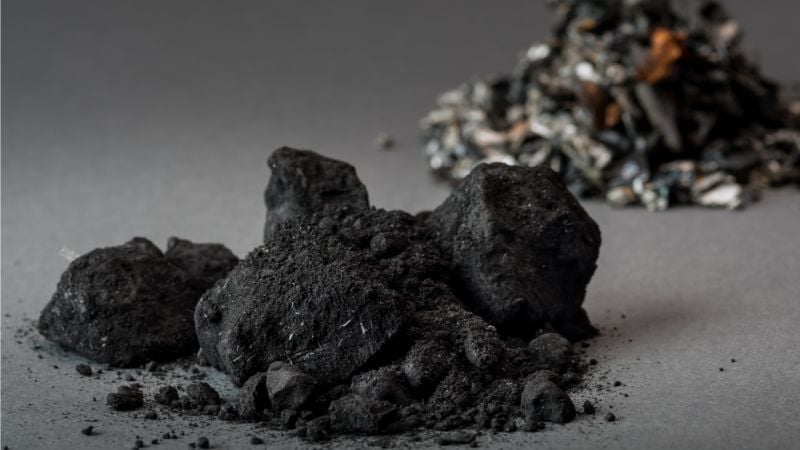
Black mass—shredded metals from conventional battery recycling. Image used courtesy of Environmental Protection Agency
Black Mass and the Recycling Problem
Conventional recycling produces black mass, a shredded mix of metals from the anodes and cathodes. Black mass varies in quality and composition. It usually contains quantities of valuable metals like graphite, lithium, cobalt, and nickel, with inactive or useless materials.
The black mass usually undergoes pyrometallurgy or hydrometallurgy. These long-loop processes are energy-intensive and potentially polluting.
Pyrometallurgy breaks down metals by burning lithium-ion batteries at temperatures up to 1400°C. Fossil fuel sources typically supply the energy. Pyrometallurgy can also produce fluoride and carbon dioxide emissions.
Hydrometallurgy uses chemical solutions, often strong acids or bases, to leach the metals from the used batteries. The process creates metal salts, which require additional processing before they can be used in new batteries. Hydrometallurgy uses less energy than pyrometallurgy, but it can release heavy metals and other undesirable byproducts.
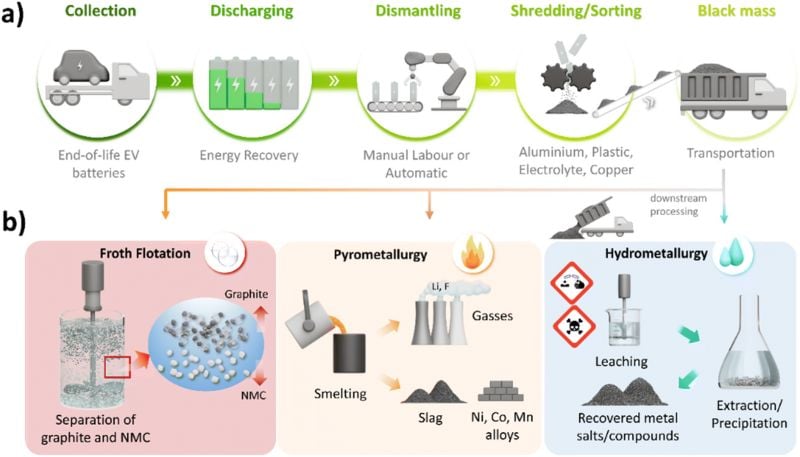
Typical lithium-ion battery recycling process. Image used courtesy of Lei et al.
Pyrometallurgy and hydrometallurgy also reduce the quality of recoverable lithium by damaging the lithium metal oxides’ crystalline structure. This requires further purification steps.
An alternative recycling process, froth flotation, uses water and a hydrophobic (water-repellent) substance. The hydrophobic substance sticks to the metal particles and, when air bubbles are added, floats to the surface as froth that can easily be skimmed off. However, the method is time-consuming and sometimes diminishes the quality of the desired metals.
University of Leicester researchers wanted to find a more efficient and sustainable way to separate graphite and lithium metal oxides. They discovered an ultrasonic process to stabilize an oil-water mixture. When heated, the method separates the desirable metals without harming their quality. This process of combining abundant, natural substances could make battery recycling more sustainable and cost-effective.
Their study appeared in the RSC Sustainability journal, and they have applied for a patent.
Short-Loop Recycling
Oil and water are not chemically compatible and can’t create a stable mixture without an emulsifier, which is usually soap. The researchers believed they could make a stable oil-water mixture by using ultrasound.
As a test, they combined 1% of vegetable oil or kerosene with deionized water. Then, they immersed an ultrasonic horn into the mixture. The process turned the water “milky” in color and created an oil-in-water suspension that remained stable for two weeks or more.
The oil nano-droplets adhered to the carbon in the mixture and bound the graphite particles into oil-graphite conglomerates. The lithium metal oxides remained suspended in the water. When the oil-graphite clumps were skimmed off, the valuable metal oxides remained.
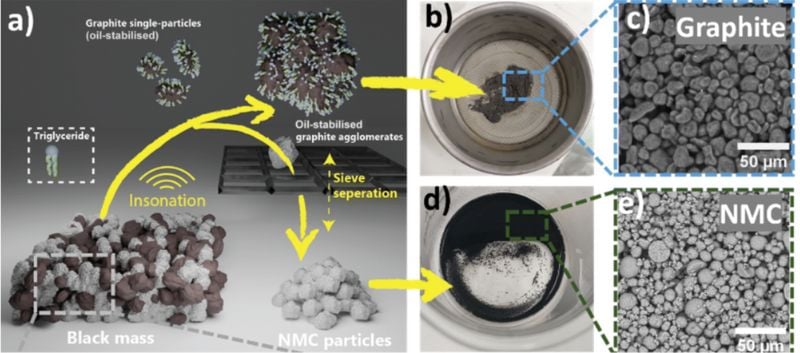
Using the emulsified oil-water mix to extract graphite and other metals. Image used Image used courtesy of Lei et al.
Following the trial, the researchers applied the process on a larger scale to pre-treated black mass. Using the oil-water emulsion, the ultrasonic agitation process, and heat, they could separate graphite and lithium metal oxides with up to 96% purity in just minutes.
Researchers figured the total cost of the process was about 44% lower in energy consumption than directly incinerating black mass at 850°C for an hour. They concluded that this short-loop process is a promising alternative to typical recycling methods and could make the battery supply chain cheaper and more sustainable.
How Can Oil and Water Help Recycling?
The short-loop recycling process could effectively close the recycling loop. With a less expensive recycling process, more companies could start offering lithium-ion batteries, thus keeping used EV and storage batteries out of landfills. An increase in recycling would reduce reliance on mining and lead to better availability of quality lithium, graphite, and other metals necessary for new battery manufacturing.