Facebook
 Google
 GitHub
 Linkedin
Pushing the Boundaries of SiC Cooling
Learn how Rogers' curamik DirectCool integrates cooling into the SiC substrate, minimizing the thermal path. This allows for compact, reliable, high-performance power modules that reduce weight up to 75% for e-mobility.
This article is published by EEPower as part of an exclusive digital content partnership with Bodo’s Power Systems.
SiC power semiconductors are driving power density and switching frequency into new levels—pushing cooling to the physical limits of conventional modules. A new concept from Rogers, the curamik® DirectCool solution, integrates the Micro Channel Cooler directly into the substrate and bonds it to the ceramic already during the manufacturing process. This shortens the thermal path to an absolute minimum, enabling high heat flux densities to be reliably removed in a very small footprint.
With the use of SiC MOSFETs, the limits in power electronics are shifting noticeably. Higher junction temperatures, significantly shorter switching times with correspondingly high dv/dt and di/dt values, as well as the ability to operate at greatly increased switching frequencies on the system level, enable more compact modules that deliver more power within the same area. However, these advantages come at a price: the power losses are concentrated in a very small region, often even in the form of hotspots with extreme heat flux densities.
What sounds like increased efficiency in theory quickly becomes a thermal challenge in practice. The real limitation is not set by the semiconductor device itself, but by the thermal path from the chip to the coolant. Every additional layer between the semiconductor and the cooler lengthens this path, increases the thermal resistance, and at the same time represents a potential weak point for ageing and failure mechanisms.
Limitations of Conventional Cooling Concepts
Traditional module concepts are based on a substrate mounted on a massive baseplate and connected to an external cold plate via thermal grease or a gap filler. The heat flow has to pass several interfaces: from the active semiconductor surface via metallization, ceramic, and copper to joining layers and TIM (Thermal Interface Material) layers before it finally reaches the cold plate. The consequences are higher temperatures at the semiconductor, larger variation in the behaviour of individual modules, and an increased risk of early failures due to ageing effects such as pump-out or cracking. At the same time, the overall module volume increases, which has a negative impact on weight and required installation space – factors that are particularly critical for e-mobility applications like inverter and on-board-charger.
To reduce these drawbacks, most manufacturers have now started to solder or sinter the substrate directly onto the cooler. In this way, not only the baseplate but also the intermediate TIM layer can be eliminated, and the thermal path is significantly shortened. At the same time, bonding the substrate to the cooler only after completion of the fully assembled module is associated with additional process steps, materials, tolerances, and yield losses.
curamik® Micro Channel Cooler as Key Enabling Technology
Rogers takes things one significant step further: the cooler is not attached afterwards, but is directly integrated during substrate production. This eliminates additional layers in the system and creates a reliable, permanent bond between substrate and cooler. The basis for this is the micro channel cooler manufacturing technology developed by Rogers, which is built on more than 25 years of experience in thermally demanding applications.
This technology makes it possible to implement complex three-dimensional structures that significantly increase heat transfer efficiency and cooling surface area. At the same time, the pressure drop remains within the requirements by the automotive industry, from 100 to 200 mbar, while complying with the specified channel widths greater than 1.0 mm. Strictly speaking, these are no longer classic microchannels, but structures in the millimeter range. Nevertheless, this concept achieves an efficiency comparable to that of a microchannel cooler.
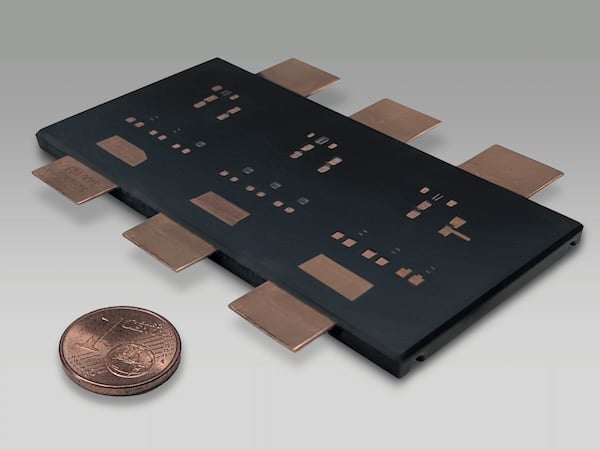
Figure 1. The power module developed by Fraunhofer IZM, equipped with curamik® DirectCool and 18 CoolSiC™ Gen2 MOSFETs from Infineon, is a B6 bridge inverter that enables motor output power of up to 250 kW. Image used courtesy of Bodo’s Power Systems [PDF]
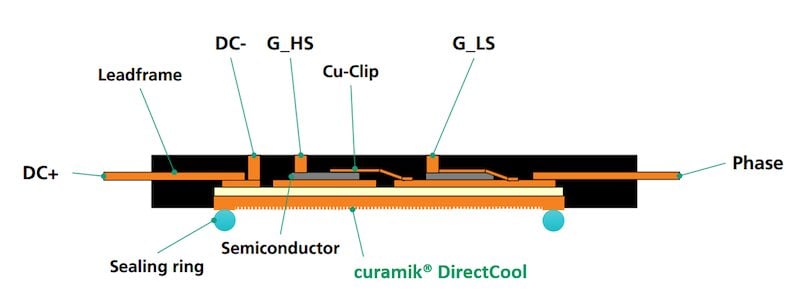
Figure 2. Illustration of the Fraunhofer B6 bridge inverter with the integrated curamik DirectCool solution. Image used courtesy of Bodo’s Power Systems [PDF]
The real trick – and at the same time the greatest challenge – lies in reliably controlling substrate warpage both during the manufacturing process and in the customer’s subsequent processes and in the final application.
Rogers has succeeded in achieving controlled warpage behaviour even with an asymmetric stack-up featuring 0.5 to 0.8 mm copper on the top layout (circuit) side and a cooler on the back side with a thickness of up to 3 mm. This allows the advantages of micro channel cooling to be leveraged without having to accept any compromises in mechanical stability and reliability.
Thermal Performance in Practice
In real-world applications, the strengths of the curamik DirectCool concept become particularly apparent. The elimination of additional layers in the system significantly reduces the overall junction-to-fluid thermal resistance. Heat now flows from the semiconductor surface via the directly cooled substrate straight into the cooler – without additional interfaces. The performance was impressively demonstrated in a joint demonstrator with the Fraunhofer Institute for Reliability and Microintegration IZM.
The tests were based on a particularly compact 6-in-1 module architecture. Under application-oriented conditions — IMS = 363 A (three chips), Tj,max = 150 °C, coolant temperature 65 °C and VDS = 1200 V — a junction-to-fluid thermal resistance of R_h,j-f = 0.158 K/W (flow rate 10 L/min) was measured. For a worst-case operating point with a nearly depleted battery at an operating voltage of 650V, this results in a calculated inverter output power of 280 kVA, corresponding to around 220 kW motor power.
Fraunhofer IZM combined the substrate with an intelligent and application-oriented circuit and gate-drive architecture, whereby the module stray inductance, including the DC+ and DC– terminals, was determined by simulation to be 3.23 nH. Power densities of this order of magnitude, combined with a manufacturing concept designed for scalability and cost efficiency, have the potential to define a new standard that has not been achievable until now.
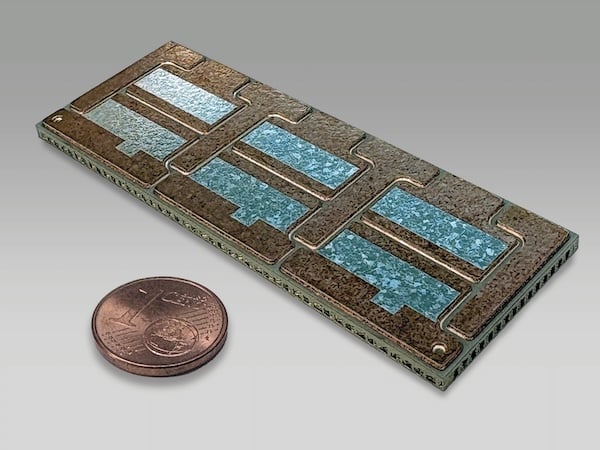
Figure 3. Si3N4 AMB Substrate with integrated curamik® Micro Channel Cooler. Image used courtesy of Bodo’s Power Systems [PDF]
Lighter, More Robust, More Sustainable—More Than Just Cooling
In addition to its clear thermal advantages, the curamik DirectCool concept also offers mechanical, system-level, and ecological benefits. By eliminating a massive baseplate, conventional cooling components, and reducing the footprint, the module weight can be reduced by up to 75 percent. This is a major advantage, particularly in e-mobility, where it directly translates into increased range and efficiency. At the same time, the concept follows the trend towards miniaturization, as the reduced overall height and volume significantly decrease the required installation space.
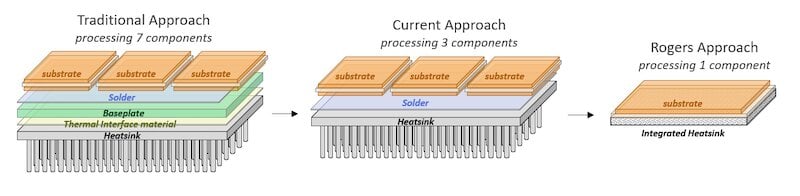
Figure 4. Module Packaging (R)Evolution - From 7 components to just 1 — smaller, lighter, smarter. Image used courtesy of Bodo’s Power Systems [PDF]
The simplified structure also contributes to substantially higher reliability: fewer layers also mean fewer interfaces where aging or failure mechanisms can occur. In extensive testing, the DirectCool substrate was subjected to more than 1,500 passive thermal cycling loads in chambers at temperatures between −55 and +150°C – without any noticeable signs of fatigue. This opens up potential applications beyond the automotive sector, where typical load specifications usually range between −40 and +125 °C.
Another advantage lies in resource efficiency. Intermediate layers rich in precious metals are largely avoided, and the material and process requirements are also reduced for the module and system manufacturer. This saves effort, lowers costs, and improves both the economic and environmental footprint. Rogers places particular importance on guaranteeing that all innovations contribute measurably to environmental sustainability.
Rethinking Module Design
The curamik DirectCool concept is far more than just a step forward in cooling – it pushes the boundaries of future SiC module design. While conventional cooling solutions are reaching their physical limits, DirectCool opens up new degrees of freedom in the module architecture. Design engineers can realize more compact, higher-performance modules that combine increased power density with enhanced reliability.
DirectCool thus stands not only for technical innovation, but also for a new era of efficiency and cost-effectiveness in power electronics. As a key technology capable of meeting tomorrow’s requirements, it is setting a clear signal for the further development of power electronics – and offers engineers and companies alike the opportunity to create sustainable, and therefore future-proof, solutions.
Further information on the Fraunhofer B6 bridge inverter can be found online via the link in the QR code in the article: Energy transition: Increasing efficiency with low-inductance power modules.
This article originally appeared in Bodo’s Power Systems [PDF] magazine.