Facebook
 Google
 GitHub
 Linkedin
Free Flowing Ions in Solid-State Batteries Create Safer EVs
These solid-state lithium-metal batteries can provide a stable interface for high-voltage operation.
As electric vehicles become more widespread, the limitations of current lithium-ion battery technology have become more evident. Issues such as limited driving range, slow charging times, and concerns over battery safety, particularly fire risk, have spurred research into alternative battery technologies.
Solid-state batteries, with their potential for higher energy density and improved safety, have emerged as a promising solution to address these challenges. Replacing liquid with solid electrolytes causes these batteries to operate at higher voltages and to reduce safety risks associated with lithium-ion batteries.
Researchers at McGill University have achieved a breakthrough in developing a solid-state electrolyte that could lead to safer batteries that last longer.
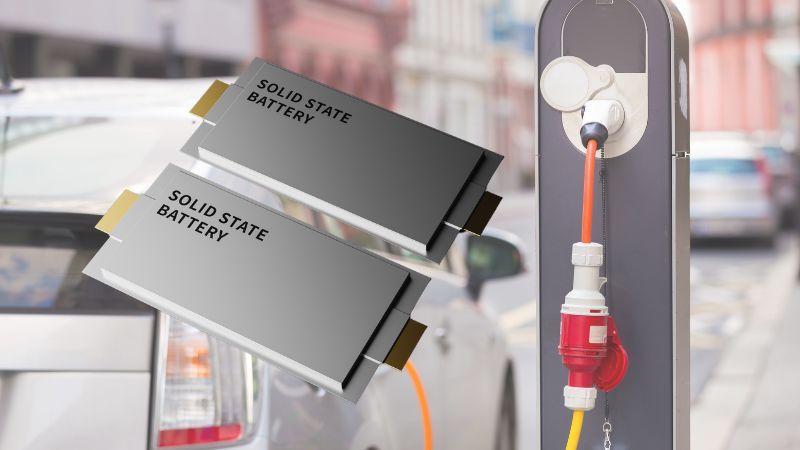
Solid-state batteries for EVs. Adapted from images used courtesy of Canva and Adobe Stock
Interfacial Resistance Challenge in Solid-State Batteries
The rapid expansion of lithium-ion battery-powered EVs necessitates energy density and safety improvements by replacing graphite anodes with lithium-metal anodes. However, lithium metal is electrochemically unstable when in contact with organic liquid electrolytes and prone to forming lithium dendrites during the Li+/Li plating-stripping cycles, potentially piercing the separator and causing safety risks.
Solid-state electrolytes offer a solution by enabling the safe use of lithium-metal anodes. However, the high interfacial resistance between the ceramic solid electrolyte and the battery electrodes presents a barrier.
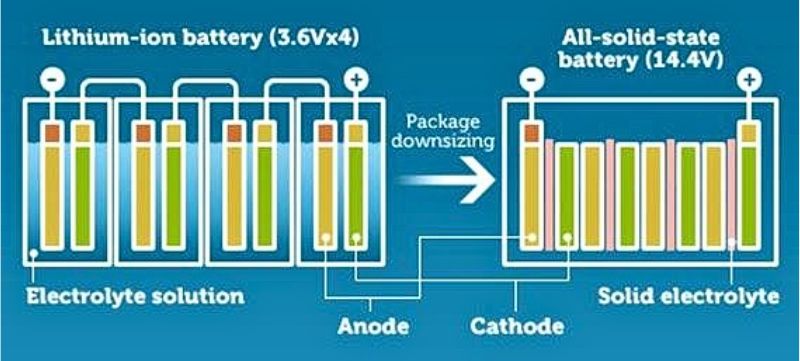
Lithium-ion vs. solid-state battery interfaces. Image used courtesy of Kartini and Genardy
Interfacial resistance in batteries is the impedance at the interface between two different materials, typically the electrode and the electrolyte. It arises from poor ionic conductivity or physical contact at the interface, hindering the smooth ion transport across the boundary and affecting energy transfer.
While more stable and safer, the solid ceramic electrolyte has a rigid structure that does not naturally allow for easy lithium-ion transport when in contact with the electrodes. Over time, this resistance can lead to a capacity loss. Additionally, as voltage levels increase, the unstable interface between the solid electrolyte and the electrodes can degrade, leading to further performance issues such as energy leakage and structural failure.
This problem and the manufacturing difficulties in creating a consistently smooth interface have been significant obstacles in advancing commercial solid-state batteries.
Overcoming Interfacial Resistance
Researchers have introduced a novel design for all-solid-state lithium batteries, focusing on overcoming high interfacial resistance issues.
The team used a porous ceramic membrane instead of the conventional dense plate and filled the pores with a small amount of polymer. The membrane allows ionic conductivity while maintaining structural stability. This design lets lithium ions move more freely, enabling a stable, high-voltage operation.
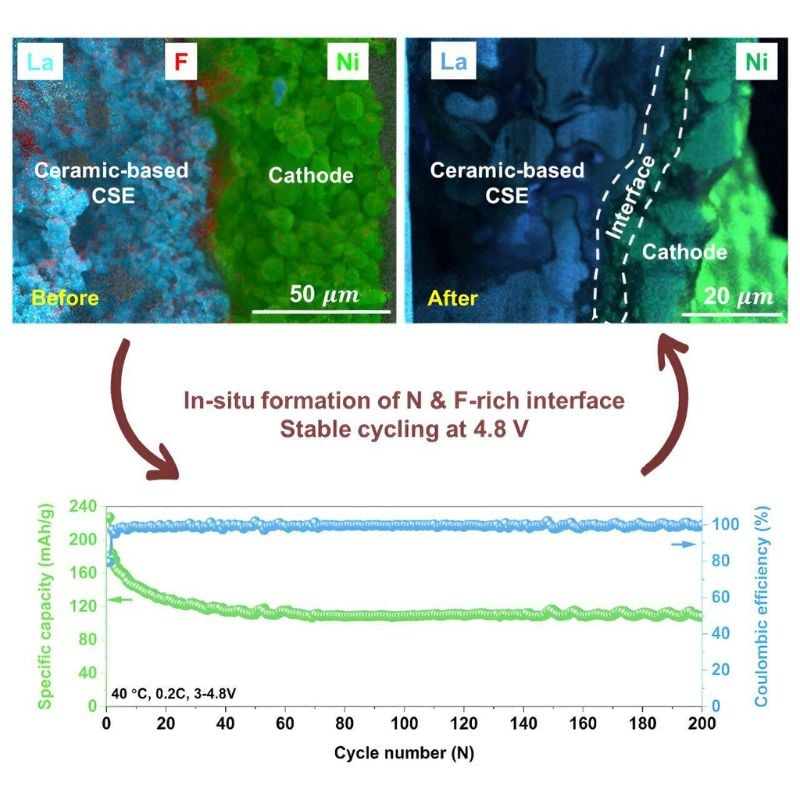
Stable interface formation between electrolyte and electrode. Image courtesy of Wang et al.
Solid-state electrolytes are generally classified into ceramic, polymer, and composite types. Ceramic SEs typically provide high ionic conductivity at ambient temperatures, excellent electrochemical stability, and strong mechanical properties. Among them, cubic garnet-type SEs are particularly promising, with ionic conductivities around 1 mS/cm and robust stability against lithium metal. However, these garnet-type SEs suffer from poor electrode contact, leading to high interfacial resistance.
The research team developed a 4.8-V all-solid-state lithium-metal battery utilizing a highly conductive garnet-based composite solid electrolyte (CSE) to solve the persistent issue of high interfacial resistance and poor wettability between ceramic electrolytes and electrodes. The researchers designed a CSE using a porous cubic Li6.1Al0.3La3Zr2O12 (LLZO) framework infiltrated with polyvinylidene fluoride (PVDF), which exhibited high ionic conductivity of 0.437 mS/cm and a lithium transfer number of 0.72 at 25°C. With 45.74% porosity, the garnet framework provided continuous ion-conductive channels, reducing interfacial resistance and enabling efficient lithium-ion migration. The material’s electrochemical window extended up to 5.08 V, making it suitable for high-voltage applications.
Future Outlook
As EVs continue to shape the future of transportation, advancements in solid-state battery technology hold immense potential to redefine energy storage. By addressing issues such as safety and energy density, this battery innovation could significantly extend the lifespan and performance of EVs.