 Facebook
 Google
 GitHub
 Linkedin
Pressurized Wind Tunnel Optimizes Wind Turbine Power Design
Researchers found that adjusting tip speed during yaw misalignment unlocks significant additional energy.
Optimizing wind turbine performance requires understanding the turbine’s speed and angle in real-life conditions and accounting for varying wind speeds and directions. Wind energy is an extremely challenging problem for experimental research, mainly because chaotic, turbulent atmospheric conditions make controlled field experiments nearly impossible.
However, a multi-university research team has figured out a way to closely replicate real-world atmospheric conditions in a laboratory using a highly pressurized wind tunnel. The team found a method to test the wind turbines in a lab, reducing the need for additional field tests.
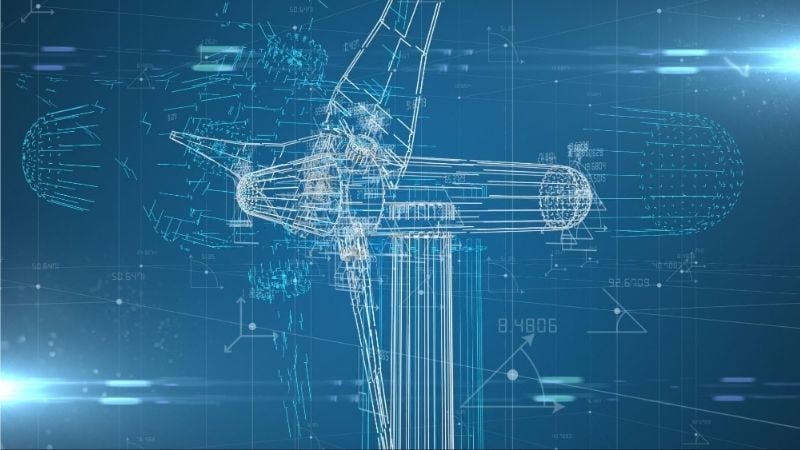
Engineering a wind turbine. Image used courtesy of Adobe Stock
Bridging the Gap Between Lab and Field
Wind turbines are the largest rotating machines ever built, and testing new designs or control strategies under realistic conditions has long been difficult. Traditional wind tunnels can accommodate scaled-down turbine models, but the flow physics around these miniaturized rotors differ substantially from what occurs in the atmosphere.
The core issue is Reynolds number matching: real wind turbines operate at Reynolds numbers between 107 and 108, while conventional lab tests typically achieve only 104 to 105, introducing aerodynamic sensitivities that confound results.
The research team addressed this by using Princeton University's High Reynolds Number Test Facility, a wind tunnel that can be pressurized up to 240 atmospheres. By increasing the air density inside the chamber by a factor of 100 to 220, the researchers could test 15 cm turbine models at Reynolds numbers of 4 x 10⁶, approaching the range of commercial-scale machines. The pressurization effectively simulated turbines between 15 and 35 meters in diameter within a laboratory.
Tip Speed Optimization Under Yaw Misalignment
The experiment produced a key practical finding: the optimal tip speed ratio for maximizing power production changes depending on a turbine's yaw misalignment angle.
In real-world operation, turbines often become misaligned with the wind as atmospheric conditions shift. Yet, most existing control systems assume a fixed optimal tip speed ratio regardless of the wind's approach angle.
The researchers tested yaw misalignment angles from -30° to 30° across tip speed ratios from four to 10, generating comprehensive performance maps of thrust and power coefficients. The results showed that thrust and power changes with misalignment strongly depend on tip speed ratio, establishing a nonlinear relationship that conventional cosine-based models underestimate.
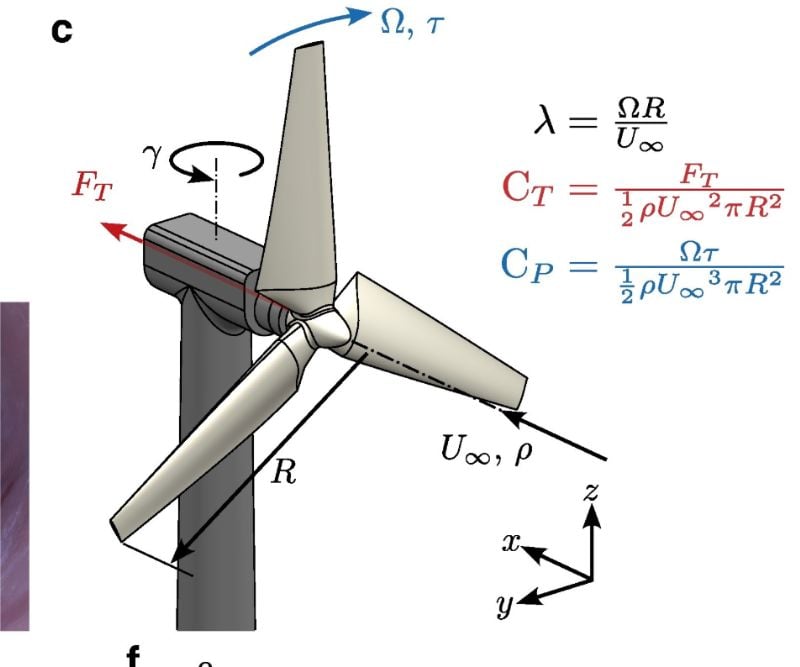
Wind turbine model schematic indicating parameters and derived quantities. Image used courtesy of Kurelek et al.
Based on these measurements, the team developed a Unified Wind Turbine model that predicts aerodynamic behavior and power production without relying on empirical corrections. The model's predictions aligned with experimental measurements within experimental uncertainty across all tested conditions.
An Experimental Paradigm
The validated model could yield about 40% higher energy gains than conventional approaches for designing wind farms using wake steering strategies, where upstream turbines are intentionally misaligned to reduce wake effects on downstream machines. Optimizing turbine alignment, blade pitch angles, and tip speed relative to wind conditions could generate tens of thousands of dollars per turbine every year in additional revenue.
The study could provide improved and validated models for wind turbine control protocols in existing wind farms. The longer-term significance lies in establishing a “new experimental paradigm” to prototype and validate simulation models more quickly, and to test hypotheses about improved designs and control strategies much faster than was possible before, according to MIT.
The pressurized tunnel approach offers a middle ground between idealized computer simulations and expensive, time-consuming field campaigns. In 2022, a previous study at a commercial wind farm found that wake steering could meaningfully increase output, but it required temporarily misaligning real turbines for months to gather enough data. The pressurized facility compressed months of field work into several weeks of controlled laboratory testing.
The Natural Sciences and Engineering Research Council of Canada, the National Science Foundation, and the MIT-GE Vernova Alliance funded the research. The paper appeared in PNAS Nexus.