 Facebook
 Google
 GitHub
 Linkedin
Subsea Power Plant Taps Volcanic Heat for Geothermal Energy
Endurance Energy successfully generated 8.7 seconds of net-positive electricity from its subsea geothermal power plant, proving the concept viable.
Nearly a mile beneath the Pacific Ocean, a first-of-its-kind power plant has demonstrated the potential for net-positive geothermal energy production on an active underwater volcano.
For developer Endurance Energy, the successful demonstration marks an important first step toward harnessing geothermal energy beneath the ocean. Taking a “make it exist first, make it perfect later” approach, the startup prioritized proving the concept in real-world conditions.

Adélie, the subsea geothermal generator. Image used courtesy of Endurance Energy
The Plant and the Process
Seattle-based Endurance Energy engineered the plant, dubbed Adélie, to demonstrate the full process of subsea geothermal power generation: drilling a well, deploying and operating a power plant on the seafloor, converting geothermal heat into electricity, and communicating with the system from shore in real time.
The three-ton system was successfully deployed on Axial Seamount, an active underwater volcano about 300 miles off the Oregon coast, and connected to a natural hydrothermal vent with temperatures reaching approximately 281°C (538°F).
Using the University of Washington’s seafloor fiber-optic network, part of the National Science Foundation’s Ocean Observatories Initiative, the team controlled the plant in real time from Seattle. Engineers also tested optical and acoustic communication links and ran high-temperature hydrothermal fluid through the system.
During testing, Adélie’s turbine reached about 26,000 rpm, generating a median net output of about 2 kW and a peak of 16.5 kW for approximately 8.7 seconds.
With that milestone achieved, the team is already planning upgrades and improvements based on lessons learned from Adélie.

The Adélie platform. Image used courtesy of Endurance Energy
Creating Subsea Geothermal Wells
During the three-week deployment, Endurance began by drilling and completing what it calls the world’s first offshore geothermal well: a 52-foot hole in the seafloor that, once cemented, flowed at 260 °C. The well delivered hot fluid, but it proved too restrictive to run the plant, so the team tested Adélie on a nearby natural vent instead.
The company was aware of the drilling’s environmental impact, so it placed the well away from the hydrothermal vent chimneys and the marine life around them and kept it narrow, about two inches wide. Oil, gas, and onshore geothermal wells often start with 20 to 36-inch casings. The crew also drilled with filtered seawater rather than drilling mud, avoiding the chemicals common in offshore oil and gas work.
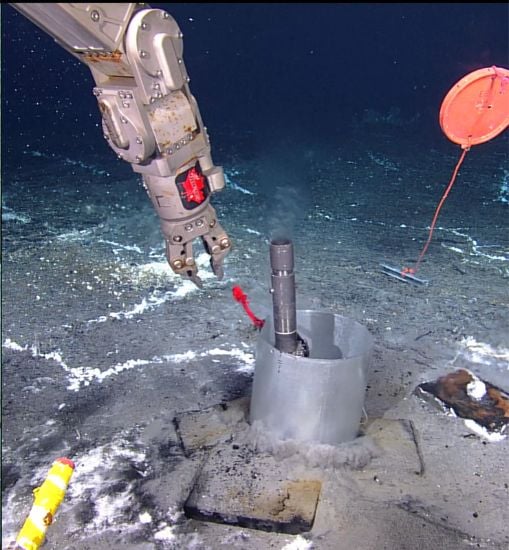
The subsea drilling. Image used courtesy of Endurance Energy
The entire deployment produced data on seafloor drilling, well flow, heat transfer, mineral buildup, high-temperature power generation, and remote control of subsea equipment.
Improving and Expanding Subsea Geothermal
Endurance is already applying lessons learned from the Adélie deployment into practice as it advances its next-generation subsea geothermal technology. This winter, the startup plans to deploy Gentoo, an upgraded system designed to generate more power over longer periods. Its lander drill can reach depths of approximately 80 meters, compared with Adélie’s 16 meters.
Meanwhile, Endurance is developing Leopard, a commercial-scale generator with a 2 MW capacity.
The company is developing its first commercial project in the Pacific island nation, the Kingdom of Tonga, targeting initial power generation in 2027. The project aims to deliver clean, round-the-clock electricity directly to Tonga’s grid, which currently relies heavily on imported diesel.
Looking ahead, Endurance hopes to bring its technology to coastal grids, industrial facilities, and data centers across the Pacific and beyond. The startup has raised $63 million in funding, including a $54 million Series A round led by Founders Fund, to help advance its ambitions.