Facebook
 Google
 GitHub
 Linkedin
4 Wind Tech Trends to Watch in 2025
Wind advances in 2025 will include capacity increases, noise reduction, and turbine recycling.
The United States is home to over 70,000 wind turbines with 153 GW of installed capacity, producing more than 10% of the nation’s electricity. Project developers added 2.5 GW in capacity in the first half of 2024, according to the latest Energy Information Administration (EIA) data. Another 4.6 GW was expected to join the grid in the second half, painting a positive outlook for wind power deployment in 2025.
Manufacturing a wind turbine larger than the State of Liberty. Video used courtesy of GE Vernova
Despite supply chain disruptions and permitting delays, wind power achieved a significant milestone last year—surpassing coal generation for two consecutive months.
The EIA’s latest Short-Term Energy Outlook estimates wind power generation will increase from 445.9 TWh in 2024 to 464 TWh this year, up from 420 TWh in 2023. Overall, the nation’s wind fleet will grow to 162 GW in 2025.
Much of this capacity involves land-based projects. However, with financial headwinds beginning to stabilize in the offshore wind industry, developers are now targeting proposed leasing areas in the Gulf of Maine and Mid-Atlantic. America’s offshore wind project pipeline grew 53% from 2023 to 2024, reaching a potential generating capacity of 80 GW, according to the U.S. Department of Energy (DOE).
Facing high market demand, technology developers are introducing next-generation models designed to produce more power with enhanced efficiency.
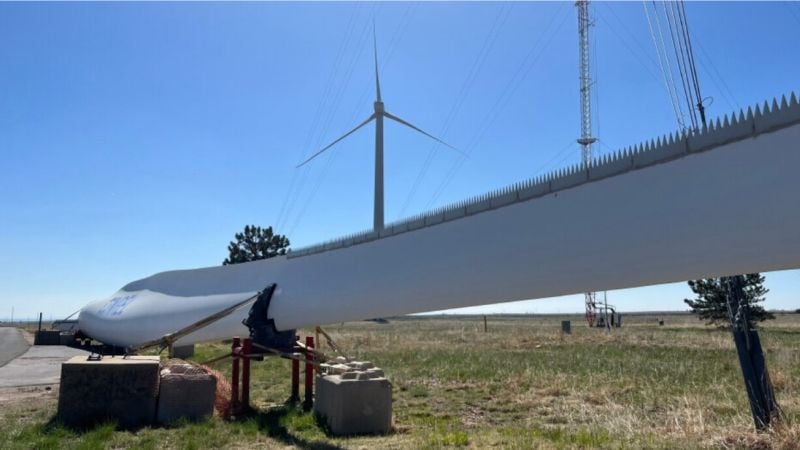
Serrated trailing edges can reduce wind blades’ noise emissions. Image used courtesy of National Renewable Energy Laboratory/by Prateek Joshi
1. Turbines Are Growing in Size and Capacity
Turbines are getting larger and more powerful as manufacturers aim to maximize power generation and efficiency, all while adhering to land constraints. Larger turbines lower the cost per kilowatt-hour of energy production and increase plants’ market value on the grid, leveraging larger rotors to capture more wind energy.
A Lawrence Berkeley National Laboratory study projects that onshore wind plants installed by 2025 will use larger turbines to unlock capacity and production gains, which requires fewer turbines per unit of land. Turbines are expected to grow 60% compared to the average unit installed between 2011 and 2020, with heights (from the tower base to blade tip) increasing from 400 feet to 662 feet and rated capacity rising from 1.8 MW to 5 MW. The number of turbines required per land area will drop from 222 to 89 units.
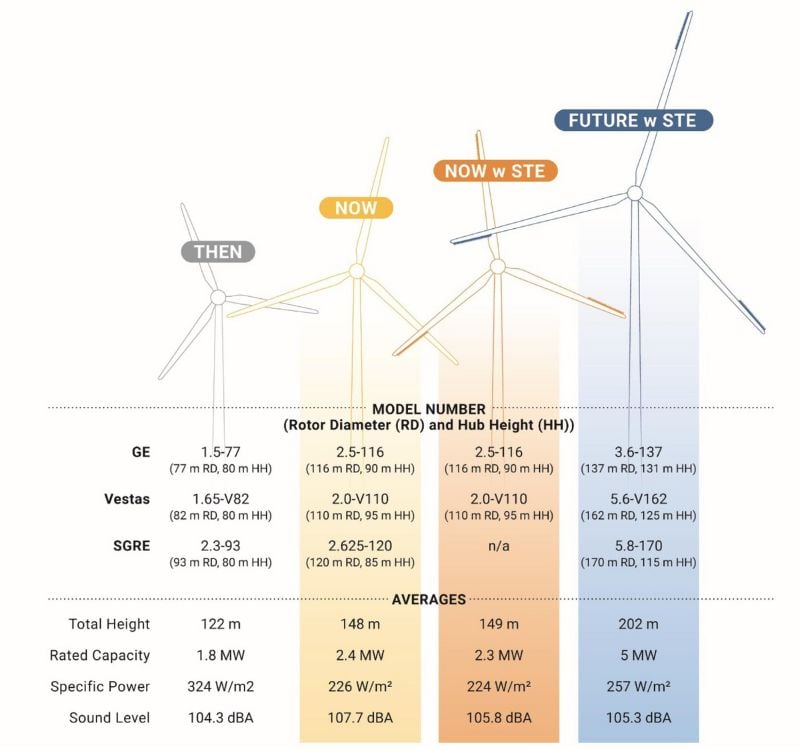
Wind turbine specifications over time. (Note: “STE” stands for serrated trailing edges). Image used courtesy Hoen et al.
Leading manufacturers are upsizing their turbines and adding new flexibility advantages for various site requirements. For example, Siemens Gamesa’s 5.X onshore platform combines flexible power ratings from 5.6 MW to 7 MW and offers two 508- and 557-foot rotors to maintain performance in all wind conditions. The company has also introduced larger offshore wind models, from 8 MW and 547-foot rotors to 14 MW and 774 feet. The largest variant, which entered serial production in 2024, unlocks a 30% increase in annual energy production (AEP) with a 15 MW power boost function.
GE Vernova’s 3.6 MW land-based wind turbine builds on its bestselling 2.8 MW model, among North America’s most installed wind turbines. Informed by over 200 million operating hours from its 416-foot predecessor, the new model has been up-sized with a 505-foot rotor blade diameter and improved durability and efficiency.
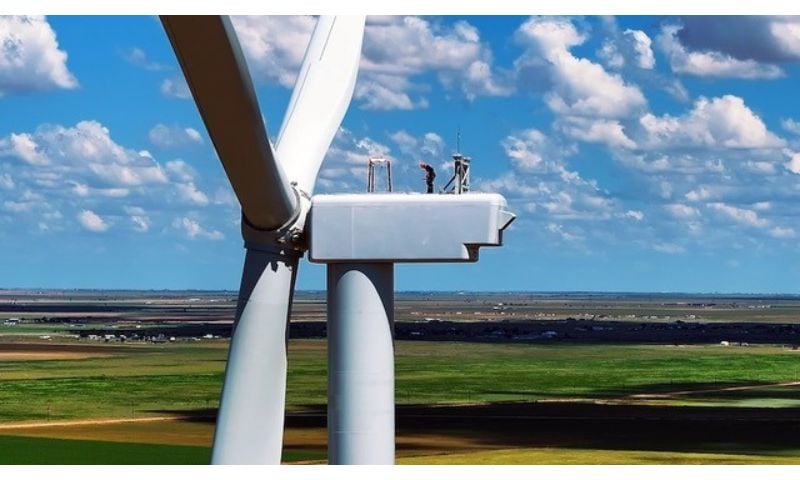
GE Vernova’s 3.6 MW-154m onshore wind turbine prototype in Texas. Image used courtesy of GE
GE Vernova’s Haliade-X platform serves offshore wind projects in the 12-14.7 MW capacity range. The 14-MW model is among the world’s most powerful offshore turbines, with a 721-foot rotor, 351-foot blade, 853-foot maximum height, and a 61% capacity factor with 74 GWh of gross AEP.
The company previously planned to release an 18-MW offshore model but pulled back the expansion in 2024 due to market uncertainty. GE Vernova remains selective with the size of its offshore wind turbines, instead focusing on meeting demand for land-based systems. This pivot strategy appears to be paying off, as the company’s onshore wind segment recently delivered its most profitable results in 12 quarters, according to its third-quarter 2024 earnings report.
2. Noise Reduction Solutions
Wind plants’ noise emissions have risen over the last decade, partly due to longer blades and faster tip speeds. However, with more projects using fewer turbines per site, the average sound levels heard by neighboring homes could drop by 18% in the future, according to the DOE.
Developers are adopting new strategies to minimize community noise impacts and related production losses. Wind plants often run at curtailed power outputs to comply with local noise regulations, reducing their AEP per decibel.
One way to minimize turbulent airflow is to place serrated trailing edges on airfoil blades. This sawtooth design reduces sound emissions by 0.5 to 3.2 dBA with minimal impact on turbine power output, according to the Lawrence Berkeley National Laboratory.
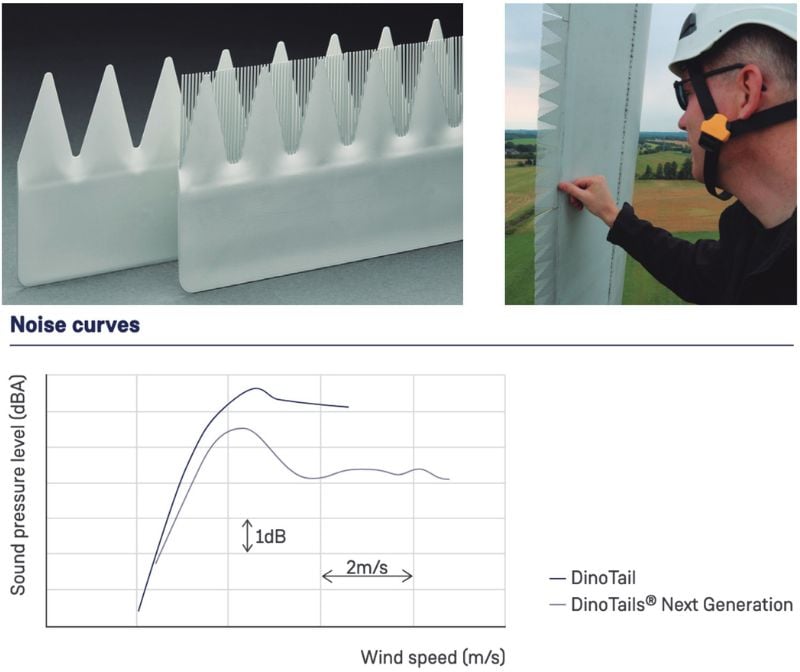
Siemens Gamesa’s next-generation DinoTails add-on offers serrated blade edges to reduce noise emissions. Image used courtesy of Siemens Gamesa
Siemens Gamesa’s DinoTails aerodynamic add-on mounts a serrated trailing edge onto turbine blades. The next-generation offering demonstrates strong performance and significant noise reduction at all wind speeds without compromising power production.
3. Blade Recycling
About 85-90% of a turbine’s total mass can be recycled, representing an attractive opportunity for manufacturers to unlock new revenue streams while meeting sustainability goals. Many components in wind towers and nacelles can be recycled using well-established methods for processing steel, cement, gearing, and copper wire.
However, blades are difficult to recycle because they contain composite materials like glass or carbon fibers and polymers. While these complex materials are ideal for boosting turbine performance and enabling lighter and longer blades with smooth aerodynamics, they also present challenges for end-of-life decommissioning over the plant’s standard life (about 30 years for land-based plants), with many turbines ending up in landfills.
As the first European turbines have already reached the end of their operational life, some countries have banned blades from landfills, including Germany, the Netherlands, and Finland. WindEurope estimates that 25,000 tonnes of blades will begin decommissioning annually by 2025.
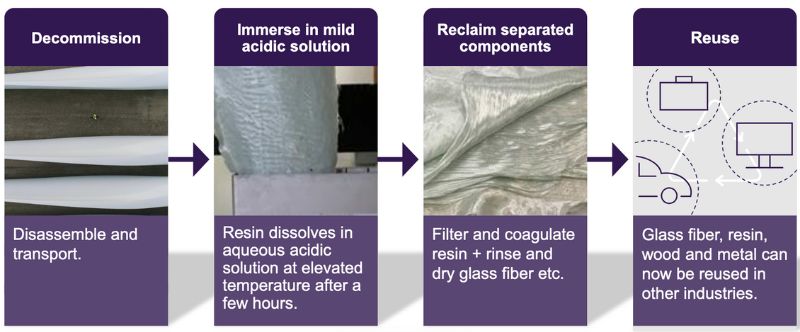
Siemens Gamesa’s RecyclableBlade process. Image used courtesy of Siemens Gamesa and Sandia National Laboratory
Some manufacturers are swapping hard-to-recycle materials with sustainable alternatives. Siemens Gamesa, which targets 100% recyclable turbines by 2040, introduced RecyclableBlade technology with recyclable resin as an alternative to conventional epoxy resin. According to the company, the recyclable Briozen resin is structurally equal to current resins and can be re-dissolved after decommissioning.
4. Wind Engineers Adopt AI
Turbine design and manufacturing engineers benefit from new artificial intelligence tools that streamline meticulous tasks like data collection and manual quality inspection.
Companies are integrating AI into their engineering practices. GE Vernova implemented a system to identify minuscule deviations in blade surfaces that could impact turbine longevity and quality. Vestas used Microsoft’s machine learning software to simulate methods to recapture energy through wake steering, pointing turbines away from upstream winds.
Last year, the National Renewable Energy Laboratory’s Wind Plant Graph Neural Network also identified wake-steering strategies to reduce land requirements by 18%. The model was trained on more than 250,000 simulations with various geographies and turbine designs.