Facebook
 Google
 GitHub
 Linkedin
Power Sector Urgently Needs More Engineers With Diverse Skills
A study by Kearney and IEEE Power & Energy reviews how the power industry could recruit and train enough engineers to meet rapidly evolving energy needs.
Power engineers are crucial as energy demand grows and the industry diversifies. Highly skilled workers must be able to design and manage the energy needs of data centers, distributed resources, electric vehicles, and renewable energy. By 2030, the number of power engineers needed could double to up to 1.5 million jobs, according to global consultant Kearney.
However, qualified engineers may be difficult to find, especially those trained in renewable fields and digital technologies, according to Kearney’s The Future of the Energy Workforce. The report details the fastest-growing sectors in the power industry and describes the efforts needed to recruit, train, and retain engineers who can plan and execute the energy future.

Are power engineers ready for the future of energy? Image used courtesy of Adobe Stock
Surveying Present Engineers about the Future
Kearney prepared the report in collaboration with IEEE Power & Energy Society. The study surveyed over 771 engineers and 190 industry executives across 37 countries. Also included were two public university officials and 27 executives in power generation, transmission and distribution, and electrical equipment.
Of those surveyed, 50% were electrical engineers, and about 30% were either mechanical or chemical engineers. About 45% worked in renewable power generation, while 36% were in fossil fuel generation. Respondents in technical positions comprised 76%, and those in management roles accounted for 24%. Only about 23% were female.
The report analyzes the changes and trends in the energy sector and recommends steps industries can take to develop, attract, and retain engineers trained in the skills the future will need.
Recognizing the Need for Change
Engineers and managers are on the front line of an industry in transition. Energy demand is skyrocketing, expected to increase by more than 50% by 2040. Kearney reported that the biggest increases will be in India (239%), Mexico (99%), and China (97%). Driving the demand are data centers, EV infrastructure, industrial electrification, and more frequent severe weather events, leading to increased heating and cooling needs.
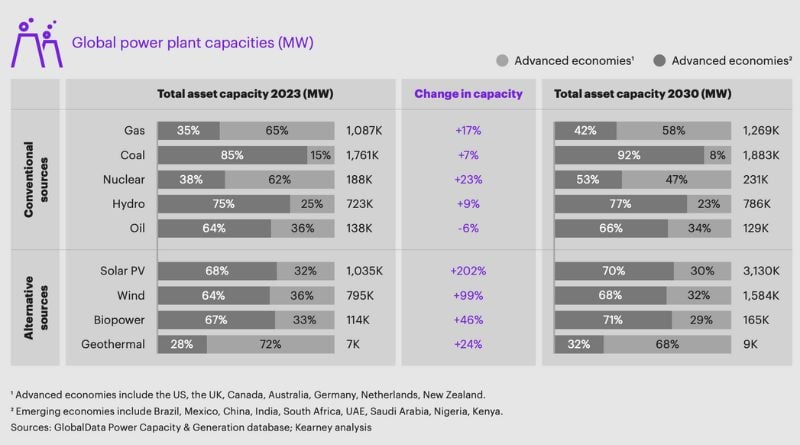
Renewable and low-emissions sources are changing the electricity supply. Image used courtesy of Kearney
At the same time, energy sources are diversifying as power generation shifts to renewable energy. By 2030, solar could triple, wind double, and biopower increase by half, according to Kearney’s report. As more countries invest in renewables, the workforce grows. Already, more people are employed in clean energy fields than in traditional fossil fuel industries. By 2030, the renewable and low-emissions industry will need between 450,000 and 1.5 million more engineers who can design, implement, and operate clean energy systems, according to Kearney’s report.
Energy management is also digitizing with technologies such as virtual power plants, digital twins, artificial intelligence and machine learning, and IoT. Digital and emerging technologies like small modular reactors require more workers with diversified skillsets.
Attracting Talented Engineers
Power engineering has an image problem, according to the report. People see other technical fields, such as IT and computer programming, as more “glamorous,” while power industries are viewed as old and “stodgy.” Education STEM programs are heavily skewed toward IT. As a result, student engineers are 4 ½ times more likely to choose IT or computer programming than power engineering, according to Kearney.
Recruiting efforts are needed immediately, as about 15% of employed engineers plan to retire within the next decade. Some retiring engineers would like to continue working part-time or as project consultants. If more companies had this option, the senior engineers could pass on their knowledge and experience to younger workers, the report stated.
Retention is also a problem. Over half the engineers surveyed have changed jobs within their present company, with a new company, or have left the industry. The top reasons cited were burnout and a lack of stimulating work. About 68% of engineers who left had fewer than 10 years on the job.
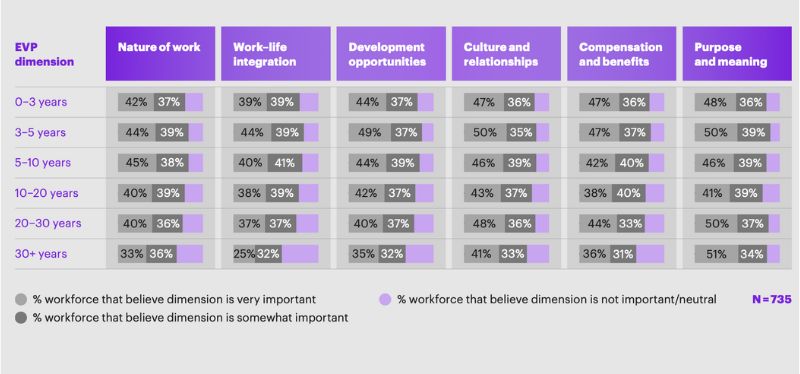
Six employment value propositions. Image used courtesy of Kearney
The Kearney report recommended a few measures that companies can take. They can increase recruiting efforts, expand outreach to women, and network for ethnic diversity. To retain workers, they could motivate employees by offering development opportunities, competitive compensation, work-life balance, and other employment value propositions.
Rethinking Education and Training
The report encourages companies, universities, and professional organizations to work together to teach and reinforce skills. The future will need more well-rounded engineers with skills such as project management, communication, teamwork, and creative thinking.
While technical skills remain important, they are also changing. At present, university curricula don’t always align with industry needs. More emphasis is needed on cross-disciplinary skills as the grid decentralizes and digitizes. Education and training should include instruction in AI, cybersecurity, data analytics, grid technology, and other emerging technologies. Universities could also develop practical work opportunities to give students hands-on training.
Beyond the university, power companies can offer on-the-job training, certification opportunities, and mentorships that can prepare younger engineers and reskill experienced ones.
Planning Ahead
Kearney’s report emphasizes the importance of developing effective recruiting, training, and retention strategies so the engineering workforce can keep pace with the rapidly changing power industry.