Facebook
 Google
 GitHub
 Linkedin
Reducing Transportation Sector Carbon Emissions With Power Modules
This article presents the latest developments in 3.3 kV SiC power modules.
This article is published by EEPower as part of an exclusive digital content partnership with Bodo’s Power Systems.
For the common goals of reducing carbon emissions and becoming carbon neutral, the railway infrastructure is of strategic importance for decarbonizing the transportation section. However, still today, many diesel railcars are in operation, especially when railway lines are not electrified. In Europe (EU-27), these non-electrified lines account for 43% of the federal railway networks.

Image used courtesy of Adobe Stock
Recently, battery trains allow locally CO2-emission-free transport even on non-electrified or partly electrified lines. For these battery trains, Silicon-Carbide (SiC) converters allow efficiency increase of the drive train and more regenerated braking energy. Hence, SiC is a perfect match for battery trains to increase range, shrink battery size, and reduce operational costs.
For many years, Mitsubishi Electric has gained field experience with SiC power modules in railway applications. The first traction converters with Mitsubishi’s hybrid SiC power modules have been deployed in 2013. In 2015, the first traction converter with Full-SiC power modules started field operation. In 2022, more than 55 different train types in Japan use SiC traction inverters, predominantly with Mitsubishi Electric’s SiC power modules.
In May 2023, Mitsubishi Electric first announced the availability of their newly developed 3.3 kV SiC power module with embedded Schottky barrier diode (SBD) and 800 A current rating. Embedding the SBD allows the unipolar operation to avoid bipolar degradation. Moreover, this device allows substantial switching loss reduction and lower thermal resistance compared to the previous 3.3 kV SiC power modules. Finally, in June 2024, Mitsubishi Electric announced two additional power-module variants with embedded SBD rated for 200 A and 400 A.
This family of newly launched SBD-embedded SiC power modules is called Unifull. It is dedicated to the use of cutting-edge railway converters; be they auxiliary, battery, or traction converters.
Outstanding Performance
Unifull modules exert a superior switching performance compared to their previous generation of SiC modules. It is achieved through optimized chip design, increased switching speed and reduced switching delay time. This results in a 67% reduction in switching energy when comparing the Unifull FMF800DC-66BEW with the predecessor FMF750DC-66A at nominal conditions. The packaging technology for the Unifull power modules has been improved by using an aluminum nitride substrate in combination with a low Rth solder to reduce the thermal resistance from junction to case for better thermal performance.
To compare the performance of the new Unifull modules with the predecessor SiC module FMF750DC-66A, a simulation has been performed considering the operating conditions given in Figure 1. It can be observed that the FMF800DC-66BEW enables higher output current and, thus, higher output power for the whole switching frequency range of the simulation compared to the FMF750DC-66A. For example, the output current can be increased by 62% considering 7 kHz switching frequency and given operation conditions. Alternatively, the switching frequency could be increased, for example, from 2 kHz to 7 kHz while achieving the same output current. Hence, the new Unifull FMF800DC-66BEW allows users to either increase the output current or the switching frequency significantly.
When comparing the new 400 A-rated Unifull module FMF400DC-66BEW under the same operation conditions, simulations show that it can also outperform the FMF750DC-66A due to its superior switching performance. Hence, users might consider replacing the FMF750DC-66A with a 400 A-rated Unifull power module.
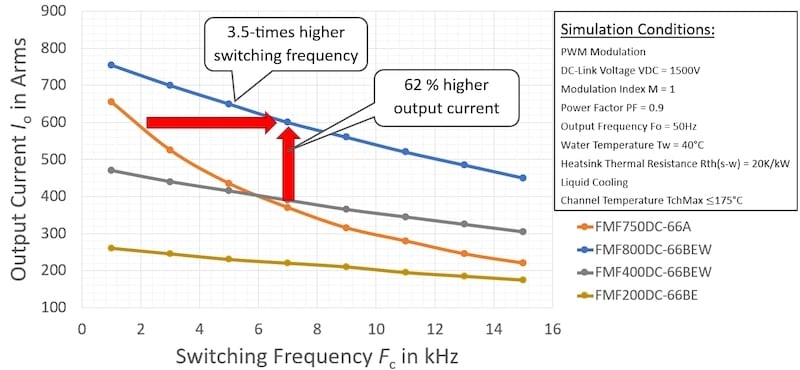
Figure 1. Achievable output current in dependency of the switching frequency of the Unifull SiC power module and previous generation 3.3 kV SiC power module. Image used courtesy of Bodo’s Power Systems [PDF]
Embedding SBD Structure for Avoiding Bipolar Degradation
Bipolar degradation refers to an undesired degradation mechanism in SiC devices in which stacking faults expand from basal plane dislocations. This expansion of stacking faults is caused by bipolar currents. Bipolar degradation will cause an increase in the on-state resistance RDS(on) of the SiC device. This effect is particularly crucial for high-voltage SiC devices (i.e., blocking voltage of 3.3 kV or higher). Due to the thicker epi layer in such high-voltage devices, stacking faults can compromise a larger area. Although a SiC MOSFET itself is a unipolar device, its intrinsic body diode is a bipolar device. Therefore, the operation of the body diode is to be avoided because its bipolar current may lead to growing stacking faults and bipolar degradation.
In the past, Mitsubishi Electric addressed this degradation mechanism by mounting unipolar SiC Schottky Barrier Diode (SBD) chips next to the SiC MOSFET chips (cf. Figure 2 (a)). Since the forward voltage of the SBD is substantially lower than the threshold voltage of the SiC body diode, the SBD will conduct the reverse current, and bipolar current flow through the MOSFET’s body diode is avoided. From the beginning, Mitsubishi Electric has used this method for their high-voltage SiC devices. Today we see that the effectiveness of this method has been proven by the many years of reliable field operation in SiC railway converters.
However, mounting additional SBD chips takes up valuable space inside the power module. Nevertheless, we cannot compromise on the quality and reliability of our SiC power modules. Therefore, Mitsubishi Electric has developed the MOSFET chip with embedded SBD.
Figure 3 shows the chip structure of a conventional SiC MOSFET in comparison with the SBD-embedded MOSFET. From Figure 3 (b) it is evident that the SBD shorts the body diode. This prevents bipolar currents and, with it, bipolar degradation. Furthermore, there is no need to add dedicated SiC SBD chips. This also saves valuable space inside the power module.
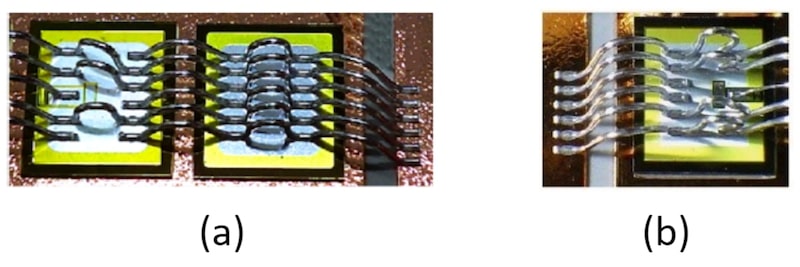
Figure 2. (a) Conventional MOSFET chip and SBD chip in parallel (b) Unifull SBD-embedded MOSFET chip. Image used courtesy of Bodo’s Power Systems [PDF]
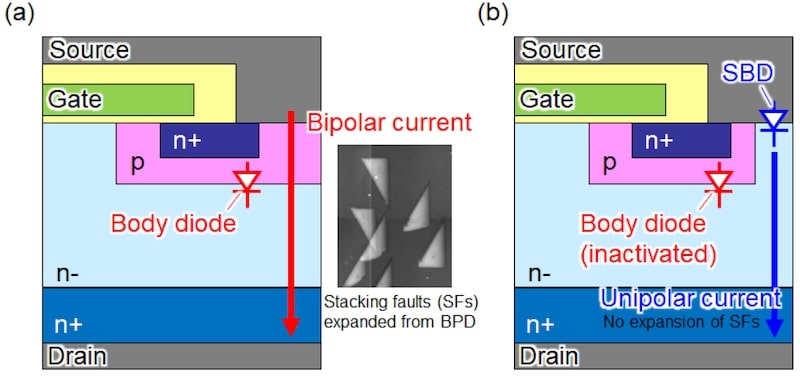
Figure 3. (a) Conventional SiC MOSFET with intrinsic body diode (b) Unifull SBD-embedded MOSFET with deactivated body diode. Image used courtesy of Bodo’s Power Systems [PDF]
Surge Current Improvement With BMA Cells
In case of converter failures, a high surge current might flow through the power semiconductor devices for a short time period. The excessive loss of energy by the exceptionally high current and the caused temperature increase may result in a device failure. Therefore, the device’s surge current capability is a key parameter for the module’s reliability.
It is known that connecting multiple SBD-embedded MOSFET chips in parallel results in a lower surge current capability compared to the expected combined capability of all the parallel chips due to a current crowding phenomenon at one single chip. In order to increase the surge current capability of the SBD-embedded MOSFET technology, Mitsubishi Electric has developed a novel structure called the bipolar mode activation cells (BMA cells) to enhance the surge current capability.
In a normal surge current scenario for SBD-embedded MOSFET chips without the BMA cells, the surge current would slowly increase at the embedded SBD. This initial unipolar current flow Isd caused a voltage increase Vsd based on the SBD characteristics. However, with increasing surge current and, thus, increasing voltage drop, the parasitic bipolar diode of the corresponding chip will be activated after its threshold voltage has been reached.
This will cause a bipolar current flow during the surge current event resulting in a conductivity modulation in the drift region due to the injection of minority carriers and, thus, leading to a voltage decrease of Vsd as seen in Figure 4 (a). The voltage transition point from unipolar to bipolar current flow is defined as the snapback voltage Vsnap and may vary between different chips based on their SBD width. In an exemplary case of 4 parallel connected chips (cf. Figure 4 (b)), chip A has a lower Vsnap compared to the other 3 chips called B. The bipolar current will start to flow at the lowest Vsnap chip A due to its lower resistance compared to the other chips which did not reach their Vsnap voltage yet. Consequently, chip A takes over the whole surge current resulting in a current crowding phenomenon. Therefore, the whole surge current capability is just determined by the surge current capability of a single chip with the lowest Vsnap. Unfortunately, Vsnap already differs around 1 V when the SBD width is just varying by 0.1 µm. Due to the manufacturing process and its tolerances, it is very difficult to produce chips with a uniform Vsnap among all chips resulting in an overall low surge current capability of a normal SBD-embedded MOSFET module.
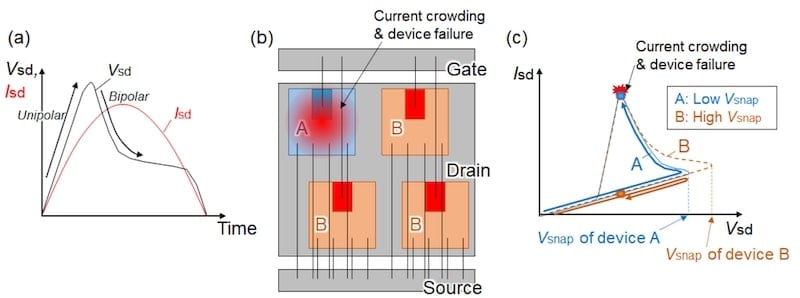
Figure 4. (a) Source-Drain Current Isd and Source-Drain Voltage Vsd under surge current condition; (b) Example of four parallel connected SBD-MOSFET chips; (c) Isd vs Vsd characteristic of the example. Image used courtesy of Bodo’s Power Systems [PDF]
Using the novel BMA cell structure, the tolerances in the Vsnap between the parallel connected chips can be compensated. By filling an embedded-SBD area partly with a body, a pn-diode is created in place of a normal SBD. This BMA cell is shown in Figure 5 (a). In case of a surge current event, the current will initially flow through the neighboring SBD cells as a unipolar current. When the fault current reaches a certain level, the BMA cells become active. Due to the bipolar current flow through the BMA cell, the minority carriers will cause a conductivity modulation of the drift layer at the BMA cell and its vicinity due to the diffusion of the carriers inside the cell. Thus, the drift layer resistance at the adjacent SBD cells near the BMA cell will decrease due to the conductivity modulation which leads to a higher current density at the JFET region of the adjacent cells. Consequently, the applied voltage at the JFET region and thus, the voltage at the parasitic body diode of the cell will increase until its threshold voltage, leading to an activation of the cell’s bipolar current flow. The activation of the bipolar current flow in the SBD cell will again lead to the activation of the bipolar current flow of its adjacent SBD cells based on the same principle, causing a propagation of the bipolar operation to all cells. This is shown in Figure 5 (b). Thus, the BMA cell allows stabilization of Vsnap and causes all cells to take over the surge current due to the bipolar propagation instead of the current crowding at one single chip.
The Weibull plot in Figure 6 (a) shows that using the BMA cell technology allows the SBD-embedded SiC MOSFETs to reach a similar surge current capability to that of usual body diode operated SiC MOSFETs. Additionally, the comparison of the chip surface after a surge current test with and without BMA cells is shown in Figure 6 (b). Without BMA cells, the failure is concentrated on one single chip which has the lowest Vsnap. However, the chips with BMA cells show damage across all chips, indicating a more uniform distribution of the surge current. Therefore, the concept of the BMA cells has been proven as intended. To achieve the surge current capability improvement, it has been shown that using 0.2% of the active area for the BMA cell is already sufficient.
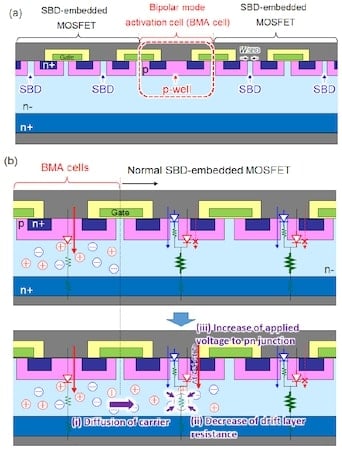
Figure 5. (a) Cross-sectional view of the BMA cell; (b) BMA cell during a surge current event. Image used courtesy of Bodo’s Power Systems [PDF]
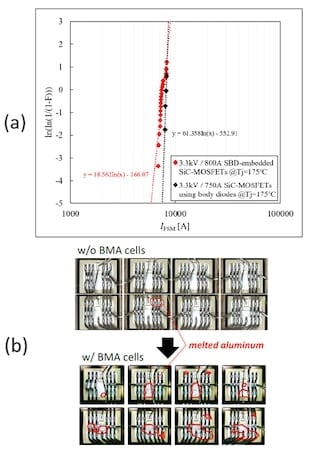
Figure 6. (a) Weibull plot of surge current measurement results; (b) Failed chips after surge current capability evaluation. Image used courtesy of Bodo’s Power Systems [PDF]
The BMA cell is only active in irregular events to improve surge current capability. During normal operation, however, the BMA cell does not activate, so that no bipolar current through the parasitic body diodes, and thus, no risk of bipolar degradation occurs.
Increased Ruggedness against Bipolar Degradation
To validate the ruggedness of the new Unifull power modules against bipolar degradation, we have performed a repetitive surge current test in which we applied 50 surge pulses with a peak current density of approximately 550 A/cm² for 10 ms to different MOSFET chips. Afterward, the device operates in “normal operation” for one week to allow stacking fault expansions. “Normal operation” in this case means 10 kHz switching frequency, 1 μs dead time, 100 A/cm² current density at 150°C.
In order to investigate the impact of the bipolar degradation during these surge current events, the relative ratio ΔRON of RON before and after an excessive surge current test has been evaluated. This ratio can be directly correlated to the expansion area of the stacking faults. Figure 7 illustrates the cumulative frequency of the ΔRON ratio after a repetitive surge current test combined with normal operation. Under the given conditions, the conventional MOSFET already reaches a 20% RON increase with a probability of around 1%. On the contrary, the SBD-embedded MOSFET’s probability for 10% RON increase is around 10-11.
Again, this clearly underlines the higher reliability of the Unifull SBD-embedded SiC MOSFET compared to a conventional MOSFET.
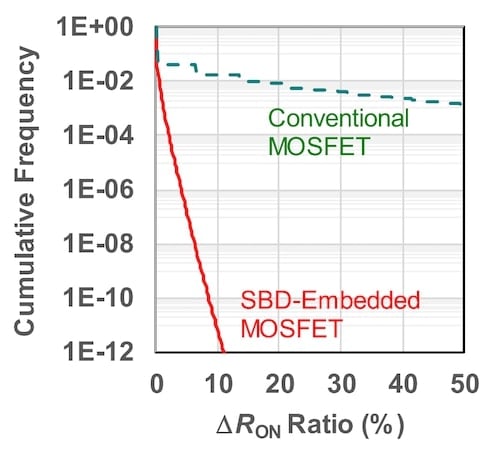
Figure 7. Cumulative frequency of RON increases after repetitive surge current operation and one week of normal operation. Image used courtesy of Bodo’s Power Systems [PDF]
Humidity Robustness
Especially for railway applications, there is a legitimate caution regarding operation at high humidity. Since the power modules are not hermetically sealed, vapor might diffuse into the power module and eventually reach the proximity of the power electronic chips. This might cause degradation and unexpected device failure in the field.
It has been the goal of an ECPE working group (consisting of major power-electronics manufacturers, railway converter designers, and end users) to assess the risk of high humidity and develop a testing scheme to confirm the humidity robustness of power semiconductors. ECPE guideline PSRRA 01 has been published, and with it, the HV-H3TRB testing scheme.
According to this guideline, the FMF800DC-66BEW has been tested at a temperature of 85°C and 85% relative humidity for 2000 hours. Although the ECPE guideline demands a drain-source voltage of 1950 V, we have performed the test with 2100 V to confirm our extensive quality margin. The test results, presented in Figure 8, confirm that there is no leakage current increase over the 2000 hours testing time. We have, moreover, confirmed the stability of the electrical characteristics of the device after the test. These test results confirm the excellent humidity robustness of the new Unifull SiC power modules.
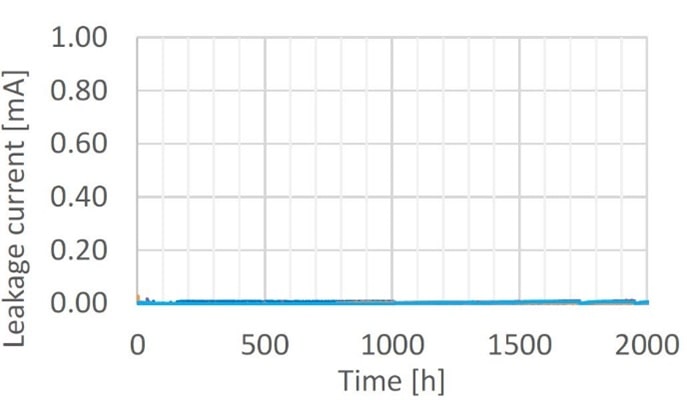
Figure 8. Confirmation of humidity robustness according to the HV-H3TRB test. Image used courtesy of Bodo’s Power Systems [PDF]
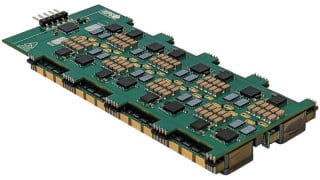
The Unifull product family features Mitsubishi Electric’s third-generation high-voltage SiC chip technology in the standardized LV100 package with 6 kV isolation voltage. Due to the symmetrical and low inductive package design, an optimal utilization of the SiC technology is provided.
Figure 9 shows the lineup of the Unifull product family. The Unifull modules are available for 3.3 kV blocking voltage for current ratings from 200 A to 800 A. Target applications for this product group are especially applications with high requirements in performance and reliability. This includes auxiliary converters as well as low and high-power traction converters in railway applications.
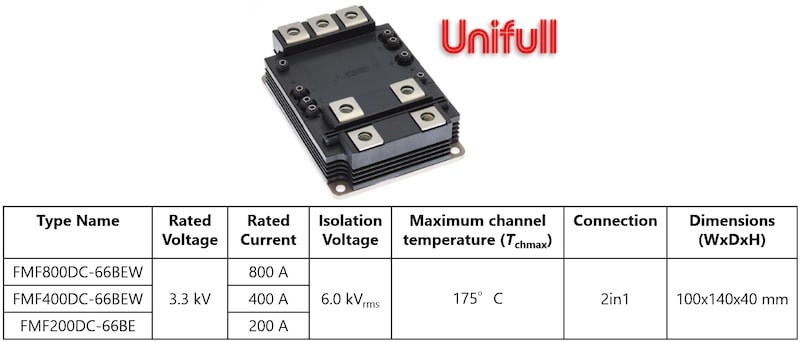
Figure 9. Unifull product family. Image used courtesy of Bodo’s Power Systems [PDF]
Electrifying Railways
Today, 43% of European railway lines are not electrified. Since diesel trains will no longer be used in the future, battery trains are a solution to further decarbonize the transportation sector. For such applications, the Unifull 3.3 kV SiC power modules offer drastically reduced switching losses and lower thermal resistance. This enables power converters with higher power density and higher efficiency. The ruggedness of these devices has been confirmed against bipolar degradation and operation at high humidity.
Unifull 3.3 kV SiC power modules can also be used in other applications that have the highest standards of efficiency, power density, and reliability.
This article originally appeared in Bodo’s Power Systems [PDF] magazine and is co-authored by Nils Soltau, D. He, Mitsubishi Electric Europe B.V., Germany and R. Tsuda, S. Yamamoto, Mitsubishi Electric Corporation, Japan.