Facebook
 Google
 GitHub
 Linkedin
Designing More Robust Battery-Powered Motor Drives With MOSFETs
Battery-powered motor drives are the dominant architecture in applications from micromobility and power tools to industrial electrification. Higher power and battery voltages require designers to balance efficiency, robustness, size, and cost.
This article is published by EEPower as part of an exclusive digital content partnership with Bodo’s Power Systems.
While low on resistance and high current handling remain fundamental performance metrics, real-world motor drive reliability is rarely defined by steady-state efficiency alone. Instead, long-term field performance is dictated by how well power devices respond to transient stress, fault events, and repeated overload conditions. In this context, MOSFET robustness becomes a primary design consideration rather than a secondary constraint.

Image used courtesy of Adobe Stock
The Reality of Battery-Powered Motor Drive Operation
Unlike line-powered systems, battery-powered motor drives must deliver high peak currents from limited voltage rails. Rapid acceleration, regenerative braking, locked-rotor events, and abrupt load changes are inherent to normal operation rather than rare corner cases. These events push inverter stages close to their electrical and thermal limits, often within compact, thermally constrained enclosures.
Short-duration fault conditions are particularly challenging. During locked-rotor events and fault conditions, current can rise to extreme levels within microseconds. Protection circuitry has a finite detection and response time, during which MOSFETs must remain electrically stable. If the device fails before the fault is cleared or the system can safely shut down, damage frequently propagates beyond the original failure point, resulting in catastrophic inverter loss.
As motor drive power scales upward, from e-bikes and scooters to electric mowers, tractors, forklifts, and industrial equipment, the frequency and severity of these stress events increase. Designing for real-world motor behavior, therefore, requires devices with meaningful electrical margin, not just optimized conduction losses.
SuperQ Robustness Starts at the Silicon Level
SuperQ MOSFET robustness is not achieved through conservative derating or oversized packaging. Instead, it is built directly into the silicon architecture. The SuperQ structure employs a fully charge-balanced trench design that preserves a wider conduction region than competing approaches that aggressively scale feature sizes to minimize resistance.
By preserving a wider current-conduction path while maintaining charge balance, SuperQ MOSFETs achieve low on-resistance without concentrating current into localized regions of the silicon. The combination of wider mesa regions, higher silicon efficiency, and optimized trench geometry spreads current more evenly across the die, reducing localized heating and improving tolerance to high peak currents and fault-induced electrical stress (Figure 1).
This architectural approach allows SuperQ devices to operate safely under electrical and thermal stress levels that would exceed the practical limits of many conventional silicon MOSFETs.
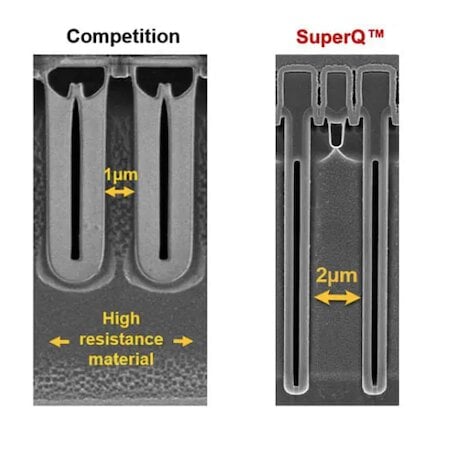
Figure 1. Comparison of traditional silicon architecture vs. SuperQ architecture. Image used courtesy of Bodo’s Power Systems [PDF]
Short-Circuit Withstand Capability Under Real Fault Conditions
Short-circuit withstand capability (SCWC) is a critical but often underappreciated metric in battery-powered motor drives. During a short-circuit event, MOSFETs must sustain extremely high current while maintaining gate control long enough for protection mechanisms to respond.
To characterize real-world behavior, SuperQ MOSFETs are evaluated using controlled short-circuit testing that drives devices to failure, rather than relying solely on static datasheet ratings. In this methodology, progressively increasing short-circuit current pulses are applied while monitoring drain current and gate voltage response. Adequate cool-down time between pulses ensures that results reflect intrinsic electrical robustness rather than cumulative thermal effects.
In comparative testing of 150V TOLL-packaged devices (shown in Table 1), a SuperQ MOSFET with a typical on-resistance of 2.5mΩ sustained peak short-circuit currents approaching 800A before failure (Figure 2). Under identical conditions, a leading competing device with a similar voltage rating and on resistance failed at approximately 580A, indicating that the SuperQ device withstood a peak short-circuit current roughly 1.4× higher.
Table 1. Comparison of leading MOSFETs for RDS(on) and SCWC
| Parameter | Units | iDEAL iS15M2R5S1T | Comp I |
| Max RDS(on) | mΩ | 2.5 | 2.5 |
| QSW | nC | 8.9 | 38 |
| SC Current per MOSFET | A | 792 | 584 |
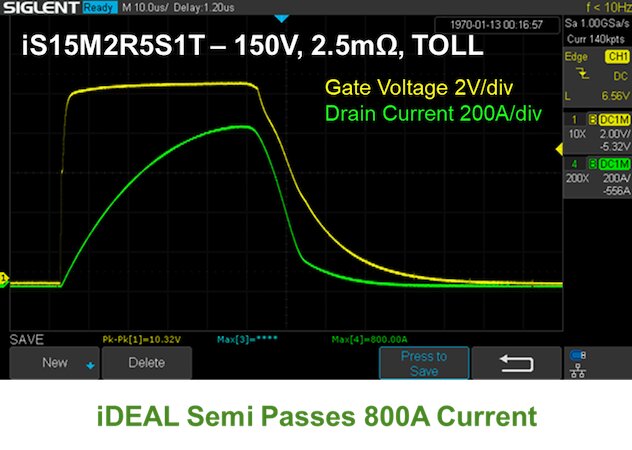
Figure 2. Short Circuit Withstand Current (SCWC) testing of 150V SuperQ MOSFET. Image used courtesy of Bodo’s Power Systems [PDF]
From a system perspective, this additional margin translates directly into longer fault-detection windows, reduced sensitivity to protection timing tolerances, and improved immunity to nuisance or delayed fault response. For motor drives operating near their safe operating area limits, this margin can significantly reduce the likelihood of catastrophic inverter failure.
Battery Disconnect and Protection Roles
In battery-powered systems, inverter robustness alone is not sufficient to guarantee system safety. Battery disconnect and protection circuits must safely interrupt extremely high fault currents, often before significant thermal rise occurs.
During an external short-circuit event, discharge MOSFETs are frequently the only elements capable of protecting the battery pack. These devices must turn off while carrying very high current, placing severe electrical stress on the silicon.
SuperQ 150V and 200V MOSFETs combine low conduction loss with high short-circuit withstand capability, making them well-suited not only for motor inverter stages but also for battery disconnect, inrush control, and pack protection applications within high-power battery systems.
The Bonus Benefit of Lower Component Count
An additional practical consequence of the trend to higher battery voltages is a reduction in the number of parallel devices required. In 48V systems operating at several hundred amperes, multiple MOSFETs are often paralleled in each switching position to reduce conduction losses and distribute thermal load. Paralleling devices increases PCB area, gate drive complexity, current-sharing sensitivity, and layout parasitics.
As voltage increases, reduced phase current lowers the current requirement per device. When combined with the very low RDS(on) in the 150 - 200V SuperQ MOSFET family, designers can often reduce the number of devices in parallel per phase leg while maintaining or improving thermal performance. This reduction simplifies gate-drive routing, lowers total gate charge, reduces PCB copper area, and improves overall system reliability by minimizing parasitic interactions. Importantly, these benefits are achieved without sacrificing efficiency, enabling designers to balance cost, size, and performance more flexibly.
Scaling Across Battery-Powered Motor Drive Applications
The benefits of SuperQ technology extend across a wide range of motor drive power levels. In compact applications such as e-bikes and drones, improved transient robustness and reduced MOSFET count support higher efficiency and longer operating time within tight thermal constraints. At higher power levels, including electric motorcycles, mowers, and industrial equipment, the ability to survive repeated overloads and fault events becomes a key determinant of uptime and warranty performance.
Even in high-power systems exceeding 100kW, such as electric tractors and heavy machinery, long-term reliability is ultimately defined by survivability during abnormal conditions rather than nominal operating points.
Designing for Real-World Motor Drive Behavior
Battery-powered motor drives operate through continuous transitions, startup, acceleration, braking, load changes, and faults. Designing for these realities requires power devices that deliver more than low resistance; it requires genuine electrical and thermal margin.
By embedding robustness at the silicon level, SuperQ MOSFETs shift fault tolerance from a system-level burden to a device-level feature. This enables simpler, more compact motor drive architectures while improving reliability under real operating conditions.
For designers developing the next generation of battery-powered motor drives, this approach enables greater design freedom, allowing efficiency, size, cost, and robustness to be optimized simultaneously rather than traded against one another.
This article originally appeared in Bodo’s Power Systems [PDF] magazine.