Facebook
 Google
 GitHub
 Linkedin
Is the Future of Batteries in the Air? Making Graphite from C02
Researchers at Lawrence Berkeley Laboratory used molten salt electrolysis to convert carbon dioxide into battery-grade graphite.
Researchers are pushing to find more efficient and environmentally friendly ways to obtain graphite, an essential mineral in batteries. Most graphite is mined, but a team led by Lawrence Berkeley National Laboratory has developed a method to pull graphite from the air—or more accurately, from a gas created from solid carbon material. The research could lead to a viable alternative in synthesizing the graphite needed for electric vehicles, storage batteries, and industry.
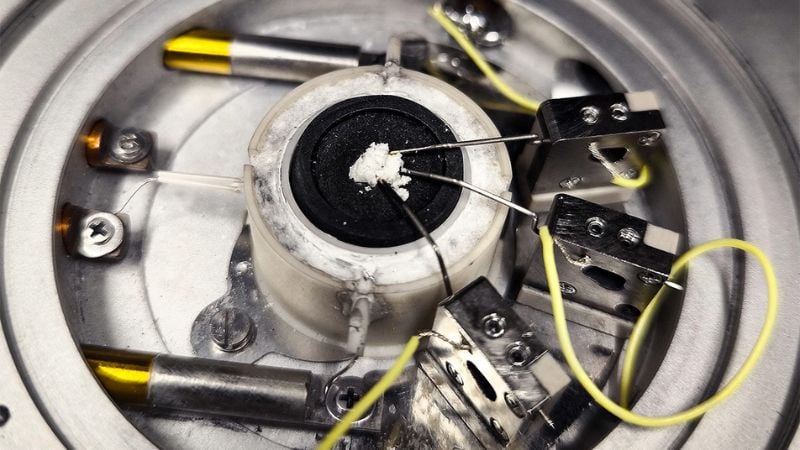
The experimental setup for converting carbon dioxide into solid carbon using molten salt electrolysis. Image used courtesy of National Institute of Chemical Physics and Biophysics/Sander Ratso
Molten Salt Electrolysis Process Creates Solid Carbon
In this study, molten salt electrolysis was used to convert carbon dioxide into graphite. Molten salts are an alternative electrochemical medium with an operating temperature of 400-750 °C and an electrochemical window of >3 V. The ionic melts enable high reaction temperatures and high ionic conductivities with Faradaic efficiencies above 95%, current densities above 2 A cm−2, and a 100% selectivity below 800 C.
In the carbon formation mechanism, carbon dioxide is reduced in molten carbonates because it reacts rapidly and exothermically with oxides in the electrolyte, forming carbonates. At the same time, cathodic carbonates are reduced to form carbon, while anodic oxidation forms oxygen.
The process can produce various forms of solid carbon, including 1D carbon nanostructures (e.g., carbon nanotubes), 0D carbon nanostructures (e.g., nano-onions), 2D graphene derivatives, 3D carbon scaffolds, doped carbon, and carbon composite materials.
The researchers wanted to see how graphite formed via molten salt electrolysis. To observe such small-scale reaction dynamics, they used operando Raman spectroscopy (operando meaning that the analysis is performed continuously over time as the reaction progresses to observe its changes and mechanisms, rather than taking a static measurement at a single point in time, which provides only information limited to that specific time point).
The team used an operando technique to observe how carbon dioxide is reduced in molten carbonates, revealing that it likely proceeds via a two-step process involving the formation of a carbon-adsorbed peroxide intermediate. The researchers could observe this process in real time, even though the reaction occurred in molten salts at 500°C (932°F).
Directly capturing carbon dioxide and converting it into solid carbon can be a way of reducing industrial waste products to produce both carbon and oxygen gas (as a by-product). Electrochemically converting carbon dioxide into carbon uses electrons as the reducing agent. While many water-based electroreduction technologies exist, they have a selectivity below 90%, low current densities, and slow reaction kinetics.
Deducing the Molten Salt Electrolysis Reaction Pathway
The researchers aimed to examine how the reaction occurs at the molecular level, a question that has been posed for decades. They chose Raman spectroscopy to investigate the mechanism because it is sensitive to the vibrational modes of carbon-oxygen bonds. This means it can readily identify a range of oxygen-containing molecules, including carbonates, oxides, peroxides, superoxides, and other reactive intermediates.
The operando spectroscopy technique directly showed the transformation of carbon dioxide into solid carbon and identified the reaction as occurring via a two-step process. Previously, it has been difficult to analyze this process directly because the hot, corrosive salts are incompatible with analytical instrumentation. The spectroscopic analysis showed that O22− oxygen species coexisted with the deposition of solid carbon onto gold, tungsten, nickel, and Inconel electrode materials. This showed that O22− acted as an intermediate species in the reaction.
The two-step pathway was identified to proceed via the following reaction equation:
$$2\text{CO}_3^{~2-}~\text{(salt)} + 2e^- \leftrightharpoons 2\text{C(s)} + 3\text{O}_2^{~2-}\text{(ads)}$$
$$\text{O}_2^{~2-}~\text{(ads)} + 2e^- = 2\text{O}^{~2-}\text{(salt)}$$
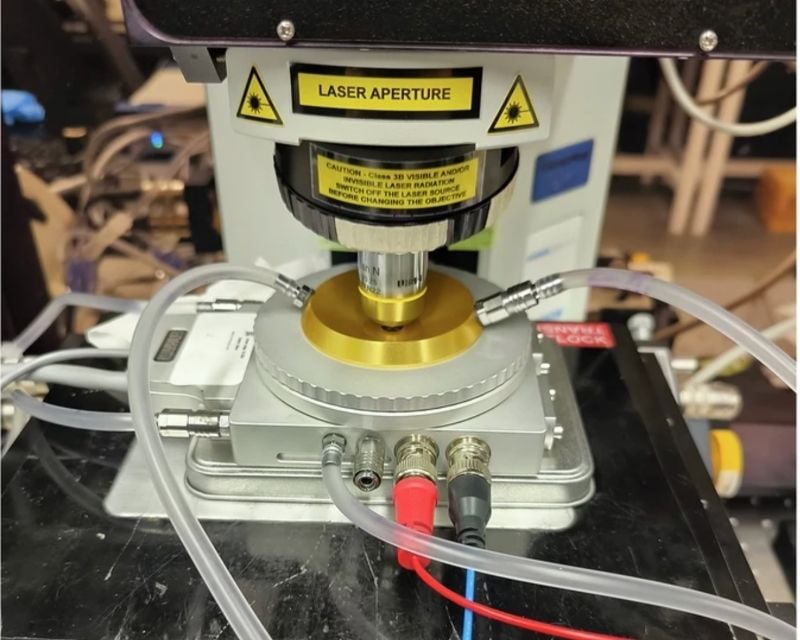
The Raman microscope. Image used courtesy of Ratso et al.
The team also found that the fundamental chemical reaction remained the same when the materials used for the electrodes and molten salts were changed. Because the fundamental reaction pathway is the same, the process can be tuned to produce different carbon products, including battery-grade graphite. To improve commercial viability and enable large-scale graphite production, the researchers need to use low-temperature, low-cost salts.
Looking Forward
The study has yielded insights into the fundamental reaction mechanisms that underpin the conversion of carbon dioxide gas to solid carbon using molten salts. The next stage for the researchers is to identify the optimal parameter combinations, including the temperature, voltages, molten salt composition, and electrode materials, to promote the formation of battery-grade graphite over other carbon materials (as well as other carbon materials of interest for different applications).
The process will need to scale up significantly to produce industrially relevant quantities without compromising product quality.
The Berkeley Lab collaborated with the University of California, Berkeley, and Estonia’s National Institute of Chemical Physics and Biophysics on the study, which was funded by the Department of Energy’s Basic Energy Sciences program. The study appears in Nature Communications.