Facebook
 Google
 GitHub
 Linkedin
Boozey Battery: Can Wine Solve the Graphite Problem?
A natural, abundant material could make batteries more efficient and sustainable.
Engineers seeking ways to make energy storage devices more sustainable have often focused on the environmental impact of metals in batteries. Studies have shown that the environmental impact of graphite, commonly used in anodes, has been understated.
Australian researchers have created a prototype battery cell using electrodes constructed with food acid compounds extracted from waste food. They used them to build a small pouch cell battery.
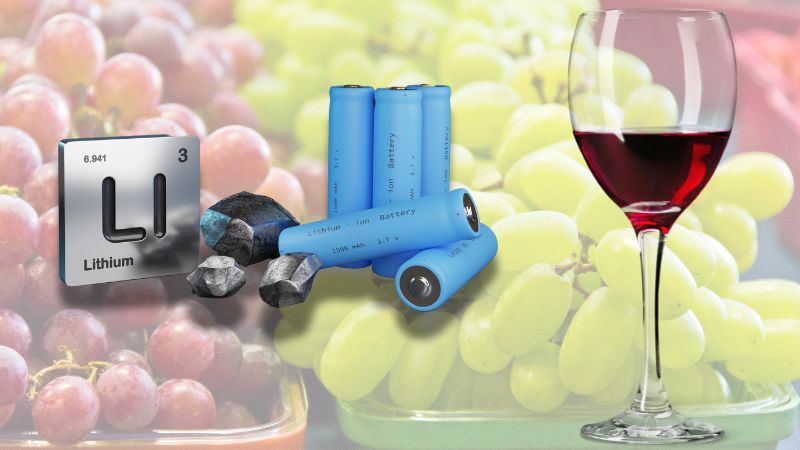
Are wine and fruit the sources for the next battery material? Adapted from images used courtesy of Canva
Environmental Impacts of Graphite Electrodes
Because of its stability and energy density, graphite is the leading anode material in lithium-ion (Li-ion) batteries. However, due to old and incomplete datasets, graphite’s carbon footprint estimates have been vastly underestimated.
The environmental impact involves graphite mining, harsh chemicals, and energy-intensive purification. Synthetic graphite production could have up to 10 times more carbon emissions than previously thought, while natural graphite production could be up to four to eight times higher. Life cycle analyses have shown that the output of 1 metric ton of natural graphite has a global warming potential of 9.3 and 9.9 metric tons of carbon dioxide—four times the reported value for battery-grade graphite in the Ecoinvent Database.
Aside from the environmental impacts of graphite production, the standard methods of refining graphite to battery-grade are not sustainable, either. Up to 60% of graphite can be lost during the processing and refining stages due to the high temperatures and strong acids used to reach the required purity level.
Using Food Waste for Electrodes
Researchers from the University of New South Wales (NSW) in Australia have developed an electrode using tartaric acid and malic acid found in fruits and wine extracts. The resulting electrodes are made from water-soluble metal dicarboxylates formed through a metal's reaction with the food-based acids. These food acids are readily available, and the chemical processes to functionalize the compounds are less aggressive than the chemical methods to process graphite, making it more sustainable. Using waste materials could help diversify the materials used to construct batteries as they could be used with abundant metals in localized regions where production occurs.
Malic acid made from fruit. Image used courtesy of Wikimedia Commons
The process will lessen graphite’s environmental impact, and it will also reduce food waste. In Australia, food waste costs the economy around $36.6 billion annually, with around 7.6 million tons of food wasted. This wastage equals 312 kg of waste per person, equating to $2,500 per household per year. This has other environmental impacts, with around 2,600 gigaliters of water being required to grow food wasted each year. So, developing batteries from food waste materials could address several environmental challenges worldwide.
Building a Prototype Cell
The researchers inserted the food-acid electrodes into a single-layer pouch cell prototype device, similar to a mobile phone battery. The cell created stored more energy than pouch cells using a graphite anode.
The team plans to expand the architecture design from this prototype by moving to larger pouch cells. Tests are ongoing to ensure the batteries can withstand repeated use over a wide temperature range while optimizing their energy storage capacity, ionic conductivity, and structural stability. The team will also experiment with battery chemistries that traditionally have electrode issues but have a higher theoretical energy density, such as sodium-ion batteries.
The researchers are currently developing the batteries for a range of applications. While the smaller and thinner cells could be developed into cylindrical and prismatic cells for medical devices, creating larger batteries for electric vehicles may be possible.
Not the First Foodstuff—Coffee has Also Been Used
The NSW researchers have also used waste coffee grounds to improve lithium-sulfur (Li-S) batteries. Li-S batteries could provide much more energy than Li-ion batteries, but they have been plagued by the polysulfide shuttle effect that breaks the electrodes and short circuits the battery. Waste coffee grounds have been used to build carbon frameworks to add into Li-S electrodes to physically entrap the sulfur ions and prevent them from migrating into the electrolyte to form intermediates that reduce the capacity and stability of the battery.