Facebook
 Google
 GitHub
 Linkedin
Companies Make 5 Major Moves in Batteries and Business
Financial challenges, AI adoption, and ever-evolving market demand are keeping the electrification race interesting this year.
The energy tech market remains highly dynamic, from financial collapses to technical breakthroughs.
A major European battery player filed for bankruptcy, while a Chinese company pushed charging speeds to the limit. Meanwhile, a British startup is turning old EV batteries into revenue opportunities, National Grid is earmarking $100 million for AI investments, and Vanguard announced an electrification partnership.

Cell manufacturing machines at Northvolt’s Skellefteå gigafactory in Sweden. Image used courtesy of Northvolt
1. Swedish Battery Manufacturer Folds
European battery maker Northvolt has filed for bankruptcy in Sweden, marking a major blow to Europe’s push for homegrown lithium-ion production. The move follows months of financial struggles, with the company’s court filing citing rising capital costs, geopolitical instability, and supply chain disruptions.
Northvolt, founded in 2016, had positioned itself as Europe’s answer to China’s battery dominance. However, European production costs run about 50% higher than in China, making it difficult for domestic manufacturers to stay competitive. Despite recent wins, such as ramping up battery production at its Skellefteå gigafactory and shipping its first million battery cells, the company was drowning in debt and forced to curtail expansion plans to conserve resources.
Waning market demand for batteries made Northvolt’s situation even more difficult to manage. According to the European Automobile Manufacturers’ Association, EU battery-electric vehicle registrations fell by 5.9% in 2024. The slowdown led some manufacturers to reassess their all-electric expansion plans. Volvo softened its 2030 all-EV target, and Volkswagen reduced its production capacity and workforce at several German plants.
The Swedish bankruptcy comes after Northvolt attempted Chapter 11 restructuring in the United States last November but was unsuccessful due to financial constraints. With just $30 million in available cash but $5.8 billion in debt, the company failed to meet the conditions to continue operating. A Swedish court-appointed trustee will now oversee its assets—including battery technology and production sites—as Northvolt hunts for a buyer or fresh investment.
2. Battery Charging Breakthrough in China
Chinese battery maker Farasis Energy revealed a breakthrough in ultra-fast EV charging through its Super Pouch Solution technology. The company reported its 6C ultra-fast charging system achieved a 10-80% charge on a lithium iron phosphate (LFP) battery in just 8.5 minutes.
As reported by CnEVPost, Farasis Energy’s new design improves heat dissipation, addressing a critical challenge for fast-charging systems. In ultra-fast charging conditions, its 5C-supported lithium-ion battery system reduced charging times from 11.8 minutes to 10.2 minutes, while the 6C-supported LFP system slashed the 10-80% state of charge window from 10.28 to 8.55 minutes.
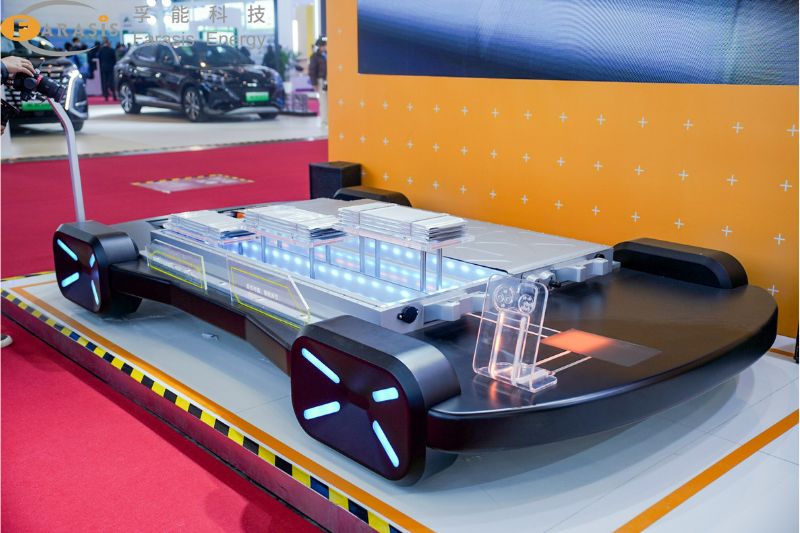
Farasis Energy’s Super Pouch Solution EV battery technology. Image used courtesy of Farasis Energy
Farasis Energy claims that both its 6C LFP and ternary lithium-ion batteries can maintain charging temperatures under 50°C, supporting safe operation under fast-charging conditions.
Today’s LFP batteries typically operate at 4C to 5C, meaning they can charge at four to five times their rated capacity. With a 6C charging multiplier, Farasis’ new system theoretically enables a full charge within 10 minutes.
Farasis’s Super Pouch System boasts a 10-minute charge time for up to 248 miles of range. It is compatible with various chassis heights and supports sodium-ion, LFP, and semi-solid-state battery chemistries.
3. British Startup Monetizing Second-Life Batteries Battery-as-a-Service
U.K.-based Connected Energy is pioneering battery-as-a-service models by giving used EV batteries a second life as energy storage systems. This approach creates new revenue streams for leasing companies and original equipment manufacturers (OEMs) and also helps mitigate EVs’ declining residual values.
According to Connected Energy, second-life applications could generate thousands of euros per battery unit, thereby enhancing the resale value of EVs. This offers a buffer against market conditions in which used EV prices have experienced significant declines over recent years amid market uncertainty and reduced demand.
EVs already have lower residual values than traditional internal combustion engine-based cars. Some new models in the U.K. have experienced depreciation rates of up to 50% within the first year, per a recent analysis by WIRED. With leasing companies facing shrinking profits, many are looking for new ways to extract value from used EVs.
For OEMs, second-life applications can improve an EV’s overall carbon footprint, as repurposing batteries for energy storage reduces the need to manufacture new ones. Connected Energy’s model also saves manufacturers from a costly recycling process, which often exceeds the value of the extracted materials. Negative scrap values average hundreds of euros per pack in Europe, according to the company.
Connected Energy’s E-STOR system, a 300 kW/360 kWh containerized unit, uses 24 repurposed Renault EV batteries to store and redistribute energy efficiently.
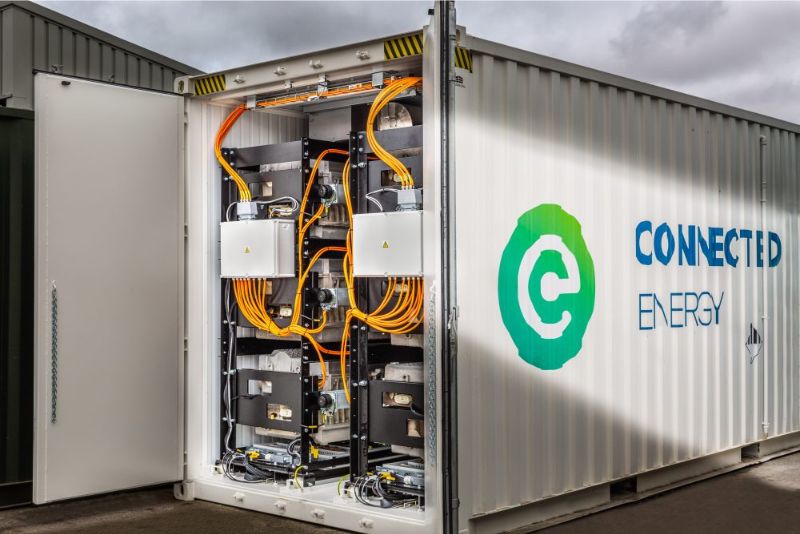
Connected Energy’s E-STOR battery energy storage system. Image used courtesy of Connected Energy
The company has collaborated with automakers to demonstrate second-life batteries for EV charging hubs, microgrids, and energy storage systems for managing surplus solar generation.
4. National Grid Partners Invests $100M in AI
National Grid Partners, utility giant National Grid’s venture fund, announced the inaugural investment pick in its $100 million commitment to fund AI-driven energy solutions.
Amperon, a Texas-based company providing AI energy forecasting and analytics, will expand across North America and Europe. It will assist utilities and independent power producers in managing demand and enhancing grid reliability.
Amperon claims its technology is continuously improving thanks to advanced machine learning, weather ensembles, and physics-based modeling, providing a 10% boost in accuracy in the past six months. The company has previously partnered with several power companies, including AES, Ørsted, and Rhythm Energy.
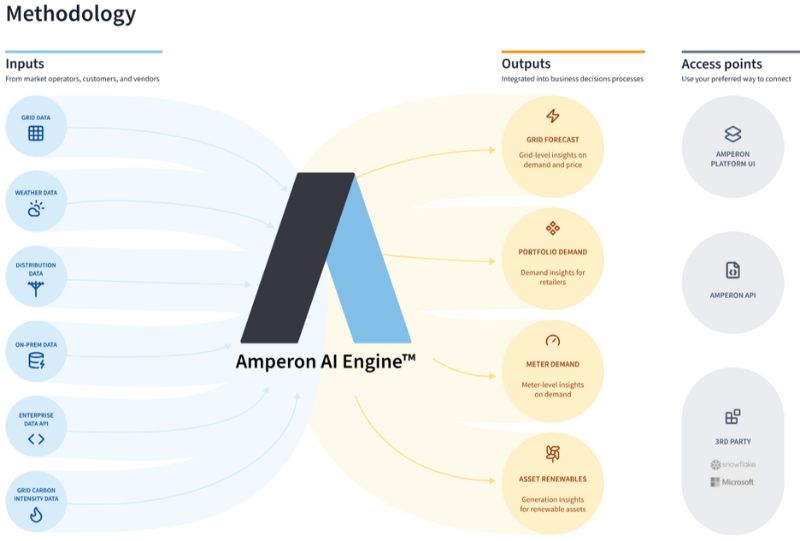
Amperon’s AI forecasting methodology. Image used courtesy of Amperon
National Grid, which operates electricity networks in the U.K., New York, and Massachusetts, has invested over $150 million in AI startups since 2018. These ventures now comprise more than one-third of its portfolio. Most of these ventures are strategically engaged with the company’s business units to automate operations, improve customer service, and expedite grid expansions.
Portfolio startups include Sensat, which has worked with National Grid to use its digital twin platform to streamline substation upgrades and data center connections. Urbint’s risk management platform helped identify 35% more hazards than National Grid’s manual process, and AiDASH’s real-time monitoring platform reduced its outages by 30% in Massachusetts. Luminance uses AI to automate National Grid’s contract management, while Exodigo has deployed an underground sensor technology to avoid obstacles during underground power line installations.
5. Vanguard Battery Technology Program Adds New Partner
JWF Technologies, a provider of fluid power and motion control technology, has joined Vanguard’s Battery Technology Partner program to accelerate electrification for OEMs.
The pair aim to simplify the transition to electric power systems for industries relying on motion control and fluid power solutions. JWF Technologies, an Ohio-based company specializing in pneumatics, advanced control systems, and hydraulics, cited the modularity and ease of integrating Vanguard’s battery packs as a big reason for the partnership.
The Vanguard Battery Technology Partner program is part of Vanguard Commercial Power, a Briggs & Stratton-owned division overseeing lithium-ion batteries, gas engines, motors, and controllers. By combining JWF’s expertise in hydraulics and pneumatics with Vanguard’s battery technology, OEMs can expect easier system integration, better performance, and more adaptable power solutions. The partnership comes as the industry is moving away from traditional combustion engines towards electric systems, particularly in industrial equipment applications.