Facebook
 Google
 GitHub
 Linkedin
Low-Waste Battery Recycling Method Yields 99% Pure Metals
Researchers have developed an electrochemical method to recover over 95% of nickel and cobalt from used lithium-ion batteries with over 99% purity.
Researchers from Ulsan National Institute of Science and Technology (UNIST) have developed a battery recycling method that recovers more than 95% of nickel and cobalt from spent lithium-ion cells, achieving purities over 99% without the heavy chemical footprint that defines current industrial processes.
The work reimagines electrochemical recovery as a primary strategy rather than a downstream add-on, showing how electrolyte chemistry and electrochemical tuning can solve one of the field’s hardest problems: getting nickel without cobalt.
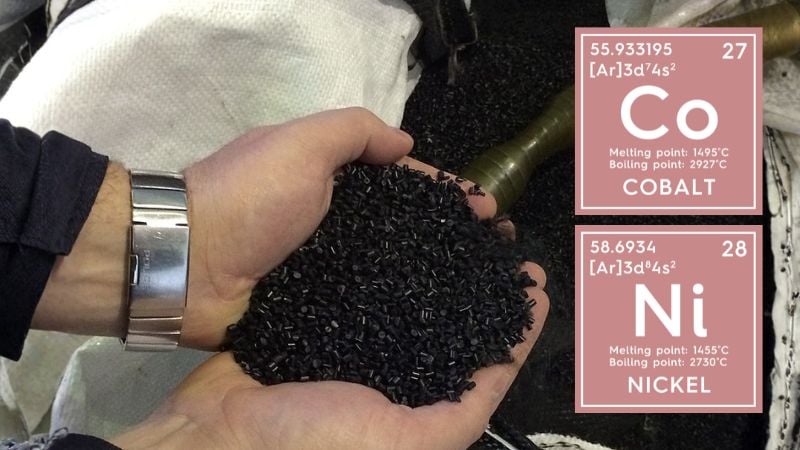
The method can recover high-purity cobalt and nickel from black mass. Adapted from images used courtesy of Wikimedia Commons and Canva
Separation Without Solvents
The study outlines a process that uses deep eutectic solvents (DESs) to selectively extract transition metals based on how they bind to different ligands. This shifts their redox potentials apart, just enough to allow for selective recovery via electrodeposition, even though the elements sit side-by-side on the periodic table. Alongside high selectivity, the method also delivers high yield and low waste, putting it in a rare category of a lab-scale battery recycling solution that looks viable in the real world.
The innovation centers on ethaline, a DES made from choline chloride and ethylene glycol. Ethaline isn’t new—it has been explored as a green solvent for years—but the UNIST team not only treated it as a medium, but also used it as a molecular tool for tuning metal coordination. In this system, ethylene glycol preferentially binds with nickel, while cobalt forms stable chloride-based complexes. That difference shifts the redox window between the two metals by around 0.3 V, especially at elevated temperatures, opening a previously inaccessible gap that allows electrochemical separation.
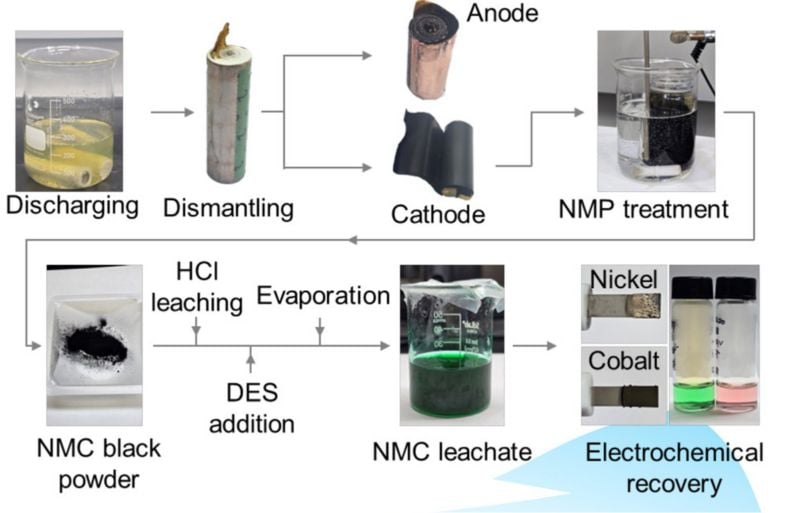
The researchers’ process flow for NMC battery recycling. Image used courtesy of Choi et al
The team further enhanced selectivity through the careful tuning of applied potential. At a “low-overpotential” regime of around -0.45 V versus Ag/AgCl, the system supported nickel deposition while leaving cobalt untouched. At higher voltages, the usual problem returned: cobalt co-deposits unpredictably, dragging down purity and breaking the process. But in this more tightly controlled regime, the team achieved a nickel/cobalt separation factor over 3000, with nickel purity exceeding 99% from a synthetic Ni-Co mixture in a single deposition step.
The system also supports what the authors called “redox-mediated self-purification.” Because chloride in the DES can be anodically oxidized to produce chlorine species, the solution itself becomes an in-situ cleaning agent. Any stray cobalt that does deposit is selectively redissolved, leaving behind high-purity nickel and enabling a one-pot recovery process with minimal loss.
Sequential Recovery, Real Leachates
Lab benchmarks are one thing, but what about black mass? The team applied the same method to leachates from real NMC cathodes (specifically NMC111 and NMC811) and demonstrated selective, stepwise recovery of nickel, cobalt, and manganese. Each was recovered electrochemically by tuning the applied potential: nickel at -0.45 V, cobalt at -0.9 V, and manganese at -1.4 V.
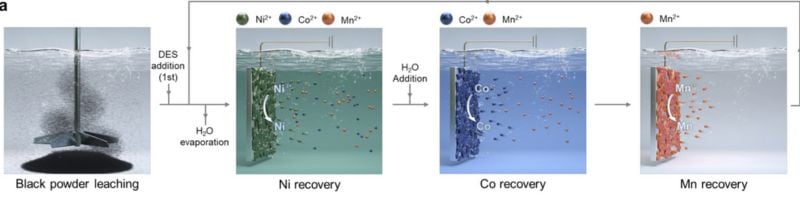
The closed-loop sequential electrodeposition process from black powder. Image used courtesy of Choi et al
What’s striking is not just the individual recoveries, including purities of 99.1% for nickel and up to 98.8% for cobalt, but the fact that they were repeatable. Over four full recovery cycles, the DES was reused with minimal degradation. The electrolyte could be dehydrated, stored, and rehydrated without performance loss. Even side reactions were limited, with GC-MS showing only trace levels of byproducts after multiple reuse cycles, and the electrolyte maintained its electrochemical behavior throughout.
The team also turned a potential safety issue into a feature. During acid leaching, chlorine gas can evolve, which is a known hazard. Instead of venting it, the researchers captured it and re-dissolved it into fresh DES, creating a Cl2-enriched solution that was then used for refining. The process boosted metal purities above 99.9% and closed the loop on both waste and process chemistry.
More Efficient Than It Looks
In terms of engineering practicality, the biggest challenge isn’t the electrochemistry but the heat. Nearly all of the energy input in the current setup goes into heating the DES to 85 °C and evaporating residual water from the leachate. Electrochemical steps themselves account for less than 1% of the system’s energy consumption, according to the team’s technoeconomic analysis.
That’s both a problem and an opportunity. The researchers used lab-scale oil baths without insulation or heat recovery, leaving substantial headroom for optimization. With thermal integration and closed-loop heating, the total process cost could drop significantly, particularly if the DES can be reused beyond four cycles, as early tests suggest.
Ultimately, the work suggests that electrochemical separation isn’t just viable, but that it may be preferable. By embedding selectivity into the chemistry itself and embracing multifunctional solvents as more than passive carriers, the researchers have carved out a path toward cleaner, smarter recycling. It’s not a silver bullet for all lithium-ion battery chemistries, but for Ni-rich cells, it’s a real contender.
The study appeared in Energy Storage Materials.