Facebook
 Google
 GitHub
 Linkedin
New Battery Storage Tech Emerges From Iron, Air, Water
Ore Energy aims to develop cost-effective, long-duration batteries for energy storage solutions.
In the renewable energy transition, batteries play an increasingly integral role in grid stability. However, challenges persist in making an affordable, long-duration storage battery to ensure grid reliability.
Ore Energy, a Netherlands-based energy storage developer, plans to develop a long-lasting, cost-effective battery based on iron-air technology. The company aims to use readily available materials to create an eco-friendly battery that lasts up to 100 hours.
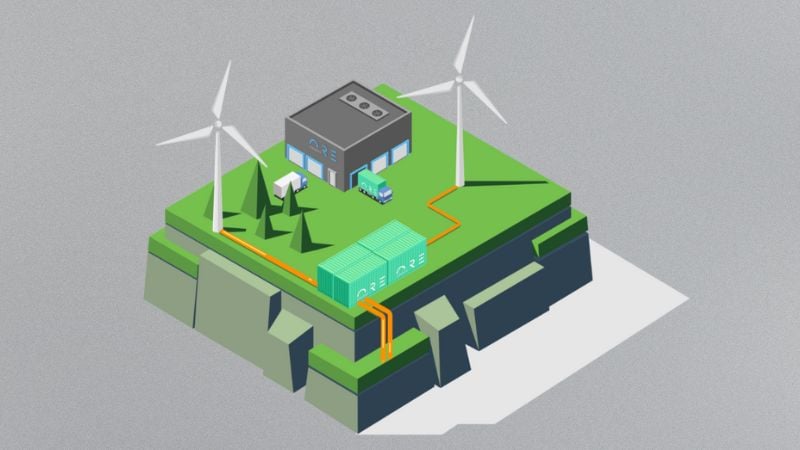
Concept of battery energy storage with renewable energy sources. Image used courtesy of Ore Energy
Rising Energy Storage Challenges
Energy storage technologies are necessary because they offer predictable energy availability to complement intermittent energy sources. Battery energy storage units are frequently installed alongside wind and solar developments to provide steady power during nighttime or unfavorable weather conditions. The nonprofit Long Duration Energy Storage Council found the long-duration energy storage market is anticipated to reach between 80 and 140 terawatt-hours by 2040.
However, amidst this meteoric growth, traditional battery technologies’ limitations loom large. Reliance on costly and scarce materials like lithium and cobalt leads to supply chain issues and high production costs. Environmental concerns surrounding lithium mining and battery disposal further complicate their use.
Lithium-ion batteries also pose safety risks, particularly concerning thermal runaway events. Moreover, their limited capacity makes it difficult to provide extended storage durations without incurring prohibitive costs.
The Iron-Air Battery
Ore Energy will use an iron-air battery in its strategy to develop a long-duration, affordable battery for grid-scale energy storage. The battery has been developed using a multidisciplinary scientific methodology. Ore Energy launched from Delft University of Technology (TU Delft) in 2023.
Unlike lithium-ion or lead-acid batteries, which rely on different chemical reactions for energy storage, iron-air batteries leverage iron’s reversible oxidation and reduction to store and release energy. Iron undergoes oxidation at the anode during discharge, releasing electrons and forming iron ions (Fe²⁺). Simultaneously, oxygen from the air reacts with water and the electrons at the cathode, generating hydroxide ions (OH⁻). In the charging phase, iron hydroxide at the anode is converted back to metallic iron, while oxygen is regenerated at the cathode, allowing for subsequent discharge cycles.
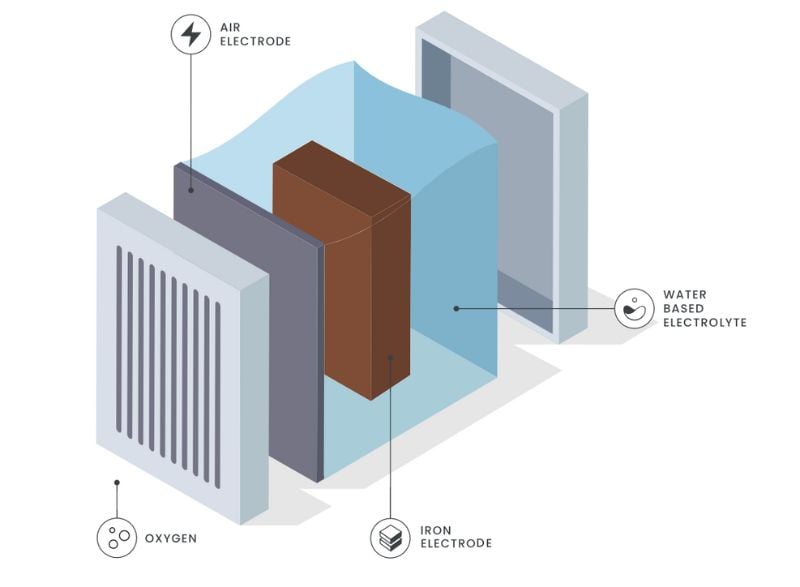
Iron-air battery technology. Image used courtesy of Ore Energy
One major benefit of iron-air batteries is that they utilize abundant and inexpensive materials such as iron, water, and air, making them a more economical and sustainable alternative to lithium-ion solutions. Moreover, iron-air batteries boast higher energy density than several traditional counterparts like lead-acid and certain lithium-ion batteries, rendering them ideal for applications necessitating prolonged energy retention.
Ore Energy’s battery will be designed for scalability achieved through a modular design, enabling integration into energy storage systems of varying sizes, from megawatt-hour to gigawatt-hour capacities.
Powering a Renewable Future
Ore Energy's iron-air batteries offer a promising pathway towards grid energy storage. With features including 100 hours of storage duration and inherent safety without the risk of fire, they could be a significant milestone in the transition to renewable energy.