Facebook
 Google
 GitHub
 Linkedin
How Commercially Cost-Effective Is Thermophotovoltaic Energy?
Thermophotovoltaic energy is sustainable, but is it less expensive than conventional energy? An economic analysis has the answer.
Thermophotovoltaic (TPV) devices are emerging as an innovative and sustainable approach for converting heat into electricity. TPVs use heat from thermal emitters to generate electricity in specially designed PV systems to produce energy silently and without moving parts.
Since TPVs are seen as a cost-effective system for producing energy, researchers from Iowa State University of Science and Technology and the University of Iowa have performed a techno-economic analysis to determine the feasibility of integrating TPVs within solar energy systems.

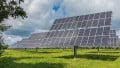
Solar panels. Image used courtesy of Adobe Stock
What Are Thermophotovoltaics?
TPVs convert heat into electricity using a thermal emitter as a heat source and a matched PV cell. TPVs have high power densities above 2.5 W/cm2 and can operate at high temperatures. They also have low maintenance costs due to no moving parts. TPVs can reach full power quicker than turbines. They are suitable for long-duration energy storage operations.
The thermal emitter can be solar, nuclear, electrical, or chemical, and waste heat sources can be harvested. When the heat travels toward the TPV, an absorber/emitter inside the device converts the radiation. The absorber/emitter acts as an infrared bandpass filter to absorb infrared photons from the heat source and emits filtered infrared photons that match the bandgap of the PV. This allows for an efficient power conversion by taking the broadband blackbody spectrum of photons and tuning them to the PV’s frequency.
The absorber/emitter also functions as a heat protector for the PV cell by blocking sub-bandgap photons with a back-surface reflector. Absorber/emitters can also use a front-surface filter to better recycle photons and improve the TPV’s power conversion efficiency. Reflecting the sub-bandgap photons away from the PV cell prevents it from overheating and improves spectral and energy efficiency.
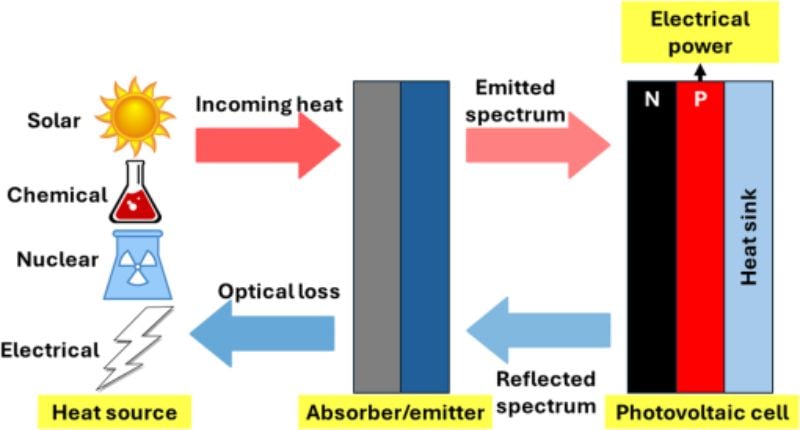
How thermophotovoltaics work. Image used courtesy of Mosulpuri et al.
The absorber/emitter also functions as a heat protector for the PV cell by blocking sub-bandgap photons with a back-surface reflector (BSR). Absorber/emitters can also use a front-surface filter to better recycle photons and improve the TPV’s power conversion efficiency. Reflecting the sub-bandgap photons away from the PV cell prevents it from overheating and improves spectral and energy efficiency.
Thermophotovoltaics Advantages
TPVs are gathering interest across energy storage, waste energy recovery, space programs, and combined heat and power (CHP) applications. Key advantages are silent operation, no moving parts, and the ability to use various heat sources. The high power density and lower cost make them attractive in thermal energy and thermal energy grid storage devices. For CHP applications, TPVs can provide both electricity and heat.
TPV devices are compared to power cycles using turbines, a widespread energy generation approach. However, TPVs can reach full power in seconds, whereas turbines may take 10 minutes to an hour. TPVs can also operate at higher temperatures because it is a contactless device. In contrast, the material constraints in turbines limit the operating temperature. Brayton cycle turbines can reach an upper operating temperature of 1500°C and Rankine cycle turbines can reach 700°C, but TPVs can operate at 1700°C with higher efficiency―40% for TPVs versus 38% for Brayton cycle turbines and 23% for Rankine cycle turbines.
Techno-Economic Analysis for Solar and Energy Storage
The Iowa researchers’ study performed a techno-economic analysis using TPV devices in a solar energy conversion and storage system. The study involved an optimization method that levelized the cost of consumed energy (LCOE) and the levelized cost of electricity (LCOEel) across four different scenarios in Boone, Iowa.
The study identified factors affecting the total cost of ownership (TCO) of TPVs. These included inflation rates, prices of natural gas, capital costs, and the system's lifetime. The four scenarios had varying levels of capital cost and fuel/electricity inflation rates that enabled these findings to be verified.
The study showed a small reduction in LCOE by $0.038 and LCOEel by $0.128 per kilowatt-hour compared to the initial estimates. Several variations could influence the costs over time. While the study showed the TPVs have economic potential, the LCOEel is higher than the average electricity price, so it will need to decrease for commercial feasibility. However, the study also identified that using energy management systems with TPVs could reduce CO2 emissions by up to 12% due to a lesser dependence on natural gas for heating and grid electricity.