Facebook
 Google
 GitHub
 Linkedin
From City Bus to Desk Size: Steam Turbines Shrink To Meet Power Production Challenges
Smaller steam turbines have been engineered to match the output of their traditionally large counterparts while using minimal space—thanks to an innovative medium.
Steam turbines, which convert steam's thermal energy into mechanical energy for electricity generation, have long been fundamental tools in power production. Despite their importance, steam turbines’ large size poses significant challenges for installation and space requirements. Ultimately, these limitations have hindered their feasibility in urban areas with limited land availability.
Southwest Research Institute researchers have manufactured a desk-sized turbine matching the output of huge conventional turbines.
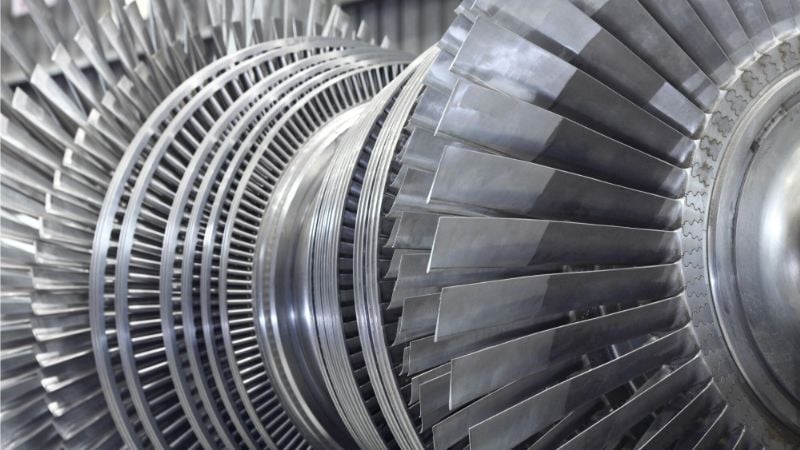
Steam turbine. Image used courtesy of Adobe Stock
Exploring the Steam Turbine Energy Wheel
Steam turbine generators harness high-pressure steam to create electricity. On a high level, this works by leveraging steam from boilers, generally heated by burning fossil fuels, to spin blades connected to a rotor, converting rotational motion into usable energy. By coupling the rotor with a generator, turbines convert rotary motion into electricity, governed by Faraday’s Law.
The principle behind the steam turbine’s operation is the Rankine cycle. This begins with compressing the working fluid in a pump, followed by heating in a boiler to produce high-pressure steam. This steam expands through a turbine, creating mechanical work before condensing in a condenser. The condensed fluid is then pumped back into the boiler to repeat the cycle.
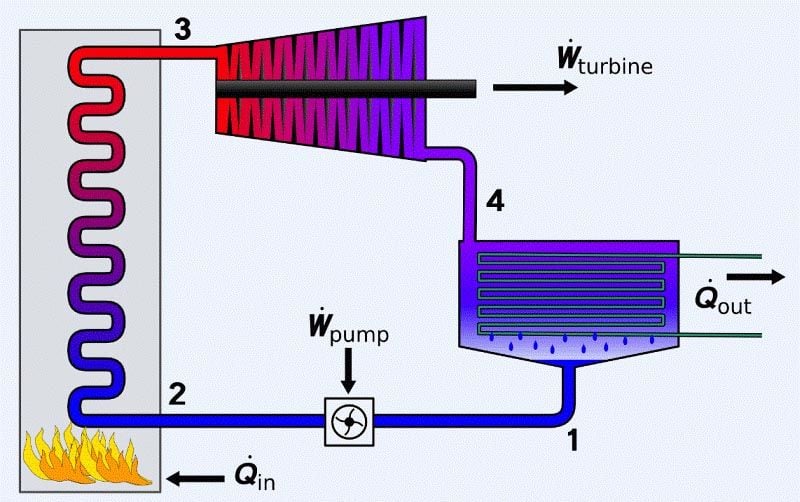
Rankine cycle layout. Image used courtesy of Wikimedia Commons (By Andrew Ainsworth)
Traditionally, steam turbines have been hindered by their large size due to steam's limitations as a working fluid. Turbines incorporate numerous stages to accommodate the expansion of steam volume as pressure decreases. As the steam transits, it sheds pressure and thermal energy, and the volume expands, necessitating larger diameters and extended blades in successive stages for optimal energy extraction.
Smaller turbines can bolster system performance by diminishing energy losses linked to extended piping and refining heat transfer efficiency. This is especially crucial in urban locations characterized by limited space.
STEP to Steam Turbine Energy Efficiency
Researchers have successfully demonstrated the downsizing of steam turbines. The project, known as the Supercritical Transformational Electric Power (STEP) demo pilot plant, focuses on replacing water with a novel working fluid called supercritical carbon dioxide (CO2).
Under standard conditions, CO2 is a gas in the atmosphere, but it can solidify into dry ice through cooling or pressurization. At elevated temperatures and pressures, it enters a supercritical state, exhibiting properties of a liquid and a gas, termed supercritical CO2 (sCO2). This substance, increasingly used as an industrial solvent, can become a medium for turbine rotation. Since its density changes minimally with temperature or pressure shifts, it proves 10% more efficient for power generation than water. This shift from the traditional Rankine cycle to the Brayton cycle offers improved energy efficiencies.
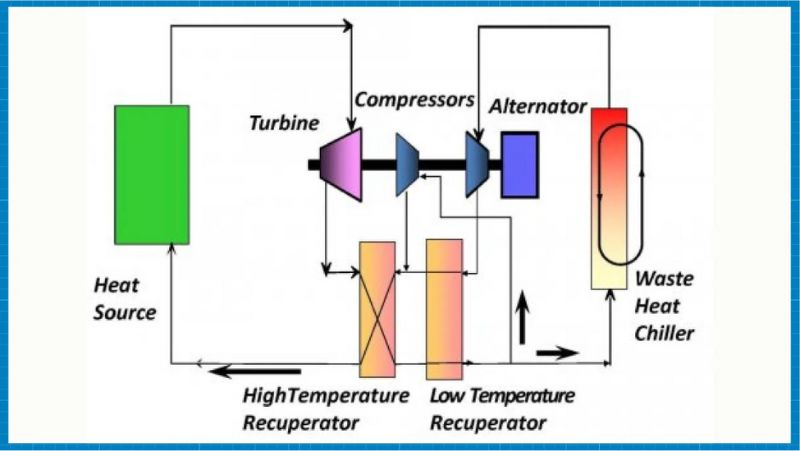
Recompression in a closed Brayton Cycle. Image courtesy of the Department of Energy
The researchers utilized the enhanced efficiency to shrink turbine dimensions, resulting in a three-foot sCO2 turbine matching the output of a 65-foot steam turbine. This equipment was constructed for $155 million, marking the first large-scale demonstration and testing of sCO2 as a working fluid. The resultant desk-sized turbine prototype reportedly produces enough power to supply 10,000 homes.
CO2 Turbines Hold the Future
This research is significant because it demonstrates steam turbines can now be downsized from the usual size of a city bus to the scale of a desk. As renewable energy increases and the electrical grid becomes more distributed, the ability to create high-performance point-of-use electricity through smaller steam turbines could have major implications on future grid stability.