Facebook
 Google
 GitHub
 Linkedin
Renewables Game-Changer? 44% Efficient TPV Cell
Researchers unlock a 44% power conversion efficiency with air-bridge thermophotovoltaic cells.
Thermophotovoltaic (TPV) cells, which convert infrared radiation from a heat source to generate electricity, could enable low-cost and on-demand energy storage to counter a major obstacle in switching to renewable energy: intermittent production from solar panels. Thermal batteries, while still in the early development stages, offer substantially higher efficiency than conventional solar cells.
TPV cells are similar to solar PV systems that harness visible light energy. Instead of the sun, TPVs target lower-energy infrared photons emitted by a thermal source, such as an industrial steel plant’s waste heat. While the solar spectrum is bound by the electromagnetic radiation from the sun’s surface, TPV cells can be engineered to tap into a broader high-temperature input range.
University of Michigan researchers have advanced the field with a TPV cell achieving a 44% power conversion efficiency at 1,435°C (2,615°F). This meets the target range of existing thermal batteries storing energy at 1,200 to 1,600°C. The design also beats the 37% efficiency reported by competing devices operating at the same temperature.
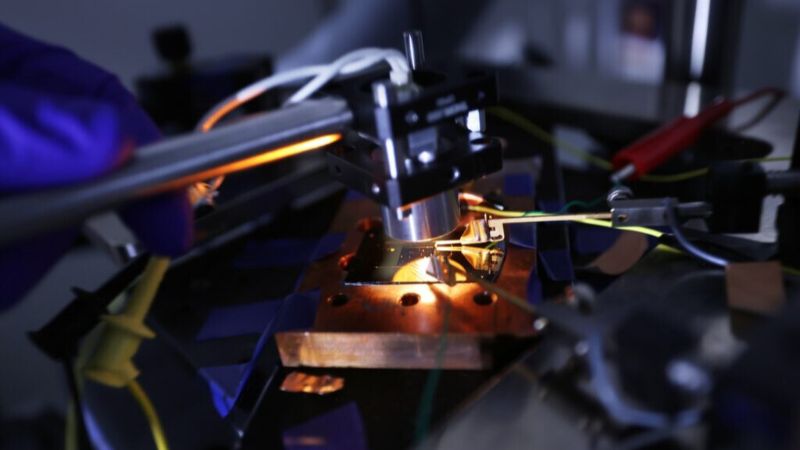
A University of Michigan researcher measures a thermophotovoltaic cell’s voltage and amperage. Image used courtesy of the University of Michigan/Brenda Ahearn
How Do Thermophotovoltaic Cells Work?
Thermophotovoltaic devices harness photons with energies higher than the cell’s bandgap. These photons radiate from a high-temperature emitter, such as steel or concrete production heat, combustion reactions, or absorbing excess concentrated solar energy.
Like other solid-state technologies, TPV devices lack moving parts and lower maintenance costs because they accommodate higher temperatures. Power density is another advantage due to the cells’ light weight, portability, and quiet operation, which makes them suitable for military battlefield applications. They can also recycle power carried by unabsorbed photons.

A thermophotovoltaic cell from a 2022 Nature study. Image used courtesy of the study’s authors
Studies testing different types of emitters have shown that the cell’s efficiency is relative to the heat source's maximum temperature. One 2022 paper demonstrated over 40% efficiency with two-junction cells using a 2,400°C halogen lamp. Another study achieved a 39% efficiency with a single-junction cell drawing heat from a 1,850°C heated graphite emitter.
Despite these advantages, TPV cells are often limited to smaller-scale thermal-to-electric applications, such as radioisotope power systems used in deep space exploration where solar resources are sparse. Broader adoption demands TPVs compatible with lower temperatures and stable emitters. Today’s cells rely on a somewhat limited selection of stable heat materials.
Electrical engineers from the University of Michigan tackled this obstacle with a novel air-bridge TPV design that approaches practical thermodynamic limits without needing ultrahigh temperatures from the emitter. The device also recuperates power from below-bandgap photons.
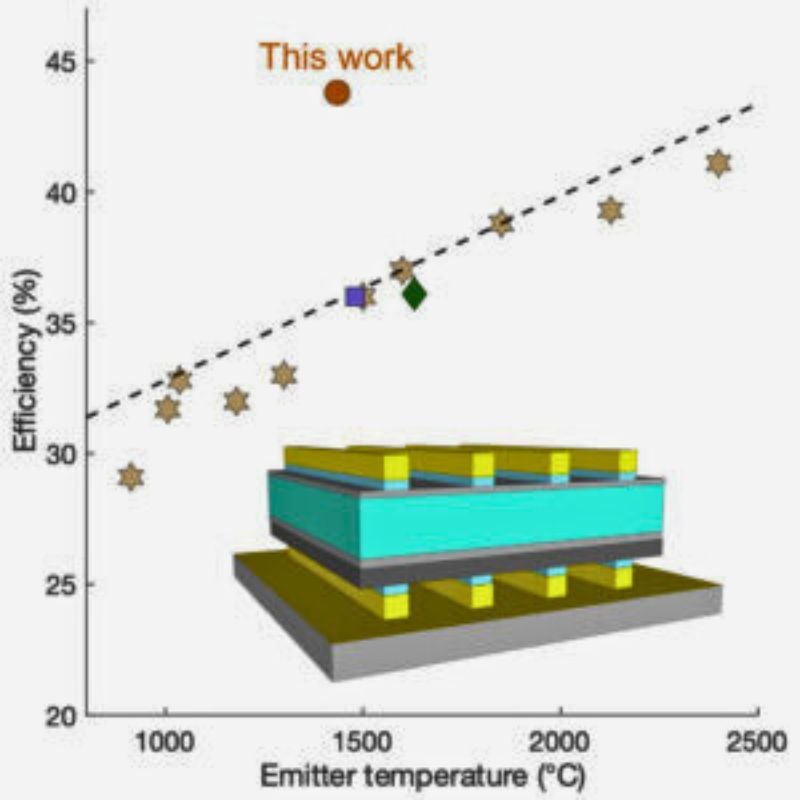
TPV cells’ efficiency compared to previous research. Image used courtesy of the University of Michigan’s Lenert Lab
Air-Bridge Structure Recycles Photons
The study, published recently in Joule, developed a single-junction device using a Group III-V absorber—indium gallium arsenide phosphide (InGaAsP)—as the semiconductor material. The absorbers were InGaAsP lattice matched to InP substrates to enhance the cell’s efficiency in meeting the target emitter temperatures, allowing the semiconductor to capture a wider range of photon energy.
When the material radiated photons at 1,435°C, only about 20 to 30% contained enough energy to generate electricity. To rescue photons operating above and below that point, the researchers added a thin layer of air near the semiconductor and a gold reflector beyond the air gap. This pocket trapped the optimal photons and directed them to the semiconductor while the remaining photons returned to the heat storage material. That way, the lower-energy photons could be re-emitted later and ideally captured by the absorber.
The results demonstrated 44% efficient conversion with the emitter heated below 1,500°C, and the air-bridge design boosted the reflectance (or recovery) of out-of-band photons ranging from 0.74 to 1.1 eV. The peak and average performance data were also significantly higher than existing TPV cells, potentially unlocking higher round-trip efficiency since the storage system could deliver more energy than it consumes.
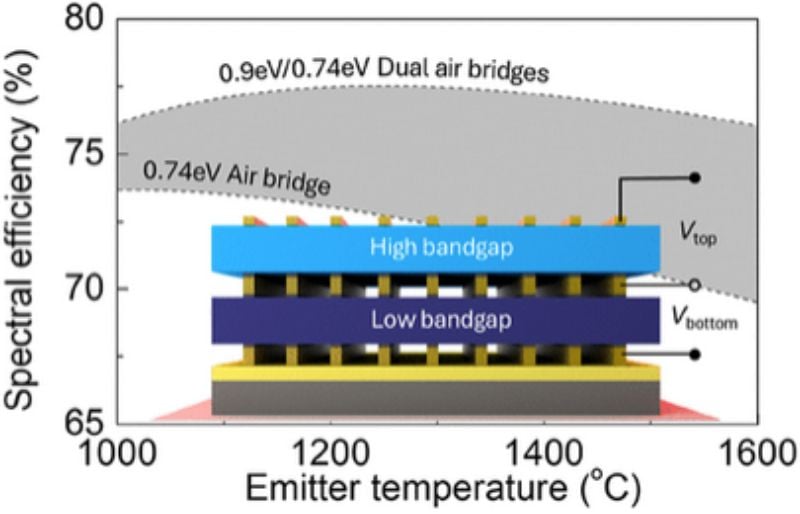
Air-bridge tandem design. Image used courtesy of the University of Michigan’s Lenert Lab
The same team recently published a separate paper in ACS Energy Letters, which found that stacking two air bridges unlocks a higher range of photons that could be converted to electricity.
In future studies, the researchers expect to push the boundaries of conversion efficiency beyond 50%.