Facebook
 Google
 GitHub
 Linkedin
Grid Modernization: What’s Keeping Power Pros Up at Night?
Grid professionals struggle to keep up with increasing power demands and a changing energy landscape.
Renewable and distributed energy resources are top factors in grid modernization, according to Black & Veatch’s 2024 Electricity Report. Close behind are aging grid infrastructure, grid resilience, supply chain issues, data centers, and cybersecurity.
Nearly 700 power professionals shared their views about issues challenging utilities’ abilities to meet power demands in the coming years. They identified major trends, such as electrification, climate change, decarbonization, and changing regulations, but most remain optimistic that grid modernization will become easier.
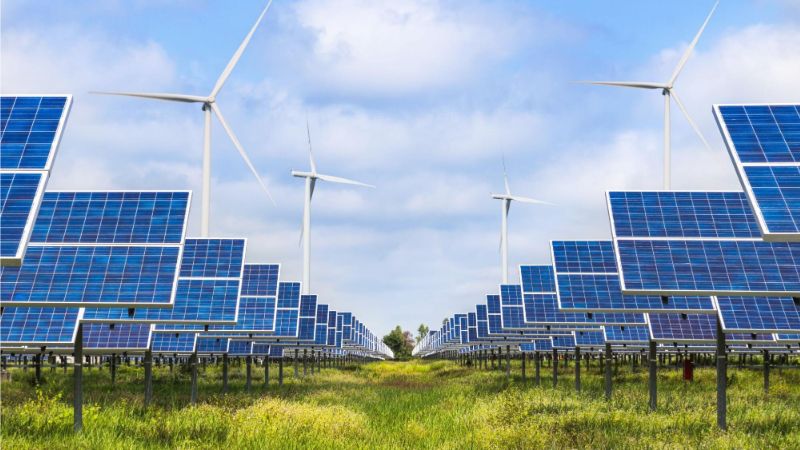
Renewable energy. Image used courtesy of Adobe Stock
Renewables, Infrastructure, and Environmental Regulations
By 2050, renewable energy in the U.S. will represent about half of all power generation. Wind and solar lead all sources, but these variable systems need energy storage to generate grid-scale power continuously. Unsurprisingly, about half of survey respondents (51%) named energy storage their top investment concern over the next five years.
Battery storage systems are expected to increase by 89% in 2024 if developers can bring their projects online as planned, according to the Energy Information Administration. If they succeed, battery capacity will grow to more than 30 GW, surpassing fossil fuels, geothermal, wood, and landfill gas.
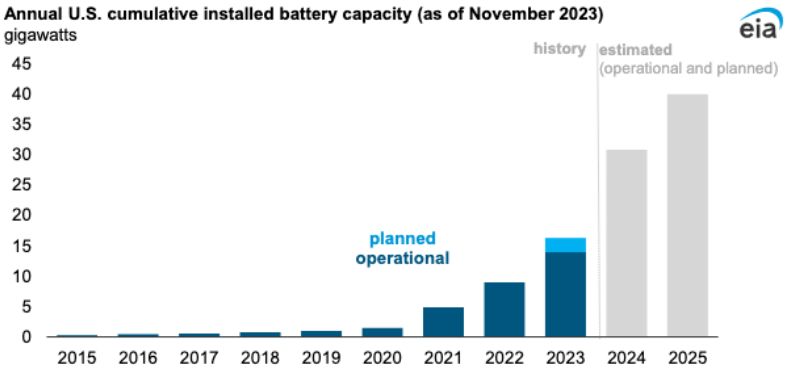
Growth of battery storage systems over the past decade. Image used courtesy of EIA
Respondents also predicted ground-mounted or rooftop solar (34%) and microgrids and distributed energy resources (29%) as major investment changes in the near future.
Integrating renewable and distributed energy sources is another challenge for the near future, survey respondents said. They identified several obstacles to grid integration, including the changing energy landscape, outdated infrastructure, and evolving regulations. The uncertainty has altered their planning practices, they said. In the past, utilities created long-rage outlooks in their region, anticipating power needs in five or 10 years. Many utilities must now update their plans once a year, Black & Veatch discovered.
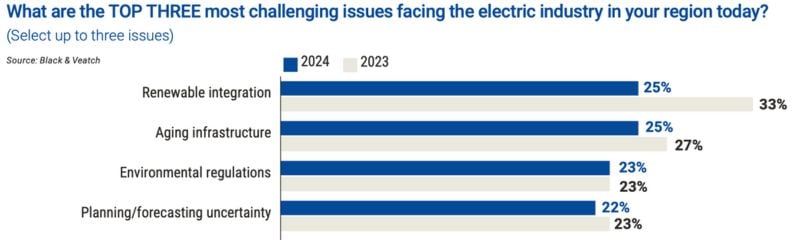
Black & Veatch asked survey respondents to name their top three concerns. Image used courtesy of Black & Veatch
Grid Resilience
Since grid expansion takes time and major investment, many utilities focus on strengthening the existing grid. Almost half of power professionals (46%) named the changing energy mix the biggest challenge in bolstering grid resilience.
Most respondents stated that increases in extreme weather caused by climate change are major concerns. Cold, ice, and high winds were identified as the greatest concerns nationwide, but in California, wildfires also worried about 66% of respondents. Yet, power grids are making some progress, as 48% of power pros said it was taking less time to recover after a weather event.
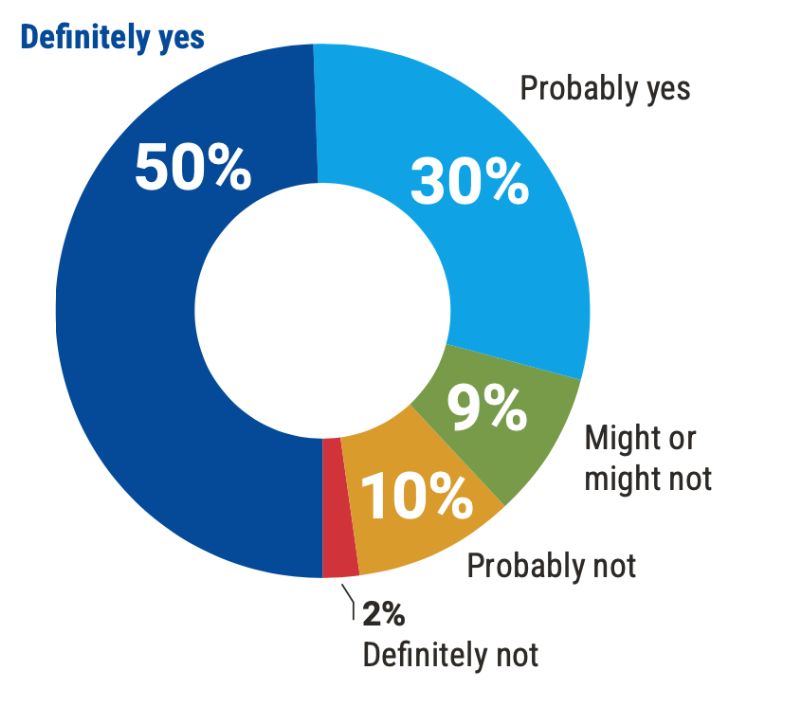
Percentage of survey respondents who stated weather events influence grid resilience investments. Image used courtesy of Black & Veatch
Other obstacles to improving grid resilience were supply chain backlogs, outdated regulations, and a lack of qualified workers.
Survey respondents found evolving regulations confusing, uncertain, and sometimes contrary to their goals. Challenging regulations struck a chord with over half of the respondents (54%). For example, Jim Matheson, CEO of the National Rural Electric Cooperative Association, told Black & Veatch that the Environmental Protection Agency’s new regulations requiring carbon capture and sequestration on gas plants would “limit the construction of new natural gas plants” at a critical time when data centers, e-commerce, and electric vehicles are creating an energy demand surge.
Modernization efforts are also inadvertently leading to a worker shortage. As digital and artificial intelligence technologies become more prevalent, grid operators and technicians may need retraining.
Data Centers
The burgeoning growth of AI data centers and their enormous power demand worry many grid professionals. These data centers demand five to 10 times more than traditional ones.
Nearly half (45%) of survey respondents stated they aren’t confident they can forecast the power load needed due to uncertain development timelines and connection details. They said it’s difficult to accurately predict load ramps (30%), substation interconnect dates (18%), and point of interconnect location (15%).
About 40% of power professionals named available power as the largest obstacle. Others (30%) stated that substations needed upgrading, and 24% said equipment availability was challenging. Due to supply chain issues, utilities sometimes wait up to three years for necessary equipment, such as switchgear, transformers, circuit breakers, and gas turbines.
Many AI data center developers, especially big tech companies like Amazon and Google, are creating their own power sources, such as microgrids, solar plus storage, and nuclear microreactors. Utilities still face issues when these companies seek grid connection for community-wide energy programs.
Survey respondents identified several ways tech companies could assist in facilitating grid connections, with clarity of load demand at the top (40%). Financial assistance in the form of advanced payments (29%) or client-furnished equipment (19%) was also recommended.
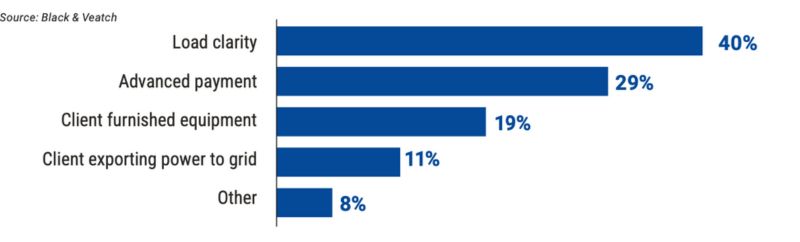
How can AI data center developers help facilitate grid upgrades for their power demand? Image used courtesy of Black & Veatch
Cybersecurity
Cybersecurity is a growing need as grids digitalize and integrate more dispersed energy sources. In 2023, cyberattacks numbered 2,365, affecting more than 3.4 million people. As the grid modernizes and changes, maintaining cybersecurity measures is a constant battle, particularly as cybercriminals are continuously devising new attack modes. Only one-quarter of utilities said they had a dedicated cybersecurity staff.
Information technology (IT) and operational technology (OT) professionals work on the front lines of cybersecurity. According to Black & Veatch, about 70% of IT pros named phishing attacks the top threat, with ransomware and malware tied for second (45%). OT workers faced an additional cyberthreat, cloud vulnerabilities (35%). To address these threats, survey respondents said they needed more threat intelligence (36%), monitoring and response strategies (34%), and vulnerability assessments (31%).