Facebook
 Google
 GitHub
 Linkedin
Grid Power: GM Pivots to Sodium Batteries and V2G Technology
As GM slows its electric vehicle production, it’s applying its battery technology to energy storage and grid support.
General Motors is expanding its electric vehicle pivot into stationary power, grid services, and charging software. The company is still selling EVs, but after scaling back some production plans, pausing battery-plant activity, and delaying next-generation electric trucks and SUVs, it's exploring other ways to make batteries profitable.
GM is one of several automakers and battery companies following the demand for grid solutions. Its latest development fits that trend: sodium-ion batteries for stationary storage and vehicle-to-grid (V2G) programs that can help make EVs part of local power systems.
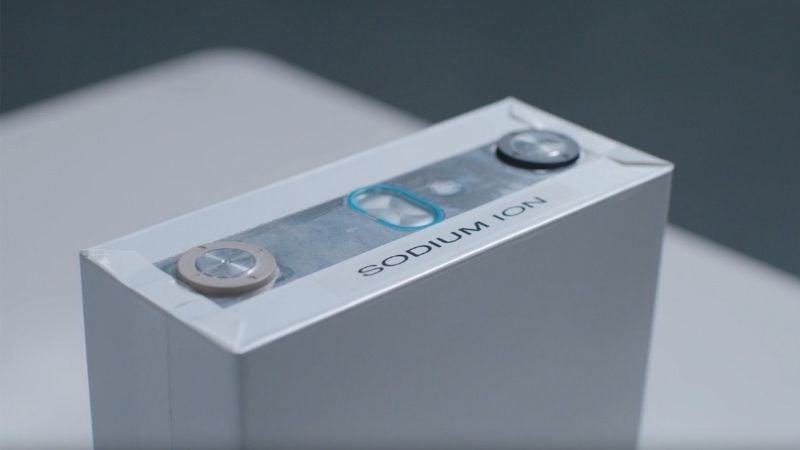
GM's sodium-ion battery cell. Image used courtesy of GM
Why GM Is Testing Sodium-ion for Grid Storage
First, GM is developing next-gen sodium-ion cells for battery energy storage systems.
Grid storage batteries are engineered for a different job than typical EV packs. Cars and trucks need to squeeze maximum range from limited space and weight, while stationary systems can prioritize durability, thermal stability, safety, and operating cost. That opens the door to chemistries that might be less energy-dense than lithium-ion but better for sitting on the grid and cycling for years.
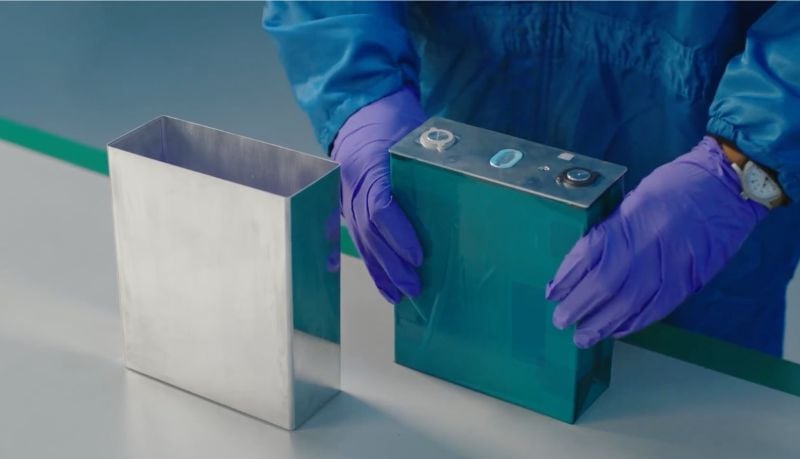
Assembling a sodium-ion battery cell. Image used courtesy of GM
That's part of why GM is developing next-generation sodium-ion cells for grid-scale energy storage with Peak Energy, backed by a GM Ventures investment. Sodium-ion batteries operate on the same basic ion-transfer principle as lithium-ion cells, giving GM a familiar technical basis for cell design and manufacturing development. Sodium is also far more abundant than lithium, an advantage GM sees as a route to lower supply chain risks and better long-term cost controls.
Stationary storage can accept lower gravimetric energy density if the cell reduces total system complexity. GM stated that sodium-ion batteries can handle more temperature variation and deliver more cycles than existing chemistries, potentially reducing or eliminating the need for active cooling in larger energy storage systems. That cooling hardware adds maintenance costs, parasitic losses, and potential failure points.
GM plans to prototype sodium-ion cells at the Wallace Battery Cell Innovation Center this year in Michigan, while Ultium Cells will soon begin producing LFP batteries for LG Energy Solution’s storage business. GM is also working with Redwood Materials on second-life EV packs, including an upcoming Michigan plant installation that will use 100 retired packs as a practical test case for repurposing vehicle batteries in stationary storage.
Rolling Out V2G and V2H for Bidirectional-Capable EVs
GM is also pushing bidirectional EV systems as storage assets that utilities could call on to support the grid.
The company's bidirectional architecture supports vehicle-to-home (V2H) and vehicle-to-grid operation. V2H allows a compatible EV, charger, and home enablement system to supply a house during an outage. V2G is harder because it requires utility participation, interconnection approval, communication standards, rate design, and customer enrollment.
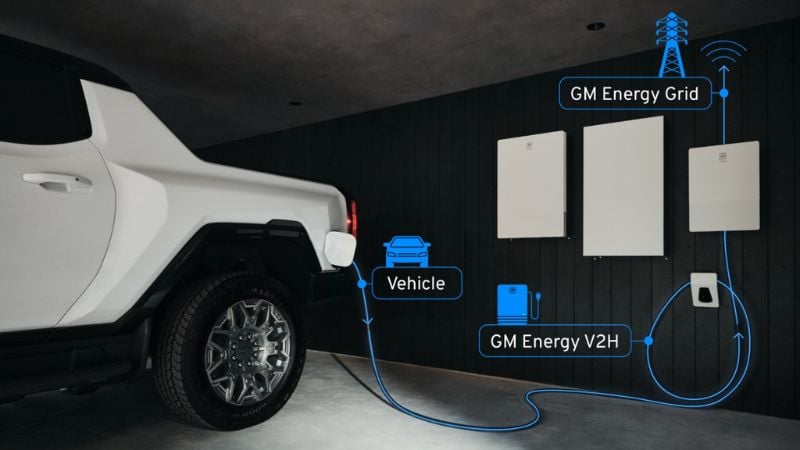
GM's vehicle-to-home charging ecosystem. Image used courtesy of GM
The company has reported that more than 250,000 bidirectional-capable GM EVs are already on U.S. roads. But, despite the large installed base, most of those vehicles aren't yet integrated into utility programs that can use their batteries for grid support.
In Northern California, GM is working with PG&E and expects that 130,000 EVs could be operating by 2030, with more than 52,000 participating in grid-balancing functions. And in Michigan, GM is testing V2G with DTE Energy in employees' homes, using the pilot to study how bidirectional charging works in real houses outside of a controlled demo.
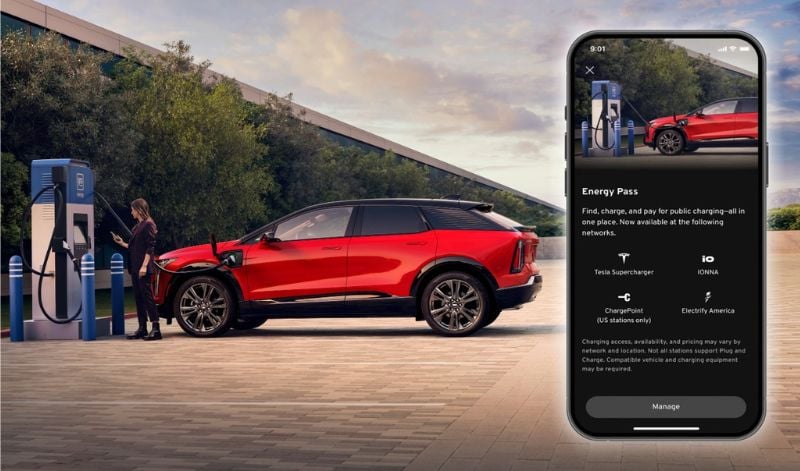
Energy Pass, GM's on-the-go public charging app. Image used courtesy of GM
Energy Pass is GM’s new public charging solution. It pulls networks such as Tesla Supercharger, IONNA, Electrify America, ChargePoint, and others into GM’s vehicle apps, giving drivers one place to handle charging sessions without juggling multiple network apps. Plug & Charge also removes another step at chargers that support it.