Facebook
 Google
 GitHub
 Linkedin
Wildfire-Safe: Using Optical Sensors to Protect Transmission
Optical fiber sensing can protect the grid from wildfires and other threats.
Wildfires are becoming more frequent and dangerous year-round in the U.S. They are becoming more intense and starting in states such as Louisiana, which has never suffered much from wildfires. These wildfires pose a risk to power system infrastructure, which can easily become damaged by the intense heat, leading to power outages.
Wildfires from space. Video used courtesy of NASA
As wildfire activity increases, engineers are finding ways to anticipate and prepare the grid. Optical fiber sensor approaches can provide early warning detection for the grid against wildfires.
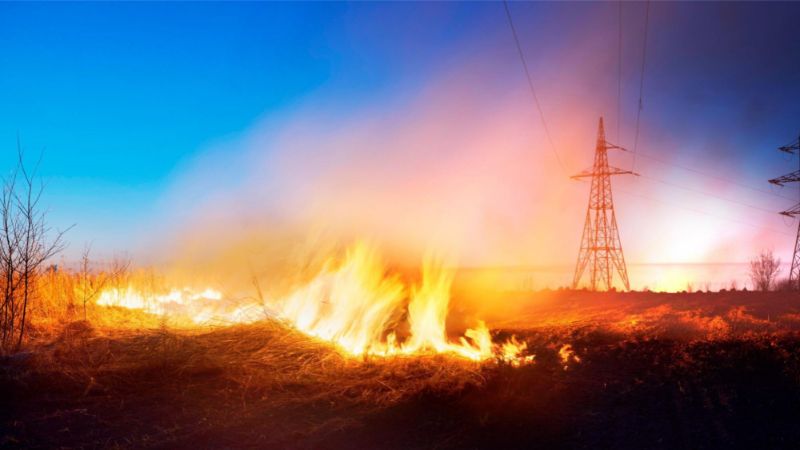
Wildfires threatening transmission towers. Image used courtesy of Adobe Stock
What Are Optical Fiber Sensors?
Optical fiber sensors use the optical fiber as the functional sensing unit. Many fiber optic sensors are “intrinsic” sensors that use direct changes in the fiber’s optical properties to provide a detectable response. The changes in optical properties along the fiber—such as intensity, polarization, phase, or wavelength—can detect changes due to strain or temperature in the local environment.
Optical fiber sensors are ideal for detecting threats against the grid because they are small and need no electrical power. They are immune to electromagnetic interference, don’t conduct electricity, and can withstand high temperatures. They can be used on high-voltage power lines without high temperatures or the local electrical and magnetic fields affecting their sensing performance. Fiber optic sensors can also provide distributed sensing over long distances, ideal for transmission lines stretching long distances.
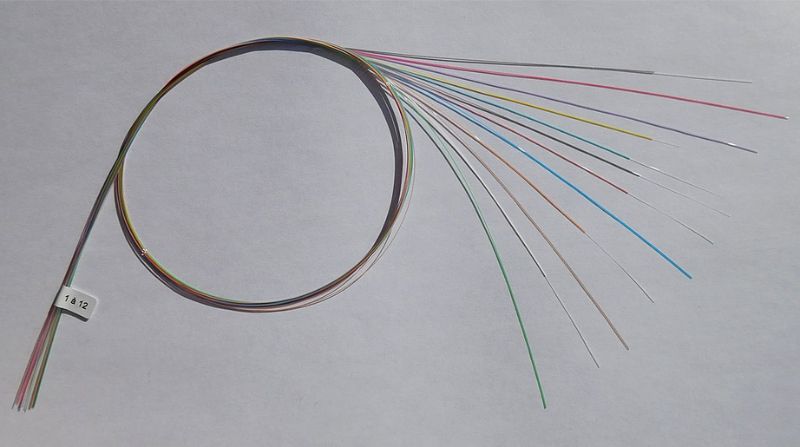
Optical fibers. Image used courtesy of Wikimedia Commons
How Can Optical Fiber Sensors Protect the Grid From Wildfires?
The optical ground wire (OPGW) lies on top of the transmission network. This cable can be utilized as a fiber optic sensor along transmission networks. The OPGW is traditionally used as an earthing mechanism for the grid and is often used in a dual capacity as an optical communication channel.
One company using this approach is Prisma Photonics, which is testing wildfire sensing in real-world field trials, most recently in Israel along a 160 kV line. Prisma Photonics turns the OPGW into a series of distributed sensors spanning thousands of kilometers using their monitoring system, an optical interrogator unit connecting to existing optical fibers, and machine learning-based monitoring software.
The optical fiber connects to a substation with interrogator units that can detect changes along the optical fiber. The optical interrogator added to the OPGW transmits an optical pulse propagating along the fiber. A small amount of the light is reflected from various points along the fiber (the sensor points) back to the substation, allowing the system to detect any changes. These changes could be attributed to temperature or other forms of strain on the power line. The optical fiber essentially becomes a continuous acoustic sensor, where each reflection point behaves like a microphone, sending regular signals back to the transmitter/receiver.
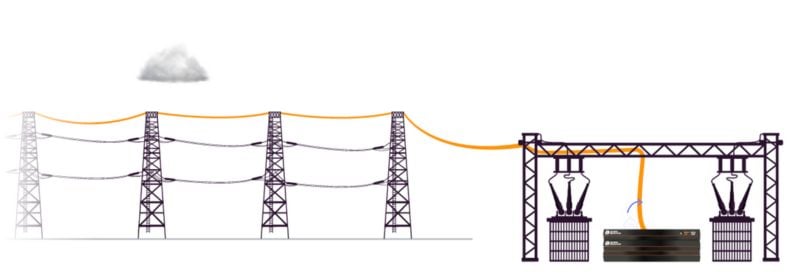
Optical fibers sending signals to substations. Image used courtesy of Prisma Photonics
Major environmental events, such as an elevated temperature change due to an incoming fire front, cause a deviation in the optical reflection. Machine learning algorithms analyze any incoming data from the optical fiber to pinpoint the location with a submeter resolution. Any reflection anomalies the algorithms pick up are sent to a control center with the nearest tower location. Transmission operators can quickly determine if a wildfire is nearby and check the grid’s status.
Beyond Wildfires
The fiber optic sensors developed to protect the grid are more functional solutions than existing early warning techniques, such as satellite imaging, aerial surveillance, and infrared imaging. These technologies have limitations in detecting wildfire threats in real-time. While there is an urgent need to protect against wildfires, the optical fiber sensing approach can also detect high winds, lightning strikes, icing, and vegetation that could down power lines. Optical sensors can also alert grid operators to vandalism, damage, or short-circuiting at any point along the transmission line.