Facebook
 Google
 GitHub
 Linkedin
Primary Distribution Systems—Part 2: Protective Devices, Automation
Protective devices, such as reclosers and sectionalizers, along with automation, can quickly detect, isolate, and restore service after faults.
Primary distribution systems must detect faults quickly, confine their impact to the smallest possible area, and restore service safely. Modern networks achieve this with a layered scheme of protective devices and automation, where automatic reclosers and sectionalizers act as field executors, and feeder automation systems provide coordination.
Devices and systems, such as FLISR in SCADA or ADMS, lead to measurable improvements in SAIDI, SAIF, and CAIDI.
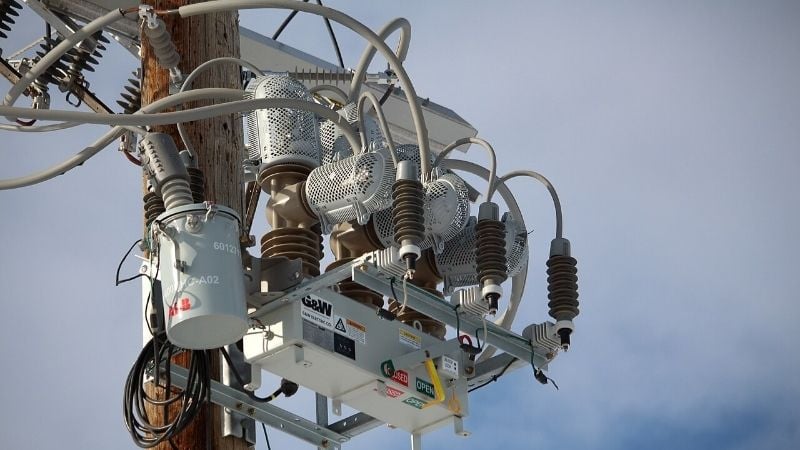
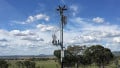
Pole-mounted recloser. Image used courtesy of Wikimedia Commons
Automatic Reclosers
An automatic recloser interrupts fault current, waits a preset “dead time,” and recloses to test whether the fault has cleared. Because a high share of distribution faults are transient—caused by lightning, vegetation contact, or wildlife—this strategy often restores service without human intervention. Utility reliability documents commonly list lightning and vegetation as the dominant drivers of distribution interruptions, with wildlife frequently cited as a leading cause of routine interruptions in many territories.
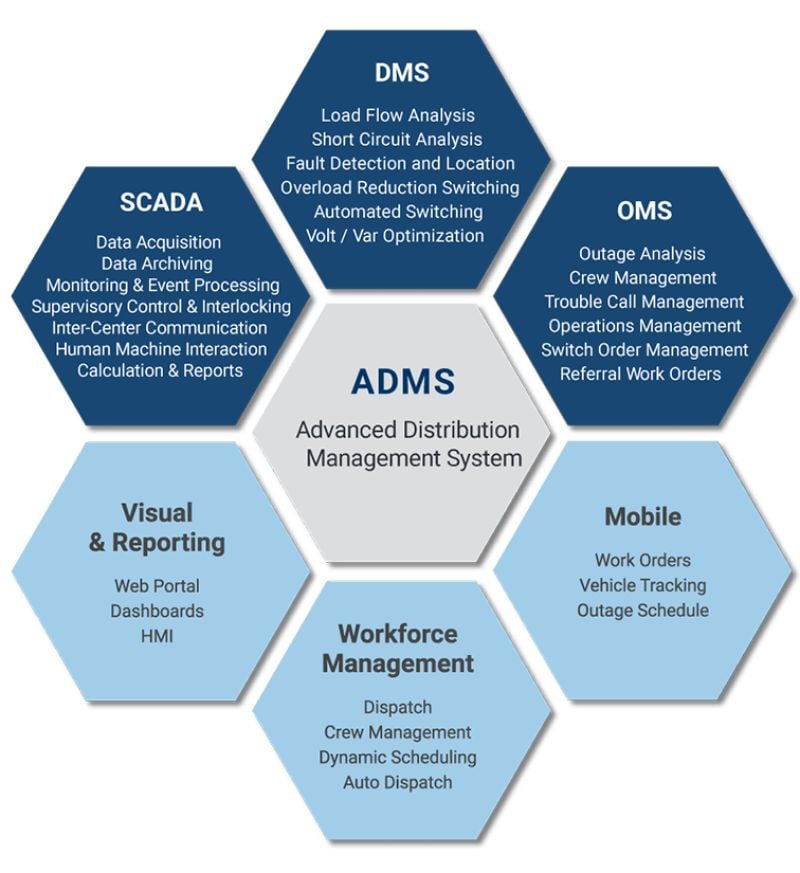
Figure 1. Advanced distribution management system. Image used courtesy of etap ADMS
Typical Fault Types in Distribution Systems
Lightning: Overhead primary lines are exposed to surges and flashover; reclosing enables rapid recovery after ionized air paths dissipate.
Tree contact: Wind or branch growth can create momentary contact; a successful reclose after branch bounce-back is common.
Wildlife: Squirrels and birds bridge energized hardware; targeted mitigations help, but animal contact remains a frequent contributor to outages for many utilities.
Reclosing Sequences and Timing
Contemporary recloser controls permit up to four reclose attempts before lockout. Sequence configuration typically mixes instantaneous (fast) and time-delayed elements—often two fast shots followed by one delayed—to clear transients quickly while allowing coordination for sustained faults. Dead times are independently programmable for each shot, and a reclaim time resets the sequence after a successful close.
Practical Settings: A common pattern is two instantaneous trips with short dead times, followed by one or two delayed operations with longer dead times to coordinate with downstream devices. If all attempts fail, the recloser enters lockout to avoid repetitive stress and to signal a likely permanent fault.
Sectionalizers
A sectionalizer does not interrupt fault current. Instead, it “counts” upstream protective device operations when fault current above a set threshold is followed by current going to zero (the upstream trip). During the next de-energized window (dead time), the sectionalizer opens, isolating its section without making or breaking heavy fault current. Features such as count restraint, voltage restraint, and inrush restraint prevent false counts during load swings or transformer energization.
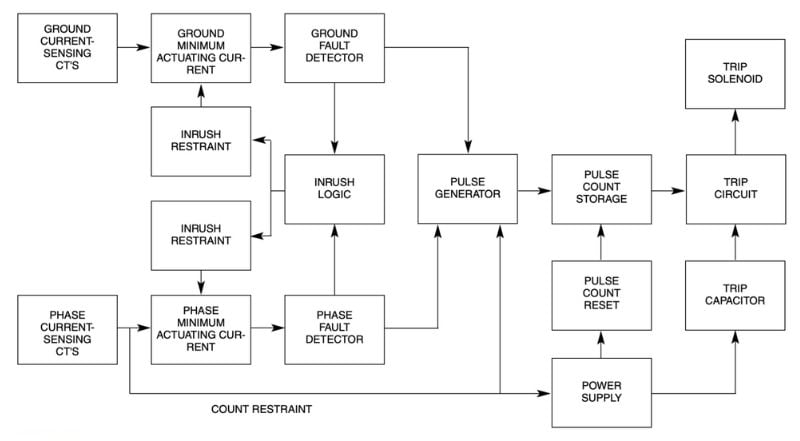
Figure 2. Sectionalizer functional block diagram. Image used courtesy of Eaton
Coordination With Upstream Reclosers
The sectionalizer count-to-open is set one less than the upstream recloser’s trips-to-lockout. For example, with a four-shot recloser, the downstream sectionalizer is typically set for three counts so it will open during the third dead time if the fault is on its load side. This ensures that the recloser regains service to the healthy portions while the sectionalizer isolates the faulted span.
If the fault is permanent on the sectionalized segment, the upstream recloser will trip repeatedly. The sectionalizer accumulates counts and opens on the next dead time, after which the recloser recloses successfully to energize the unfaulted network beyond the sectionalizer. If the fault is temporary, the sectionalizer’s count reset (after a programmed healthy-current interval) prevents an unnecessary open.
Feeder Automation Systems
Modern feeder automation blends field IEDs (reclosers, switches, fault indicators) with SCADA for real-time control and ADMS for optimization and advanced applications. DOE’s ADMS guidance defines ADMS as a platform that automates outage restoration and optimizes distribution performance, integrating functions such as FLISR, Volt/VAR optimization, and conservation voltage reduction with the utility’s operational model. Integration is nontrivial, but it enables central visibility and coordinated switching at scale.
Fault Location, Isolation, and Service Restoration (FLISR)
FLISR correlates protective operations, telemetry, and feeder topology to locate the likely faulted section, opens switches to isolate it, and restores service by backfeeding from adjacent healthy sources where capacity allows. Systems can operate autonomously or require operator validation, depending on policy and risk posture. DOE’s distribution automation documentation illustrates FLISR schematics and notes that deployments have restored customers in minutes by isolating faults and switching loads to alternate feeders.
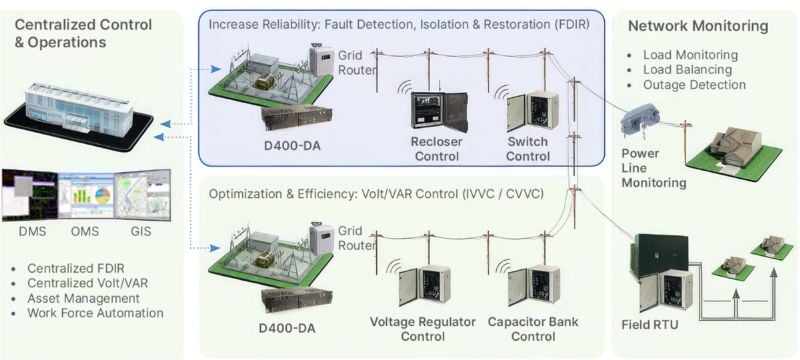
Figure 3. FLISR operations. Image used courtesy of GE Vernova
Where FLISR helps:
- SAIFI: Automated isolation reduces the number of customers experiencing sustained interruptions.
- SAIDI: Faster reconfiguration cuts total minutes interrupted across the served population.
- CAIDI: Shorter restoration time for interrupted users lowers the average duration per interruption.
DOE program results demonstrate meaningful reductions in interruptions and outage duration from feeder automation with AFS/FLISR.
Table 1: Core Reliability Indices
| Index | Definition | Formula |
| SAIFI | Average number of sustained interruptions per customer over a period | $$SAIFI = \frac{\text{Total number of customer interruptions}}{\text{Total number of customers served}}$$
|
| SAIDI | Average total duration of sustained interruptions per customer over a period | $$SAIDI = \frac{\text{Sum of all customer interruption durations}}{\text{Total number of customers served}}$$
|
| CAIDI | Average time required to restore service to interrupted customers. | $$CAIDI = \frac{SAIDI}{SAIFI}$$
|
Smart Reclosers
Modern recloser controls include Ethernet and serial communications with protocols such as DNP3 and Modbus, with optional IEC 61850 for substation-class messaging and data models. Features like Parallel Redundancy Protocol (PRP) and secure MACsec links are available on leading platforms, supporting deterministic, cyber-aware operation in distribution environments.
Commercial reclosers support simultaneous protocol stacks (such as DNP3 with IEC 61850/IEC 60870-5-104) and incorporate onboard wireless, GPS, and time synchronization to fit into diverse field communications architectures.
Typical functions available remotely include shot-counter status, last-trip cause, sequence state (“in progress” vs. lockout), measured currents/voltages, event reports, and setting-group changes. Remote close/open and profile switching—from multi-shot to single-shot during live-line work or during abnormal system states—are common operational practices supported by modern controls and enterprise SCADA.
Integration with Modern Distribution Management Systems
In an ADMS context, smart reclosers become controllable nodes in FLISR, Volt/VAR optimization, and topology processing. ADMS implementations integrate D‑SCADA, OMS, and advanced apps on a common as-operated network model, which enables automated switching plans and systematic restoration. DOE ADMS guidance highlights both the potential and the integration complexity, emphasizing cross-team governance and IT (Information Technology)/OT (Operational Technology) alignment for sustained success.
Implementation Considerations
Coordination details matter:
- Select recloser curves and time delays to maintain grading margins.
- Verify that the sectionalizer’s minimum actuating current exceeds the maximum load current and remains below the upstream device’s pickup.
- Confirm the sectionalizer count-to-open relative to the upstream lockout shots.
- Validate count/voltage/inrush restraint features to avoid nuisance operations. Manufacturer manuals and coordination guides provide test methods and tolerances for these settings.
Data feedback loop: With AMI last-gasp, feeder sensors, and IED event reports flowing into ADMS, operations teams can refine reclose dead times, shot counts, and sectionalizer counts based on actual fault statistics by feeder—gradually reducing SAIFI and SAIDI while keeping CAIDI controlled.
Conclusion
Field devices and feeder automation share a single objective: minimize the scope and duration of interruptions while preserving safety and equipment health.
Automatic reclosers handle the first line of defense against transient faults through configurable shot sequences and timing. Sectionalizers, set to coordinate one count below the upstream recloser’s lockout, isolate permanent faults without interrupting heavy current.
When these devices are connected and supervised via SCADA and coordinated by ADMS applications like FLISR, the system can locate, isolate, and restore within minutes on many events—an outcome reflected in improvements to SAIFI, SAIDI, and CAIDI documented by DOE and reported consistently in EIA reliability statistics. The engineering challenge lies in translating feeder topology, fault data, and communications capabilities into precise device settings and automation logic that keep power flowing to the maximum number of customers under normal operations and severe weather conditions.