Facebook
 Google
 GitHub
 Linkedin
Fighting AI With AI: Can It Fix the Grid Strain It Creates?
Artificial intelligence puts an unprecedented load on the power grid. Can AI remedy the problems it creates?
Electric vehicles are poised to hit a growth stride that will permanently transform daily utility grid loads as vehicle charging occurs at home overnight. Additionally, artificial intelligence has created an astounding data demand, taxing the power grid. Despite the challenges, equally bold AI solutions exist to mitigate increased demand and maximize existing infrastructure.
Engineers at the University of Texas Dallas and the University of Buffalo are developing an algorithm to replace the human element in power distribution and avoid outages. The algorithm first anticipates problems with machine learning and then rapidly reroutes power in milliseconds. With that level of precision, the grid can maximize its current capacity and successfully face the load challenges on the horizon.
AI grid coding illustration. Image adapted from Canva and Adobe Stock
EV Boom and AI Growth
EVs once seemed like a modern fantasy, but rapid technological development and government-imposed clean energy mandates are speeding their adoption, turning this fantasy into a new norm. At the same time, large language models and other AI tools have outpaced virtually all adoption trends in recent memory. These developments would be significant for the power grid, but together, they represent a distinctly modern and daunting energy challenge the power grid must face.
Data centers have had to expand rapidly to accommodate AI demand, with roughly $500 billion invested to support this growth. The average household needs about 29 kWh to function daily. ChatGPT now uses over 500,000 kWh every single day to operate. That figure accounts for only one popular AI form being rapidly integrated into myriad technology systems, including web browsers, research databases, and countless other applications.
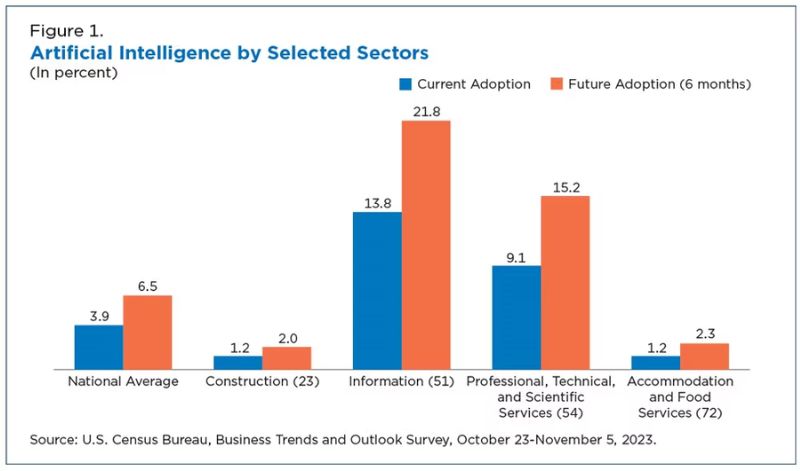
AI adoption and projected growth by sector. Image used courtesy of Census Bureau
In addition to AI’s impact on the grid, EVs will compound grid load in the coming years.
Given AI data loads, EV power demand, and other projected power needs, experts estimate that U.S. electricity demand will grow 4.7% over the next five years, surpassing the previous projection. Increases in energy demand can lead to power outages. The grid will need solutions to accommodate such growth, and AI will be a key tool for managing this challenge.
How AI Grid Automation Can Manage Heavy Load Risks
A collaboration between the University of Buffalo researchers and University of Texas at Dallas engineers demonstrates a way to mitigate outage risks using AI.
Scientists developed algorithms focusing on anticipation and prediction. Since AI can efficiently anticipate demand bottlenecks and the resulting outages, the researchers trained the system to reroute electricity around the bottleneck.
Typically, human personnel would be needed for this task, which might take a few minutes to a few hours. This delay time can be dangerous, costly, and conducive to other harmful failures like cutting power to critical medical equipment.
The researchers created a graph reinforcement learning model that can anticipate outages and take action to eliminate them in milliseconds. They vetted the model using the 13, 34, and 123-bus modified IEEE networks to ensure its performance indicates real-time conditions.
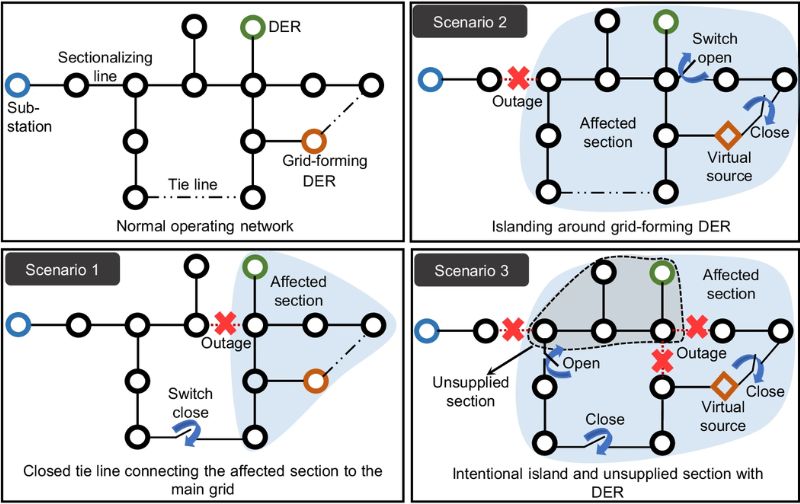
Model showing how the algorithm can reroute power. Image used courtesy of the authors
While scaling concerns remain, these robust results suggest the model can manage various outage scenarios. The model exhibited noteworthy improvements in resilience. The documented loss of energy improvement was 607.45 kWs and 596.52 kWs for 13 and 34 buses, respectively.
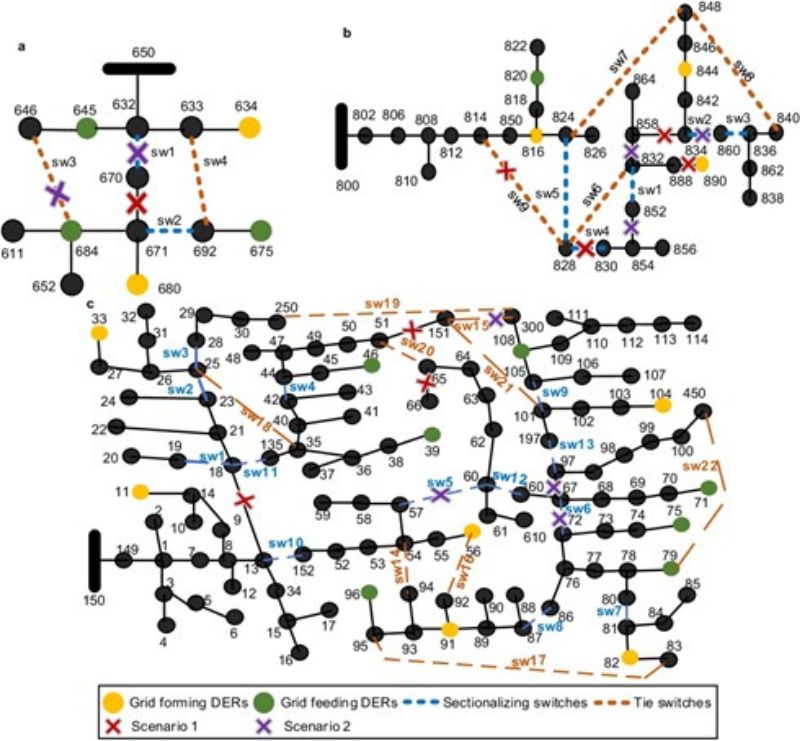
The test networks used to validate the model. Image used courtesy of the authors
Even though AI data loads, the EV boom, and other renewable sectors present new obstacles for grid management, this research collaboration and its promising results show that AI could solve some problems it creates.