Facebook
 Google
 GitHub
 Linkedin
Are AI Data Centers Putting Net-Zero Goals Out of Reach?
AI data centers are on track to increase carbon emissions as much as 20%. A Cornell University report proposes ways to slow the trend.
With the ubiquity of artificial intelligence woven into daily life, it’s becoming harder to remember a time when we didn’t have so much information and assistance at our fingertips. The rapid expansion has sent ripple effects through industries and the global economy, while also raising serious questions about its long-term environmental impact. Although scientists have long understood that AI’s growth would increase energy and water consumption, the scale of that impact has been difficult to quantify.
Over the last three years, Fengqi You, Professor in Energy Systems Engineering at Cornell Engineering, led a research team to answer the question: “Given the magnitude of the AI computing boom, what environmental trajectory will it take? And more importantly, what choices steer it toward sustainability?”
Their state-by-state analysis found that, by 2030, AI’s current growth rate could emit 24 to 44 million metric tons of carbon dioxide annually. This cumulative effect, without complementary emissions reduction strategies, would place net-zero emissions targets well out of reach.
AI data centers consume tremendous amounts of energy. Image used courtesy of Adobe Stock
Understanding AI’s Resource Drain
Remember when OpenAI CEO, Sam Altman, admitted that adding “please” and “thank you” to ChatGPT responses costs him millions of dollars because of the associated electricity usage? AI and data centers are energy-intensive because they combine high-powered hardware, constant operation, and significant cooling needs with the explosive growth of computational workloads. The systems that make our digital lives seamless and instant come with substantial behind-the-scenes energy requirements.
According to the 2024 United States Data Center Energy Usage Report, data centers consumed 4.4% of total U.S. electricity in 2023. By 2028, that share is projected to rise to between 6.7 and 12%. To put this growth into perspective, the report stated that the anticipated 24 to 44 million metric tons of carbon dioxide is equivalent to adding 5 to 10 million cars to the road. AI-driven demand is also expected to draw 731 to 1,125 million cubic meters of water annually, roughly the same amount of water used by 6 to 10 million American households each year.
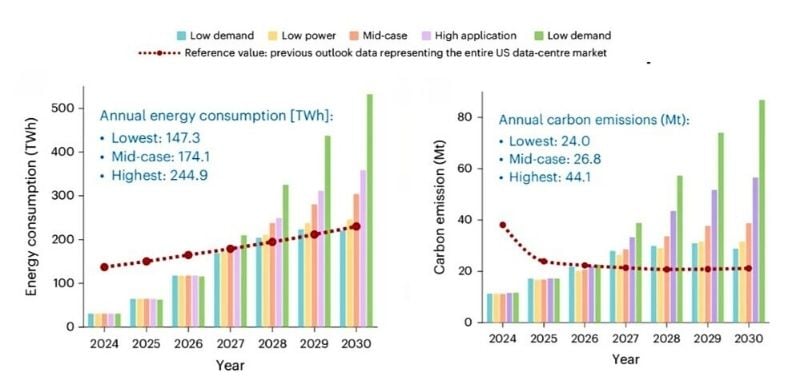
Energy consumption and carbon emissions of AI servers from 2024 to 2030 under different scenarios. Image used courtesy of Xiao et al
Energy Consumption and Emissions
In 2015, nearly every country in the world adopted the Paris Agreement, a global treaty aimed at limiting climate change. This milestone followed the Intergovernmental Panel on Climate Change’s (IPCC) Fifth Assessment Report (2014), which confirmed that Earth’s warming is unequivocal. The report documented sharp increases in atmospheric carbon dioxide, methane, and nitrous oxide, warning that continued warming without strong mitigation would greatly heighten the risk of severe and potentially irreversible impacts.
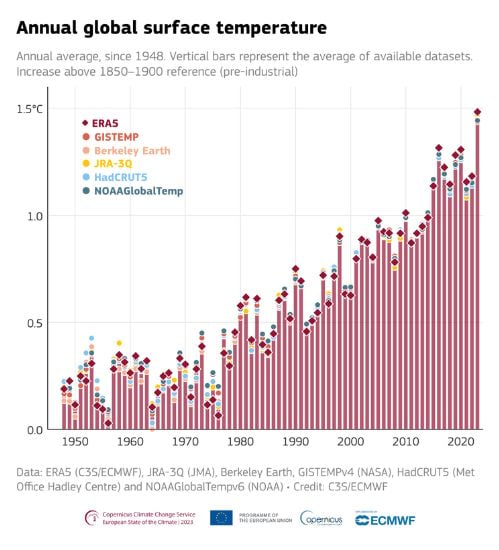
Annual global surface temperature increase, compared to the 1850-1900 average, between 1948 and 2023, as reported by six separate scientific datasets. Image used courtesy of Copernicus
The Paris Agreement committed nations to limiting global warming to “well below” 2°C, while pursuing efforts to limit warming to 1.5°C. It also set global targets of a 45% reduction in emissions by 2030 and net-zero emissions by 2050.
In recent years, temperatures have exceeded both thresholds at times. Between July 2023 and June 2024, the Earth’s average temperature reached or surpassed 1.5°C every month.
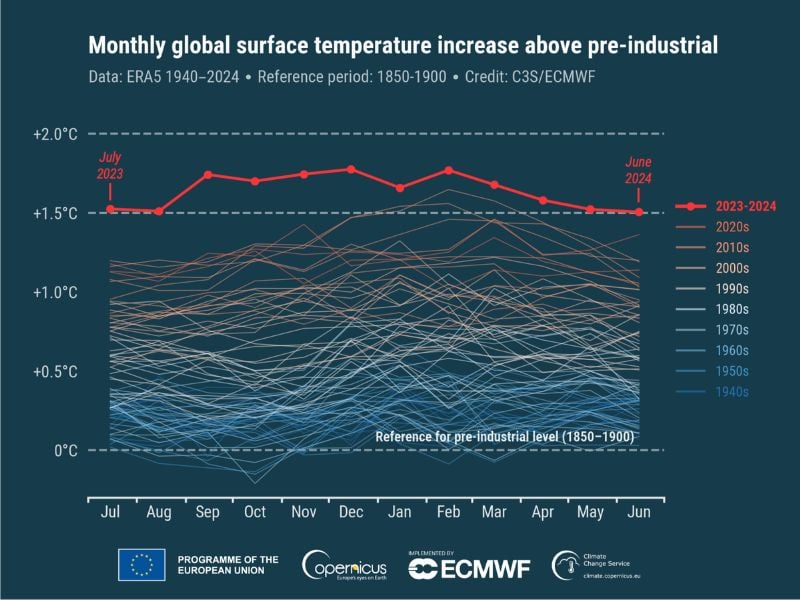
Monthly global surface air temperature increase compared to the 1850-1900 average, from January 1940 to June 2024. Image used courtesy of Copernicus
If warming continues at its current pace, scientists expect the 1.5°C threshold will be permanently breached in the early 2030s. The IPCC finds that global impacts worsen significantly at 2°C compared with 1.5°C. Human health risks increase, biodiversity declines accelerate, and socioeconomic damages intensify. Even at 1.5°C, ocean ecosystems face severe stress, with most tropical coral reefs projected to disappear. At 2°C, far more species lose over half of their livable range.
Together, these findings underscore the urgency of limiting warming to 1.5°C through strong, sustained emissions-reduction policies.
Roadmap to Net Zero
You’s research team examined three actions that can influence the total carbon emissions of expanding AI infrastructure for U.S. data centers: energy efficiencies, location, and grid greening.
Energy Efficiencies
Over the past decade, data centers have adopted a range of infrastructure and operational efficiency improvements to help temper the environmental impacts of rapid expansion. Broader analyses of these strategies indicate that, under best-practice conditions, facilities have the potential to achieve more than a 7% reduction in power usage effectiveness (PUE), meaning a greater share of their total energy is directed to actual computing rather than overhead systems like cooling and power distribution. PUE reduction demonstrates a 7% reduction in total energy consumption and carbon emissions.
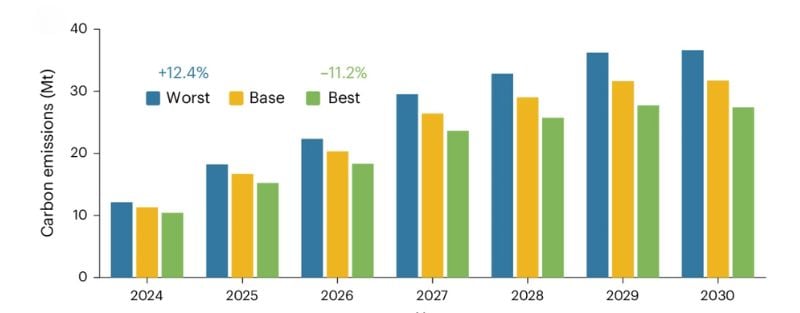
AI server carbon emissions following mid-case scenario through the worst, base, and best practices of industry efforts. Image used courtesy of Xiao et al.
Facilities could additionally adopt advanced liquid cooling (ALC) and server utilization optimization (SUO) strategies for further efficiency improvements.
- Best-case PUE reductions: 7% energy reduction + carbon reduction
- Best-case ALC reduction: 1.7% energy reduction, 1.6% carbon reduction
- Best-case SUO reduction: 5.5% energy + carbon reduction
- Maximum potential reductions: 12% energy reduction, 11% carbon reduction
Location
The site selection of data centers and AI servers greatly shapes their resource use and carbon emissions. This has a greater impact on water usage than energy because it considers already water-scarce states and hydropower use, which has a high water footprint from evaporation, even if carbon emissions drop.
In this analysis, Texas, Montana, Nebraska, and South Dakota emerge as optimal candidates because they have strong renewable energy potential and face fewer water scarcity challenges.

Carbon emissions per unit server energy and renewable energy potential by state. Image used courtesy of Xiao et al
Renewable Energy Grid Penetration
The researchers assessed future grid development under the Low Renewable Energy Cost (LRC) as the best-case and the High Renewable Energy Cost as the worst-case scenarios. These scenarios are predefined Regional Energy Deployment System (ReEDS) model cases and bracket the highest versus the lowest levels of renewable penetration.
The grid decarbonization pattern strongly influences AI server environmental impacts at both the national and state levels. Ambitious state-level electricity policies could significantly reduce these impacts and amplify the benefits seen in the LRC scenario. Wind and solar help reduce both carbon emissions and water consumption, while hydropower can reduce carbon but worsen water scarcity due to evaporation.
- HRC scenario: 20% carbon increase
- LRC scenario: Over 15% carbon decrease
_and_worst_(HRC)_scenarios.jpg)
The changes in AI server carbon and water footprints of each state under the best (LRC) and worst (HRC) scenarios. Image used courtesy of Xiao et al.
Data Center Conclusions
Ultimately, the researchers determined that deploying an array of efficiency technologies, making strategic siting decisions, and accelerating grid decarbonization could achieve carbon reductions of up to 73%. They note, however, that public health considerations, existing grid congestion, and other local factors may constrain the strategies’ effectiveness.
At the same time, companies like OpenAI and Google continue to invest heavily in AI data center expansion to keep pace with rising demand. The infrastructure choices made today will shape the scale of AI’s environmental impact tomorrow. This moment presents a critical opportunity to rethink how we plan, build, and power digital infrastructure for a more sustainable future.