Facebook
 Google
 GitHub
 Linkedin
Rethinking Data Center Liquid Cooling
University of Missouri researchers are working on a next-gen energy-efficient heat management system for data centers.
Artificial intelligence models require massive computational power, and data centers are now more densely packed with high-performance servers and GPUs. This development has led to more innovative and efficient cooling technologies. Liquid cooling, for instance, has been gaining traction as it offers better heat dissipation than traditional air cooling. Immersion cooling, where hardware is submerged in a thermally conductive liquid, is also gaining attention for its ability to handle higher heat loads with lower energy consumption.
Take a tour of a Deft data center to see the cooling technology and much more. Video used courtesy of Lawrence Systems
As AI data centers continue pushing the boundaries of computational power, the demand for innovative cooling solutions will continue to grow. Researchers at the University of Missouri are developing a breakthrough cooling technology using phase change to reduce the energy requirements of data centers.
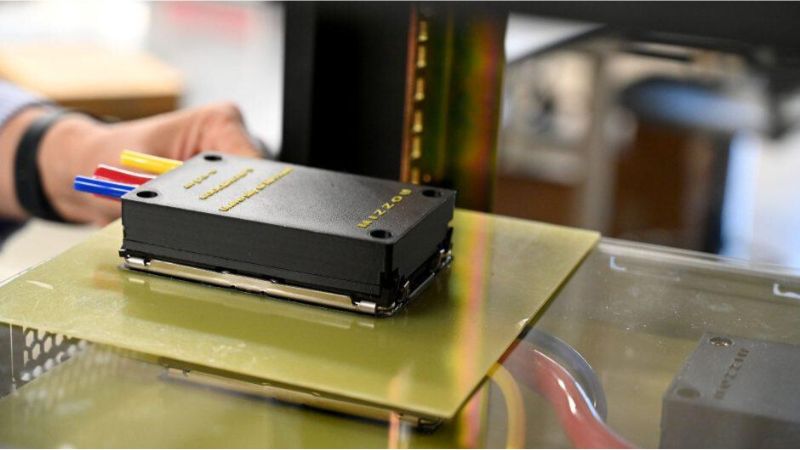
Cooling system from Park and his team. Image Courtesy of University of Missouri
The Cooling Solution Landscape in AI Data Centers
Cooling is essential for AI data centers because the processors and other components create immense heat. Poor or no heat management can lead to hardware failure, decreased performance, or even system shutdowns. AI workloads are particularly demanding on servers, pushing them to operate at peak capacity for extended periods. This continuous operation causes heat buildup. Components can degrade faster if the temperature rises too high, shortening their lifespan and leading to costly replacements and repairs.
Energy consumption for cooling systems is an essential consideration. Cooling uses up to 40% of a data center’s total energy use. With AI applications, this figure can escalate higher. As data centers aim to become more sustainable, balancing energy usage and reliable operation is crucial. While air cooling systems are popular, they are often inefficient at cooling dense racks of hardware, requiring more energy. Liquid and immersion systems have emerged as more energy-efficient alternatives. However, they still need optimization to reduce overall consumption.
Heat Management Through Phase Change
To mitigate the problem of power-hungry data centers, the U.S. Department of Energy has awarded more than $40 million to researchers to develop new cooling solutions for servers. Chanwoo Park, a mechanical and aerospace engineering professor at the Mizzou College of Engineering, and his team recently received around $1.65 million for their initiative. They are designing a two-phase cooling system using phase change to manage the heat generated by server chips.
When a liquid boils, it absorbs significant heat and transforms into vapor. In Park's system, a special liquid is applied in a thin, porous layer on the server chips. As the chips heat up during operation, this liquid begins to boil, turning into vapor and effectively whisking away the excess heat. Park said the technique could achieve efficient heat transfer with low thermal resistance using this boiling surface. The system also includes a mechanical pump that can be activated only when more heat needs to be absorbed.
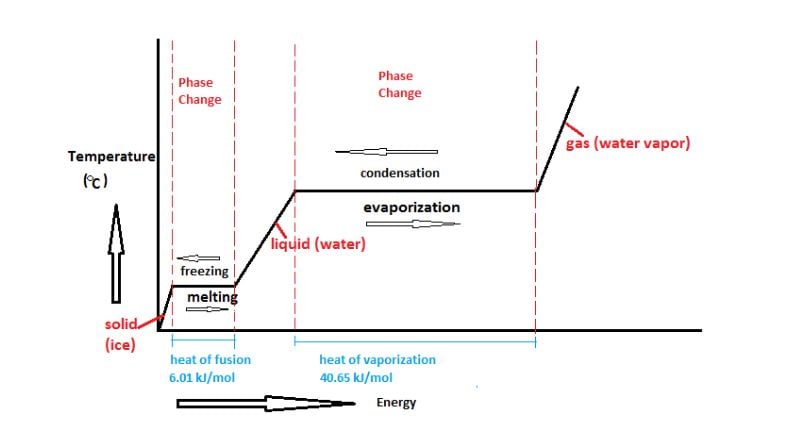
Basics of phase change. Image used courtesy of Wikimedia Commons
Initial tests show the cooling technique significantly reduces the energy needed to keep the servers cool. The team is now designing the cooling system to facilitate simple connection and disconnection within server racks. The researchers hope the new cooling technique will be helpful for the next generation of AI computing.