Facebook
 Google
 GitHub
 Linkedin
AI-Driven Battery Intelligence for UAVs
This article outlines the V.nod digital twin for UAVs: a battery-centric workflow using hardware-coupled emulation and AI. It validates batteries against real mission profiles.
Article co-authored by Logiicdev’s Marina Delilovic and Younesse Idmalek.
This article is published by EEPower as part of an exclusive digital content partnership with Bodo’s Power Systems.
UAV digital twins reduce flight-test cost and accelerate design, but many remain weak where missions most often fail: the battery and power system. This article presents a battery-centric workflow in which new packs are validated through charge-discharge cycling, mission-profile replay, and hardware-coupled emulation. The resulting data feeds AI models for state-of-charge, state-of-health, and mission-readiness prediction. Deployed on a distributed edge-cloud architecture, the twin becomes a qualification and decision support tool for mission-critical operations.
The Missing Part of Many UAV Digital Twins
Digital twins are now common in UAV development. They help engineers simulate aerodynamics, test control logic, compare mission plans, and reduce risky field trials. Yet a drone that looks safe in simulation can still fail in the air if the model treats the battery as an ideal energy block instead of a stressed electrochemical system.
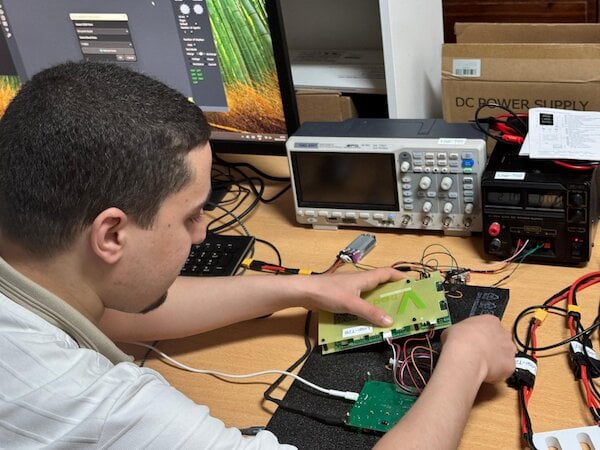
Image used courtesy of Bodo’s Power Systems [PDF]
For mission-critical UAVs, the power system is not a background component. It is the constraint that decides endurance, payload margin, return-to-home safety, and emergency reserve. Research on electric UAV battery health has shown that usable energy depends not only on initial state of charge, but also on battery health, discharge profile, and flight regime [1]. In practical terms, take-off, cruise, payload operation, and landing are different electrical events. A credible twin must know the difference.
This is the central argument of this article: a UAV digital twin becomes an engineering tool only when its battery model is validated against real hardware, real mission loads, and real degradation behavior.
Why the Battery Is the Credibility Test
Battery behavior in UAVs is nonlinear. A pack can deliver acceptable energy in a slow laboratory discharge yet become risky in a high-current mission: fast current transients cause voltage sag and thermal stress, and aging compounds this as capacity fades and internal resistance rises.
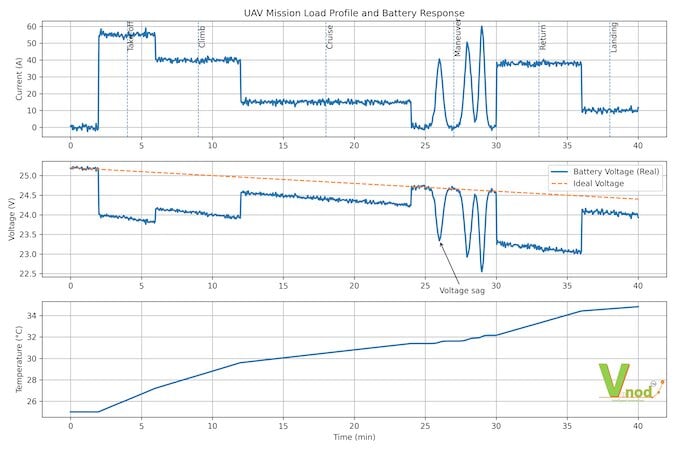
Figure 1. Mission load profile and corresponding battery response under realistic UAV conditions. Image used courtesy of Bodo’s Power Systems [PDF]
Supplier variation adds another layer of risk. Two packs can share the same label, chemistry, nominal capacity, and C-rating but behave differently under the drone's real load. This matters for defense, rescue, inspection, transport, and other applications where a forced landing is not just a failed test; it can mean loss of mission, loss of asset, or danger to people.
The practical result is simple: battery trust cannot be imported from a datasheet. It must be earned through validation.
Mission-Profile Replay Instead of Static Testing
Constant-current tests establish a baseline but do not represent real flights, which mix idle time, take-off peaks, climb demand, payload activity, wind correction, return-to-home reserves, and landing. A pack that passes a static test may still fail when these events appear in sequence.
Mission-profile replay closes this gap. The real or expected drone load is recorded, transformed into a repeatable test profile, and applied to the battery under controlled conditions. This allows the operator to compare packs, detect weak cells, estimate voltage reserve, and decide whether a battery is approved for a specific mission class.
Recent research validates discharge models under variable power loads in reproducible scenarios [5]. For V.nod™, the validation bench asks not only how much energy a pack stores, but whether it can survive the mission it is expected to fly.
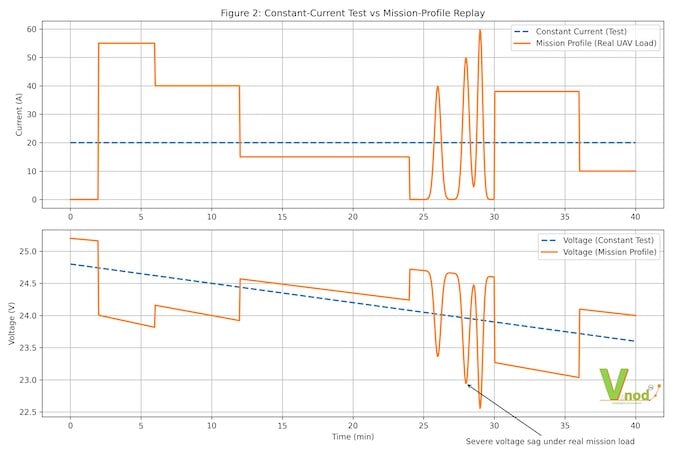
Figure 2. Comparison between constant-current testing and realistic mission-profile replay. Image used courtesy of Bodo’s Power Systems [PDF]
Battery Validation for New or Unknown Suppliers
A useful digital twin must also answer a business and operational question: can a new battery supplier be trusted? When a new pack enters the system, V.nod assigns it an identity, records its electrical behavior, and exposes it to repeated charge-discharge and mission-replay cycles before operational use.
The aim is not to test forever. The aim is to create a clear approval gate. If the new pack behaves within validated limits, the existing model can be reused or lightly updated. If the rating, chemistry, thermal behavior, voltage sag, or degradation pattern changes, the battery must trigger a new validation cycle and a new model version.
This approach turns supplier onboarding into an engineering process instead of a guess. It also creates traceability: every approved battery has a history, a model, and a mission envelope.
Hardware-Coupled Emulation: Where the Twin Meets the Drone
Simulation alone cannot prove that the UAV electronics will react correctly to a stressed battery. Hardware-in-the-loop and power-hardware-in-the-loop methods solve this by connecting real hardware to a real-time model. Battery-emulator research shows that this approach can make power-electronics testing faster, more reproducible, and less dependent on physically swapping battery packs [4].
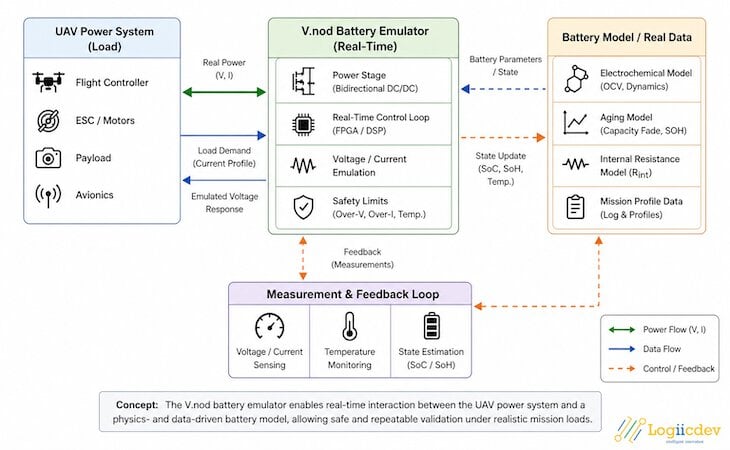
Figure 3. Hardware-in-the-loop battery emulation enabling safe and repeatable UAV validation. Image used courtesy of Bodo’s Power Systems [PDF]
In the V.nod workflow, the emulator can replace the physical battery during selected tests while reproducing the voltage-current behavior learned from validated packs. The flight controller, power distribution board, ESCs, motors, and payload electronics then experience realistic power conditions without requiring a dangerous flight test.
This is the moment when the digital twin becomes cyber-physical. It is not only predicting the battery. It is driving hardware with battery behavior.
AI-Driven Battery Intelligence
AI is useful here because battery risk is not a single number. Mission readiness depends on the state of charge, state of health, temperature, internal resistance, recent usage, cell imbalance, load profile, and expected reserve. Machine-learning BMS work for UAVs has demonstrated the use of current, voltage, and temperature data to predict SoC and estimate SoH, including practical deployment with drone hardware, embedded devices, gateways, and cloud services [2].
The role of AI in V.nod should therefore be framed carefully. It is not a black box replacing engineering judgment. It is a decision layer trained on validated hardware data. At the edge, it supports fast safety decisions: stop charging, limit discharge, flag a weak pack, or block a mission. In the cloud, it supports slower learning: fleet trends, supplier comparison, degradation models, and model version control.
A strong rule is needed: AI models may be reused only inside their validated envelope. When a supplier, rating, chemistry, or mission load changes beyond that envelope, the system must request new validation data.
Distributed Edge–Cloud Architecture
The proposed architecture separates real-time responsibility from long-term learning. The edge layer sits close to the hardware. It performs measurement, safety checks, battery emulation, charging and discharging control, and mission-profile replay. It must remain fast, deterministic, and safe even without cloud connectivity.
The cloud layer is the memory of the fleet. It collects anonymized battery histories, compares suppliers, trains and validates models, stores model versions, and produces qualification evidence. Battery digital-twin research in other electric-mobility domains also emphasizes the value of connected data pipelines for state estimation and decision support [3].
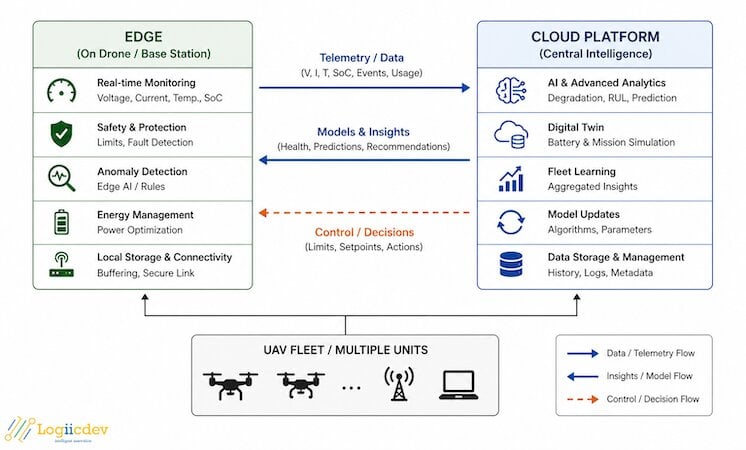
Figure 4. Distributed edge–cloud architecture combining real-time safety with fleet-level intelligence. Image used courtesy of Bodo’s Power Systems [PDF]
Standards Alignment
The V.nod architecture is designed in alignment with relevant international standards for AI systems and digital twins:
- EN ISO/IEC 23053:2023 — Framework for AI systems using ML, applied to V.nod's SoC, SoH, and anomaly-detection components.
- EN ISO/IEC 25059:2024 (and the upcoming prEN ISO/IEC 25059) — Quality model for AI systems, guiding accuracy, robustness, and explainability criteria.
- ISO/IEC 42001:2023 — AI management system, informing model lifecycle governance, validation gates, and version control.
- ISO 23247 — Digital Twin Framework for Manufacturing, whose layered reference architecture is reflected in the edge–cloud structure above.
Together, they position V.nod for future qualification, audit, and certification.
What Changes for UAV Engineering Teams
This battery-centric approach changes the role of the digital twin. Instead of being a visual or mathematical copy of the UAV, it becomes a qualification workflow. It can answer practical questions: Is this battery safe for this mission? Can this supplier be trusted? How much reserve is left under today's load profile? Has the pack aged beyond its approved envelope?
It also reduces repetition in testing. Engineers do not need to discover the same failure mode in flight. They can replay it, emulate it, and qualify against it before the mission. For defense and emergency operations, this is the difference between a useful simulation and a mission-assurance tool.
Conclusion: From Simulation to Qualification
UAV digital twins become credible only when they include the subsystem that most directly limits endurance and mission safety — the battery. Validation, mission-profile replay, hardware-coupled emulation, and AI-based analytics turn the twin from a simulation aid into a tool that verifies whether the UAV has the power-system capability to fly its mission.
Logiicdev is now scaling V.nod from prototype to qualified product and is actively seeking investors and industrial partners across the DACH region to accelerate this stage. We welcome conversations with stakeholders in defense, public safety, and industrial UAV operations who share our focus on mission-critical power-system reliability.
References
[1] B. Saha et al., “Battery Health Management System for Electric UAVs,” IEEE Aerospace Conf., 2011, doi: 10.1109/ AERO.2011.5747587.
[2] M. M. Shibl et al., “ML-based BMS for SoC and SoH estimation in UAVs,” J. Energy Storage, vol. 66, 107380, 2023, doi: 10.1016/j.est.2023.107380.
[3] R. Issa et al., “Data-Driven Digital Twin of EV Li-Ion Battery SoC Estimation,” Batteries, vol. 9, no. 10, 521, 2023, doi: 10.3390/ batteries9100521.
[4] C. Seitl, “Battery Emulator for Power Hardware-in-the-Loop Simulations,” TU Wien, 2014.
[5] A. Di Nisio et al., “Battery Testing and Discharge Model Validation for Electric UAVs,” Sensors, vol. 23, no. 15, 6937, 2023, doi: 10.3390/s23156937.
This article originally appeared in Bodo’s Power Systems [PDF] magazine and is co-authored by Deepak V Katkoria, Marina Delilovic, Younesse Idmalek, Logiicdev GmbH
Related Content