Facebook
 Google
 GitHub
 Linkedin
Goodbye Lithium Limits? World’s First Anode-Free Sodium Battery
The anode-free battery uses an aluminum powder electrolyte and an innovative structure for potentially cheaper and lighter electric vehicles.
Renewable energy and electric vehicle growth are prompting the development of advanced batteries that can hold more charge and are lighter in weight. With finite lithium resources, scientists are seeking more abundant battery materials.
Sodium has emerged as a promising battery material. Since sodium is less expensive and more abundant than lithium, these batteries are cheaper and more environmentally friendly to produce than lithium batteries. Additionally, sodium can theoretically provide a higher energy density than lithium. However, commercializing traditional sodium batteries has been a challenge. One creative solution might be to make a battery without an anode.
University of California, San Diego, and University of Chicago researchers have created the world’s first anode-free, sodium all-solid-state battery for the EV and grid storage sectors. The research was published in Nature Energy.
Sodiation and desodiation process captured with 3D imagery. Video used courtesy of ScienceVio
What Is an Anode-Free Battery?
Anode-free battery architectures only have one electrode—a metal-rich cathode, which, in this case, is made from sodium. The cathode is attached to a metal current collector. There is no physical anode.
When the battery is charged, the metal ions travel from the cathode and deposit directly onto the current collector. The current collector then acts as a temporary anode and enables the battery to discharge similarly—electrochemically speaking—to a metal-ion battery.
Anode-free battery architectures have high specific energies, cell voltages, energy densities, and less architectural complexity. They weigh and cost less.
Removing the anode is beneficial because it’s the source of many technical challenges in sodium-based batteries.
Overcoming Anode Challenges within Sodium Batteries
Sodium batteries have a high theoretical energy density, but many challenges remain with their performance, particularly their rate performance, Coulombic efficiency, and cycling stability.
The issues all stem from the anode. Sodium has an atomic radius larger than lithium, which causes slower reaction kinetics when the sodium ions enter and leave the anode (the sodiation and desodiation processes).
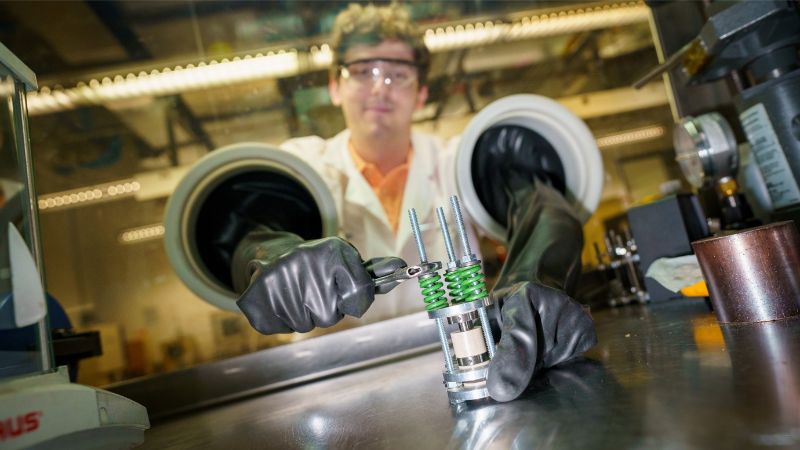
Researcher Grayson Deysher with experimental battery. Image used courtesy of University of Chicago/David Baillot (UC San Diego)
Removing the anode from the battery removes these intercalation challenges. While sodium, solid-state, and anode-free batteries have all been made independently, they have not been combined in one architecture until now.
Sodium Anode-Free Battery Features
University of Chicago and UC San Diego researchers created an anode-free sodium all-solid-state battery with stable cycling over several hundred cycles.
To create an all-solid-state battery with a complete interfacial connection between the electrolyte and current collector, the researchers developed a current collector that surrounds the electrolyte. In the conventional structure, the electrolyte covers the current collector.
The researchers used an aluminum powder that can flow like a liquid to create the current collector. Once the powder was deposited and covered the electrolyte during battery assembly, it was densified under high pressure. The densification process created a solid current collector that maintained a liquid-like and intimate contact with the electrolyte.
The aluminum current collector also facilitated efficient solid-to-solid contact with the electrolyte, enabling highly reversible sodium plating and stripping at high current densities and areal capacities.
The architecture uses sodium's higher energy density without its traditional setbacks. As the technology matures, battery designers could theoretically achieve energy densities higher than lithium batteries.
Anode-free batteries require good interfacial contact between the electrolyte and the current collector. This is easy with liquid electrolytes because the liquid can flow across the entire interface. However, liquid electrolytes create a build-up over time, known as a solid electrolyte interphase, that reduces the battery’s efficiency. Yet, traditional solid-state electrolytes cannot achieve interfacial coverage comparable to liquid electrolytes.
A More Sustainable Option
Lithium used in batteries today is only found in about 20 parts per million in the Earth’s crust. In comparison, sodium makes up 20,000 parts per million, making it a much more sustainable option for the increasing battery demands of modern-day society.
Lithium deposits are also highly concentrated in specific regions of the world. The “lithium triangle” of Chile, Argentina, and Bolivia possesses more than 75% of the world’s lithium supply, with other key deposits located in North Carolina, Nevada, and Australia. Resources with supply chains constrained to select worldwide regions are always at risk if geopolitical tensions arise.
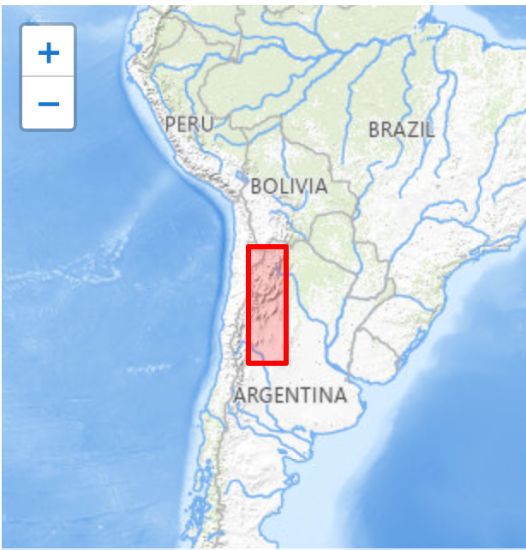
“Lithium triangle” in South America. Image used courtesy of U.S. Geological Survey
Lithium mining also damages the environment because mining methods use harsh acids to break up ores, and brine extraction methods pump massive amounts of water to the surface to dry.
In contrast, sodium is commonly found in oceans and soda ash mining, making it less prone to regional monopolization. Its extraction methods are more environmentally friendly, offering a more sustainable option for large-scale battery manufacturing.
Anode-Free Battery Targets EVs and Grid Storage
This sodium anode-free battery is designed for EVs and grid storage. It could create more efficient, cheaper, and lighter batteries, making EVs more environmentally friendly, affordable, and efficient.
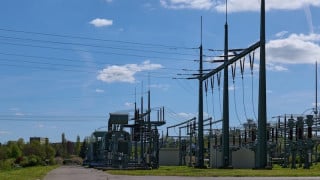
For grid storage, batteries will spearhead efforts to develop distributed energy resources. The U.S. requires one terawatt of energy per hour to keep the grid running. As decarbonization efforts increase, several hundred terawatt hours of batteries will be required. Since more batteries are needed quickly, a cheap and abundant material like sodium is attractive.