Facebook
 Google
 GitHub
 Linkedin
3D Power-Free Device Heats and Cools Buildings With Sunlight
Researchers have developed a passive device modeled after traditional Asian architecture that regulates building temperatures using a shape-memory alloy and radiative materials.
Researchers have developed a passive device that regulates building temperatures using a shape-memory alloy and radiative materials.
Buildings use nearly one-third of global energy, most tied to indoor temperature control. South Korean researchers set out to build a year-round solution that needs no wiring, sensors, or power. They developed a non-powered 3D device that can switch between cooling and heating simply by reacting to sunlight and temperature.
The design opens or closes its structure on its own, exposing surfaces that either release heat or absorb it, depending on the season. Outdoor tests in South Korea and climate simulations across fifteen regions show that the device can operate on roofs or walls, transition between modes at practical temperatures, and reduce heating and cooling demands in a range of environments.
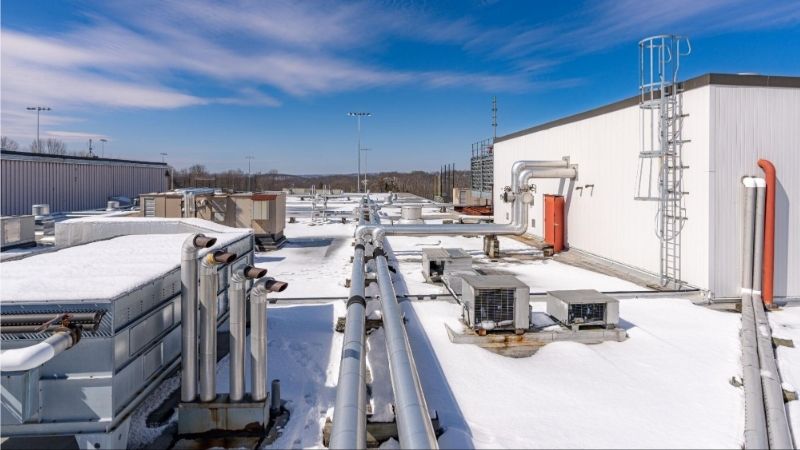
Rooftop HVAC equipment. Image used courtesy of Adobe Stock
Traditional Shading Geometry Inspires Structure
The device’s geometry borrows from a familiar architectural concept. The research team compared it to the changing eave angles of traditional Hanok and Chinese teahouse roofs, which were shaped to manage seasonal sun exposure.
Their design scales this principle to a compact module built from 3D-printed components, a central SMA spring, and a pair of dual-layer movable wings. The outer wing surfaces carry a radiative cooling film tuned for strong emission in the 8-13 µm atmospheric window, while the inner surfaces are coated in carbon black to maximize solar absorption.
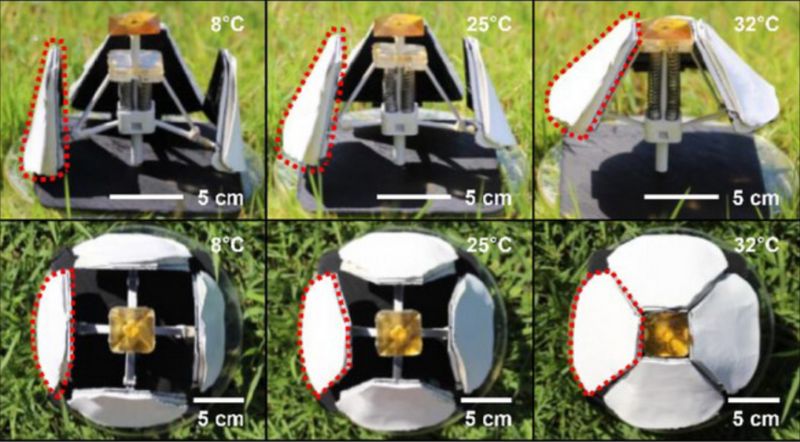
Images of the “Hanok” style devices in various temperature environments (8, 25, and 32°C). Image used courtesy of Jin et al.
Its operation hinges on the SMA element. At higher temperatures, the NiTi spring elongates, pulling the wings inward until they overlap and cover the absorber. This creates a closed structure that reflects incoming solar radiation while enabling mid-infrared emission to the sky. At lower temperatures, the SMA contracts, pushing the wings outward into a 90-degree open position that exposes the black absorber to direct sunlight.
Mechanical measurements show a clear transition range. The SMA begins shifting to its austenite phase near 35°C and to its martensite phase around 4°C. Between these boundaries, the wings move continuously rather than snapping into a binary state. The opening area varies from zero to 88 cm² as the spring length changes from roughly 5 cm to 2.5 cm. Across repeated actuation cycles, the force characteristics remain consistent, with the SMA producing up to 9.8 Newtons of push force at 40°C and 2.5 Newtons of pull force at 0°C.
The team validated these behaviors outdoors in Daejeon during summer and winter. In August testing, the wings remained fully open at night, then closed shortly after sunrise, at temperatures below the nominal SMA transition point. This indicated that solar irradiance was heating the spring directly, prompting earlier cooling-mode activation. In January, the device stayed open throughout the cold period, maintaining heating mode as intended.
_cooling_and_(b)_heating_modes.jpg)
Schematics of the device’s behavior during (a) cooling and (b) heating modes. Image used courtesy of Jin et al.
Heating and Cooling Performance in Outdoor Conditions
Scientists evaluated the thermal results on surfaces mounted at zero degrees, 45 degrees, and 90 degrees, reflecting common roof and wall installations. They tested the device alongside surfaces coated with urethane paint, carbon black paint, and the radiative cooling film.
In summer conditions, the 3D device initially ran in heating mode until the SMA closed the wings. Once closed, its bottom surface temperature converged with the radiative cooling control surface, demonstrating that the RC film was providing the dominant effect. In winter testing, the device remained open, and the exposed black absorber delivered up to 51.3°C above ambient at 6°C. In cooling mode, the system reached -6.1°C below ambient at 40°C with a net cooling power of 36.1 W/m2.
The researchers also tested a version of the structure without the RC film. Even when the SMA closed the wings, the film-free version failed to cool effectively. This established that full performance required both the SMA actuation and the radiative material. Across all panels and angles, the reversible device matched or exceeded the performance of fixed-function coatings while providing functionality in both seasons.
Modeling Energy Savings Across Global Climates
To assess building-level impact, the team applied a simplified heat-transfer model to simulate annual HVAC energy use for a reference building. The simulations were run for fifteen representative cities across different Koppen-Geiger climate classes, using measured relationships between ambient temperature and device opening area.
In tropical monsoon climates, the device spent most of the year in cooling mode and delivered estimated cooling-energy savings of 9.1%. In hot desert regions, where both hot summers and cold nights occur, the model produced the largest gains: 17% cooling-energy savings and roughly 17% heating-energy savings.
In continental cold climates, the device spent long periods in heating mode and showed heating-energy reductions of about 4.6%. Semi-arid regions produced balanced results, with combined savings above 16%. The researchers attribute these differences to solar altitude, temperature swings, and seasonal irradiance patterns.

Cities representing various climate scenarios. Image used courtesy of Jin et al.
Across all scenarios, the simulations show that the reversible 3D structure can reduce heating and cooling loads without power consumption or mechanical control systems. The device’s ability to operate at different tilt angles and respond to both temperature and sunlight makes it adaptable to varied building geometries.
The study concludes by noting that the SMA transition temperature could be tuned for specific climates or building types. With materials limited to standard 3D-printable plastics, a PDMS composite coating, and commercially available SMA springs, the team positions the work as a platform for scalable, passive thermal management in building envelopes.
Researchers from Daegu Gyeongbuk Institute of Science and Technology, Korea Advanced Institute of Science and Technology, and Pohang University of Science and Technology led the study, published in Advanced Materials.