Facebook
 Google
 GitHub
 Linkedin
3D Device Controls Temperature With Radiative Cooling
The smart energy device enhances solar energy by integrating heating and cooling capabilities.
About half of global energy consumption comes from heating and cooling, according to the International Renewable Energy Association (IRENA). Conventional temperature control systems, while effective, are unsustainable because of rising environmental concerns and the pressing need for climate-conscious solutions.
DGIST's Department of Robotics and Mechatronics Engineering researchers have introduced an advanced 3D smart energy device that combines reversible heating and cooling in one adaptable system. The smart device could set a standard for versatile, low-impact temperature management.

Can smart temperature control become even smarter? Image used courtesy of Adobe Stock
Is Sustainable Temperature Management Possible?
Temperature management involves heating and cooling to maintain indoor comfort, support industrial processes, and protect equipment. Conventional methods use combustion, electric resistance, and heat pumps for heating while cooling mostly relies on vapor-compression refrigeration.
IRENA indicates that heating and cooling comprise nearly half of the world’s total energy consumption, surpassing electricity (20%) and transport (30%) as the largest end-use sector. This demand also drives 50% of energy-related carbon dioxide emissions globally. By 2050, the global need for cooling alone is projected to rise by 45% compared to 2016 levels.
Solar heating and radiative cooling offer effective solutions for reducing global energy consumption by harnessing the sun for heating and outer space for cooling.
In radiative cooling, the emission of infrared radiation rises from a surface to the sky or outer space, effectively allowing the surface to cool below ambient temperatures. This process relies on materials that can efficiently emit thermal radiation in the infrared spectrum while avoiding absorption from the sun.
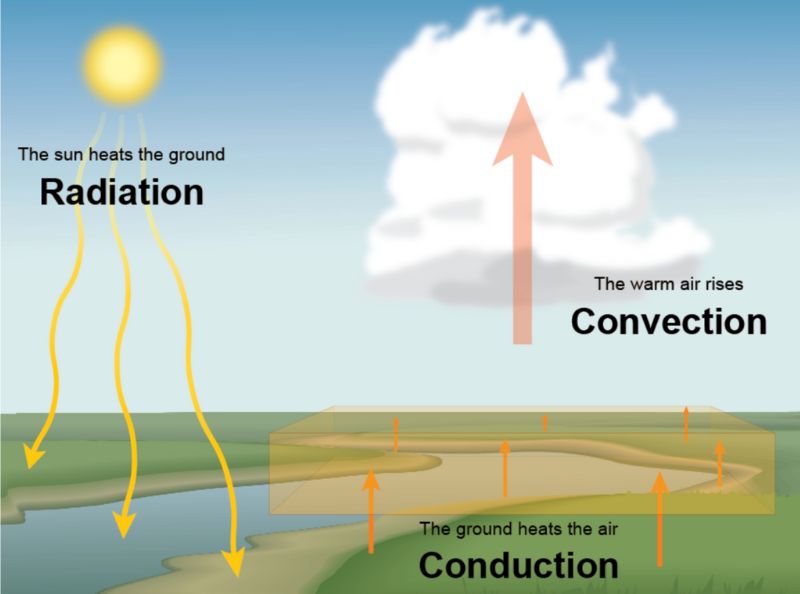
Principle of radiant cooling. Image used courtesy of National Oceanic and Atmospheric Administration
Solar absorption focuses on capturing sunlight as heat. Surfaces designed for solar absorption are typically coated with materials that maximize the capture of solar radiation. While these eco-friendly methods enable high-performance thermal management, their effectiveness is restricted by daily temperature variations and seasonal shifts due to single-mode operation.
Smart 3D Heating and Cooling Devices
Researchers have invented a 3D smart energy device to integrate radiative cooling and solar absorption, offering reversible heating and cooling functions within a single system. The smart device operates through a novel 3D structural mechanism. When mechanically peeled open, a silicone elastomer and silver layer is exposed, activating radiative cooling by emitting infrared radiation and effectively lowering the temperature.
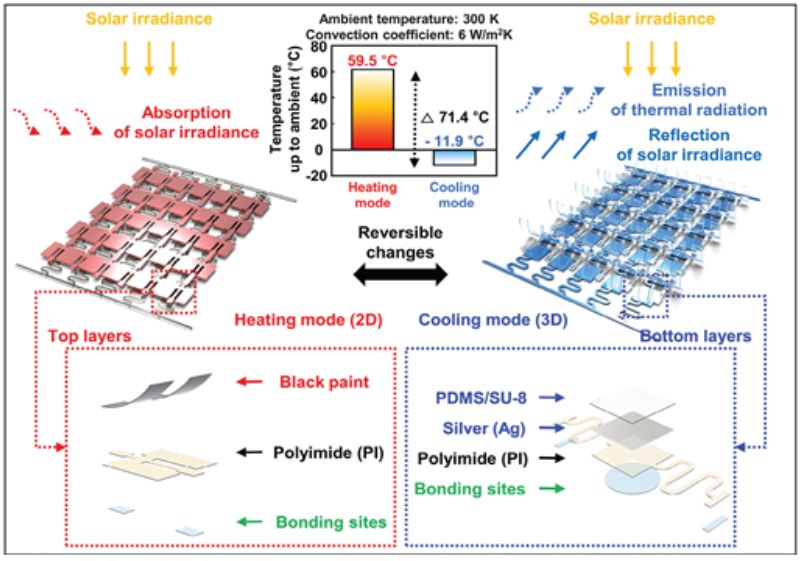
Schematic of 3D heating and cooling device. Image used courtesy of DGIST
When the structure is closed, a black paint coating on the outer surface maximizes solar heat absorption, generating warmth. This dynamic adjustability is achieved through precise angle modifications of the 3D structure, allowing the device to control thermal properties based on external conditions and energy requirements. Testing on varied substrates such as skin, glass, steel, aluminum, copper, and polyimide demonstrated consistent performance, with devices achieving heating and cooling temperatures of 59.5°C and -11.9°C, respectively.
Future Outlook
The development of dual-mode, adaptive devices could reshape energy use in temperature management. With 50% of the world’s energy consumption coming from heating and cooling, a more sustainable solution can significantly impact global energy expenditure and enable a more sustainable future.