Facebook
 Google
 GitHub
 Linkedin
3 Advances in Solar Desalination, Electrolytes, and Perovskite
From universal electrolytes to solar-powered desalination and defect-resistant photovoltaics, researchers push the boundaries of sustainable energy technologies.
Breakthroughs in materials science are addressing some of the most persistent bottlenecks in energy and water systems. University of Wisconsin-Madison researchers have created a universal electrolyte stabilizing lithium, silicon, and graphite anodes. Meanwhile, a UNIST team has developed a perovskite-based photothermal system that enables high-speed desalination using only sunlight. In solar energy, scientists at the University of Colorado Boulder and the National Renewable Energy Laboratory have uncovered how microscale defects lead to catastrophic breakdowns in perovskite solar cells under partial shading.
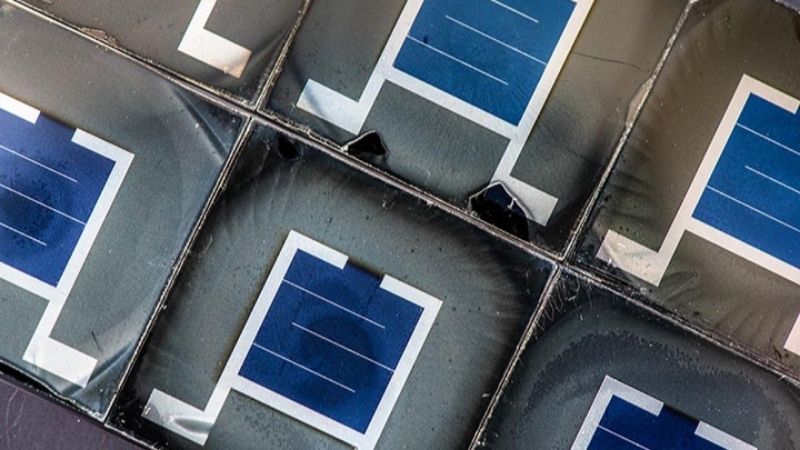
Perovskite solar cells. Image used courtesy of National Renewable Energy Laboratory
1. PV-Based Photothermal System for Power-Free Desalination
UNIST researchers have developed a novel solar evaporator based on an inverse-L-shaped architecture incorporating a perovskite oxide—La0.7Sr0.3MnO3 (LSMO)—as a high-efficiency photothermal material. Unlike conventional carbon-based or plasmonic absorbers, LSMO offers near-complete solar absorption across the UV-vis-NIR spectrum, leveraging intra-band trap states and oxygen vacancies to promote non-radiative recombination and maximize heat generation.
Synthesized via a low-cost precipitation process and deposited onto a hydrophilic GF/C membrane, LSMO exhibits exceptional thermal stability, robust water compatibility, and nanoscale morphology optimized for light trapping. When integrated into the custom inverse-L geometry, the system exploits capillary-driven flow to wick seawater upward, where it is rapidly evaporated under one sun illumination at a rate of 3.40 kg/m2/h, which is up to 10 times faster than conventional solar desalination techniques.
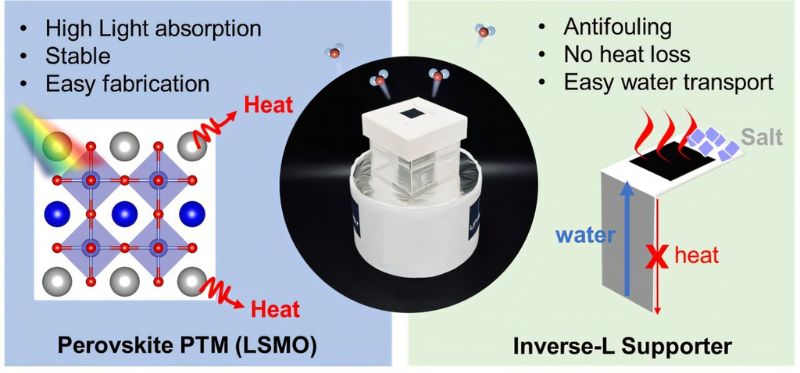
Illustration of the salt-rejecting evaporator. Image used courtesy of Chaule et al.
The mechanical design behind the evaporator is just as important as the materials science that enables it. By elevating the photothermal interface and introducing one-way water transport, the system creates a localized salt gradient that drives crystallization toward the device’s edge, away from the light-absorbing surface. This passive salt rejection mechanism avoids the common issue of surface fouling that plagues long-duration desalination operations. Field-relevant stress testing showed stable operation in brine with 20% salt concentration for over two weeks, while salt recovery rates reached ~140 g/m2/h.
The device’s ambient operation and lack of external power make it especially promising for deployment in remote or resource-limited environments, potentially marking a leap forward in delivering clean water solutions powered by sunlight.
2. Universal Electrolyte Stabilizes Anodes for Safer Batteries
A research team at the University of Wisconsin-Madison has developed a novel electrolyte formulation capable of stabilizing lithium metal, silicon, and graphite anodes within the same electrolyte environment. The innovation hinges on a multi-layered solid electrolyte interphase (SEI) that forms spontaneously on each anode type, enabled by a unique mix of ethereal solvents and lithium salts with a tailored solvation structure.
The electrode-agnostic electrolyte demonstrates high Coulombic efficiency across various charge/discharge regimes and shows no short-circuiting, even in lithium metal half-cells under aggressive cycling conditions. In lithium-metal full cells with LiFePO4 cathodes, the electrolyte supported over 180 stable cycles at 2.0 mAh/cm2, highlighting its practical durability for high-energy systems.
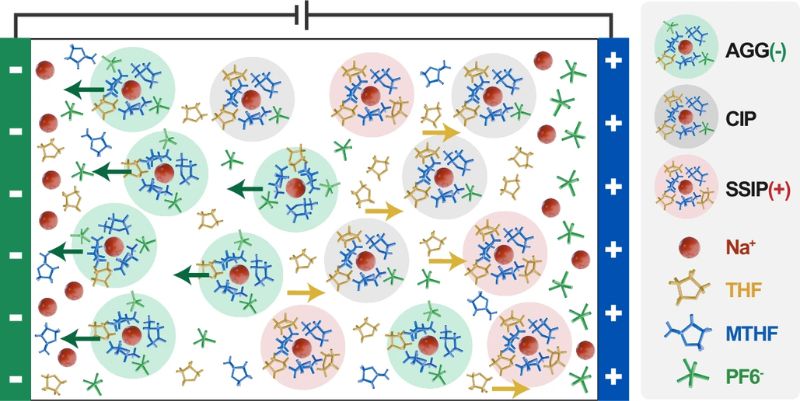
Solvent distributions in the electrolyte during charging. Image used courtesy of Xing et al.
The electrolyte maintains chemical and electrochemical stability across a broad voltage range, eliminating the need for separate formulations tailored to specific anode chemistries. Molecular dynamics simulations revealed that its performance stems from the formation of dense, ionically conductive SEI layers rich in LiF and organic decomposition products, which inhibit dendrite growth and electrolyte degradation.
This universal compatibility could streamline the development and manufacturing of next-gen lithium batteries, especially designs exploring anode material switching or hybrid architectures. The team’s findings, published in Nature Communications, offer a new pathway toward safer, longer-lasting, and more versatile battery systems for consumer electronics and electric vehicles.
3. Microscale Defects Trigger Breakdown in PV Solar Cells
University of Colorado Boulder and the National Renewable Energy Laboratory researchers have pinpointed a key weakness that threatens the long-term viability of perovskite solar cells: microscale defects formed during fabrication can initiate thermal runaway under reverse bias conditions.
Unlike silicon solar cells, which use bypass diodes to handle shading events, perovskites lack the structural resilience to cope with current reversal. This vulnerability becomes catastrophic when defects like pinholes and thin spots in the perovskite layer heat up rapidly and “melt,” leading to permanent shorting between contact layers. Using advanced diagnostic tools, including electroluminescence imaging, scanning electron microscopy, laser-scanning confocal microscopy, and video thermography, the team could correlate defect sites with local heating and device failure in real time.
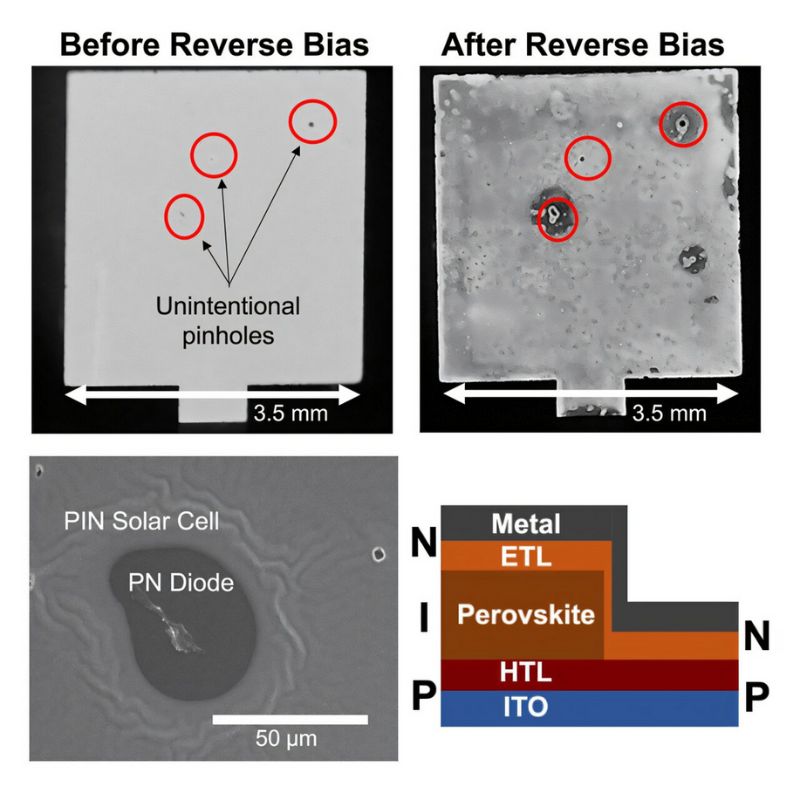
Pinholes in the perovskite layer. Image used courtesy of Johnson et al.
To study these failure modes with high statistical power, the researchers fabricated ~100 microscale devices just 0.032 mm2 in area, enabling the creation of both defective and defect-free samples. Their analysis showed that only devices with pre-existing flaws degraded under reverse bias, while pristine cells remained stable for hours.
The findings in Joule emphasize the importance of producing pinhole-free perovskite films and robust contact interfaces to prevent reverse-bias breakdown during real-world conditions, such as partial shading on solar rooftops. This work clarifies the degradation mechanism that has long plagued perovskite solar development and establishes a foundation for engineering more durable architectures in commercial modules.