Facebook
 Google
 GitHub
 Linkedin
3-in-1 Energy Generator Uses Waves, Wind and Solar
Meet NoviOcean, a wave-wind-solar energy system offering higher outputs than standalone renewable resources.
Swedish startup NoviOcean has debuted a 1 MW hybrid energy converter leveraging wind, solar, and waves to generate 3.5 GWh annually per unit, enough to power 1,050 homes.
See how the NoviOcean converter works.
The floating system produces 650 kW of wave energy, 300 kW of wind through six vertical-axis turbines, and 50 kW of solar through photovoltaic (PV) panels. NoviOcean claims it offers four times the output of any other validated concept.
After recently completing its 1:5-scale prototype, NoviOcean has entered stage four development to reach a technology readiness level of seven (TRL 7). This milestone entails testing its 1:1-scale prototype in real-world conditions at sea by 2027. The company aims to achieve TRL 8 by 2029 with a pre-commercial array, targeting commercial deployment by 2032.
NoviOcean anticipates an initial 500 MW of contracted units by the decade’s end, then 10 GW deployed by 2050. If successful, the product could claim a significant share of the European Union’s wave energy targets, eyeing 1 GW of installed ocean energy capacity by 2030 and 40 GW by 2050.
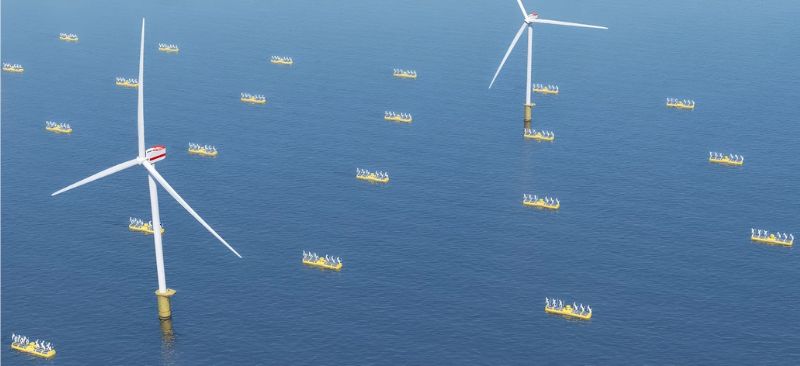
NoviOcean can be positioned near offshore wind turbines to boost electricity production. Image used courtesy of NoviOcean
Novel Hybrid Concept
The 124-foot-long raft produces 30 MWh per ton, operating 24/7 in 90% of sea conditions. NoviOcean’s wave energy converter leverages the force of buoyancy and uses shared moorings and subsea cables to reduce material costs. The company claims it’s the only device utilizing a rectangular float design to lift 600 tons in four-meter waves. A hydraulic cylinder under the platform connects to Pelton turbines that convert wave motion via rotation.
NoviOcean’s capacity factor averages 40% in medium-condition locations, with the potential to reach 70% in other areas. This makes it competitive with solar (25%) and offshore wind plants (about 41%). Wave energy capacity factors are more difficult to compare due to site-based variability. For example, some parts of the North Sea reach as high as 25-32%, while the Gulf of Mexico, the Mediterranean, the Caribbean, and the Malay Archipelago have capacity factors below 20%.

NoviOcean prototype.
NoviOcean has a smaller physical footprint than offshore wind turbines, allowing project developers to optimize their sea area utilization. Its weight-to-power ratio is also half that of floating offshore wind structures.
In addition to power generation applications, NoviOcean’s technology can meet other needs like reducing diesel reliance at offshore oil rigs, powering desalination processes at water plants, and enabling a clean energy supply for ports and harbors.
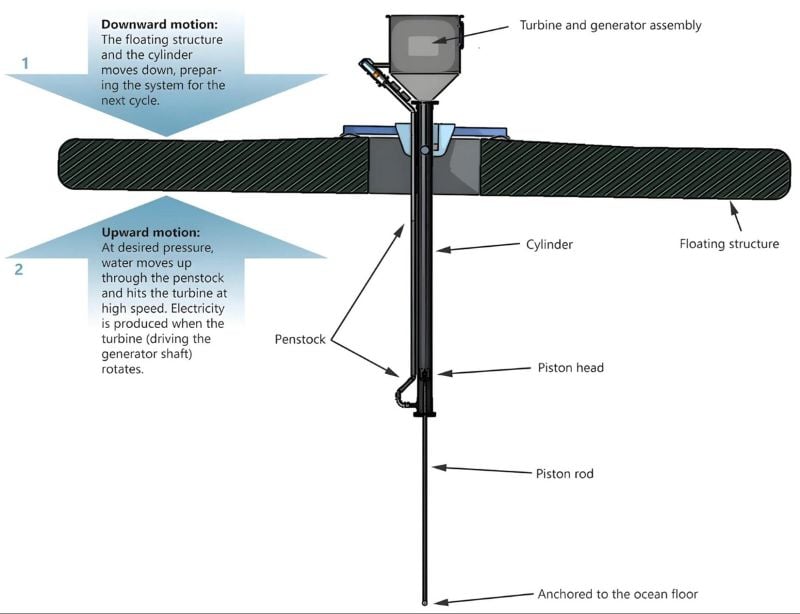
NoviOcean components.
How NoviOcean Works
NoviOcean taps into waves’ natural movement and pressure with a valve control mechanism. The floating platform and cylinder move down as the wave rises. Once reaching the lowest point, the device’s valve closes, and the structure maintains a fixed position relative to the sea floor. Pressure rises as 600 cubic meters of air is restricted underwater. Then, the valve opens as the wave moves upwards, releasing high-pressure water to the Pelton turbine and mounted generator.
Underwater, the hydraulic cylinder stays stabilized on a stationary piston and rod. At the optimum pressure, high-speed water pushes through the penstock to the turbine. Electricity production corresponds to the turbine rotation driving the generator shaft.

NoviOcean’s working principle.
Performance simulations indicated that NoviOcean’s 1:6-scale prototype delivered 650 kW of wave energy after losses in 13-foot waves, substantially higher than other wave converters.
NoviOcean has several target markets. Offshore wind plants can co-locate units to increase turbines’ annual output and shave 12% off their levelized cost of energy (LCOE). Future add-ons could allow customers to integrate lithium-ion battery storage, hydrogen production, and desalination functions.