Facebook
 Google
 GitHub
 Linkedin
XL Batteries Launches Its First BESS Using Flow Batteries
The company’s organic flow batteries will be deployed for long-duration energy storage at a Houston shipping terminal.
XL Batteries has partnered with Stolthaven Terminals for the first commercial use of its grid-scale organic flow batteries in long-duration energy storage. The batteries are used in battery energy storage systems (BESS), which are critical for the deployment of intermittent renewable energy sources, such as wind and solar.
XL Batteries will install a prototype of its organic-flow battery at Stolthaven Terminals, based at its facility in Houston, to provide energy storage near its facilities and shore power for ships at its terminals. The project will provide XL Batteries with real-world data needed to scale its commercial product to develop flow-battery LDES solutions for power grids worldwide.
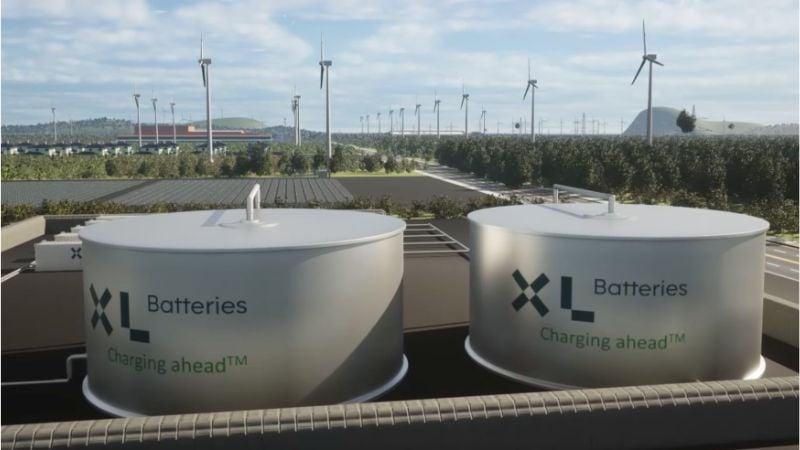
XL flow batteries for renewable energy systems. Image used courtesy of XL Batteries
Battery Storage
Long-duration energy storage (LDES) technology stores excess electrical energy produced when the wind is blowing or sun is shining, returning that energy to the grid at night or during calm periods.
Many developers use lithium-ion batteries in LDES systems. Lithium-ion batteries are used in a wide range of applications, from cell phones and personal electronics to electric vehicles (EVs), largely because they offer high energy density—they produce a significant amount of electrical energy in a lightweight package. This is important for portable devices or electric vehicles that travel long distances between charges, but is much less significant for stationary battery storage systems. Other battery options are available, including flow batteries.
Flow batteries are electrochemical energy storage systems that store energy in liquid electrolytes pumped through a cell stack. Unlike conventional batteries, they decouple power (determined by the stack size) and energy (dependent on electrolyte volume), enabling scalable, long-duration storage.
Flow battery facility. Image used courtesy of XL Batteries
Flow batteries are primarily used for stationary energy storage, such as grid-scale renewable integration, microgrids, and industrial backup power. Each chemistry is optimized based on factors like cost, lifespan, safety, and energy density.
Vanadium systems dominate the market due to their reliability and scalability, while iron-based batteries are emerging as cost-effective alternatives for long-duration storage solutions. Experimental chemistries, such as zinc-polyiodide, aim to address energy density limitations but are still in development.
Organic flow batteries (OFBs) utilize carbon-based electrolytes, offering distinct advantages in sustainability and safety while addressing limitations of metal-dependent systems. They use redox-active organic molecules, such as quinones or alloxazines, dissolved in water or solvents. These molecules undergo reversible oxidation-reduction reactions to store and release energy. OFBs can utilize abundant elements, such as carbon, hydrogen, and nitrogen, instead of scarce metals like vanadium or lithium, which reduces costs and enhances the recyclability of battery components. Non-flammable aqueous electrolytes also eliminate fire risks associated with lithium-ion batteries, enhancing safety for BESS facilities. Flow batteries are also expected to have lifetimes of 25 years or more, two to three times longer than lithium-ion batteries.
XL Batteries and Stolthaven
In 2019, at Columbia University, XL Batteries’ founders discovered an organic molecule that remained stable in both charged and discharged states. Working on a molecular level, the researchers incorporated other desirable attributes, such as solubility in salt water with a neutral pH. The organic molecules do not pass through the membrane, which solves some key challenges experienced by metal-based battery chemistries. XL’s chemistry uses inexpensive chemical feedstocks, available at low prices and high volumes worldwide.
Stolthaven Terminals specializes in storage and distribution for bulk liquids, including chemicals.