Facebook
 Google
 GitHub
 Linkedin
Volvo 14-Ton FL Electric Offers More Agility in Urban Areas
The lighter transport truck is lighter, less expensive, and more maneuverable than Volvo’s other medium-duty electric trucks.
Volvo Trucks has expanded its battery-electric portfolio with a 14-ton version of the Volvo FL Electric. This truck is designed for urban transport operations where tight turning radii, usable payload, and low noise tend to matter more than maximum driving range.
Battery-electric trucks have gained traction in city environments, but efficiency at scale remains a challenge. Many medium-duty electric models are designed to cover a wide range of use cases. However, that flexibility often comes with trade-offs. For urban delivery routes that follow predictable, stop-and-go patterns, carrying excess battery capacity can mean unnecessary weight, reduced payload, and higher upfront cost, all of which complicate the case for electrification.
The Volvo FL Electric, first introduced in 2019, was among the company’s earliest fully electric medium-duty trucks. The 14-ton variant offers lighter gross vehicle weight and revised battery configuration to reflect the daily duty cycles common in dense urban settings, where the FL Electric most often operates.

The FL Electric is designed for dense urban environments. Image used courtesy of Volvo Trucks
Designed Around Urban Constraints
At 14 tons gross combination weight, the FL Electric sits at the lighter end of Volvo’s electric truck range. It uses a battery system with 145 kWh of usable energy. With this amount of usable energy, drivers can expect a range of up to around 200 kilometers, depending on load, driving conditions, and ambient temperature.
Power comes from a 180 kW electric motor. This motor aligns better with stop-and-go urban delivery rather than long-haul operation. Volvo offers the truck with multiple wheelbases, ranging from 3,800 to 6,500 millimeters, and several axle and battery configurations. That flexibility is relevant for operators balancing payload, bodywork, and overall vehicle weight.
According to Volvo, the battery placement has been engineered not to interfere with bodybuilder installations, a practical consideration for fleets running specialized equipment.
The design also emphasizes maneuverability. The minimum width is about 2.4 meters. The truck offers 240 millimeters of ground clearance, making it better suited to narrow streets, loading docks, and uneven urban surfaces. The electric driveline keeps noise levels low, enabling early-morning or late-night deliveries in dense residential areas.
How the 14-Ton Fits Into Volvo’s Electric Range
The 14-ton FL Electric fills a gap below Volvo’s heavier urban and regional electric trucks. With configurations reaching up to 26 tons GCW, the FE Electric extends into higher gross weights and more demanding applications such as waste collection and light construction.
Volvo’s electric lineup also reaches into regional haulage and construction, with models like the Volvo FM Electric, FMX Electric, and FH Electric sitting at that end of the spectrum. These trucks are built for heavier work—higher payloads, longer distances, and operating cycles that differ from stop-and-go city routes.
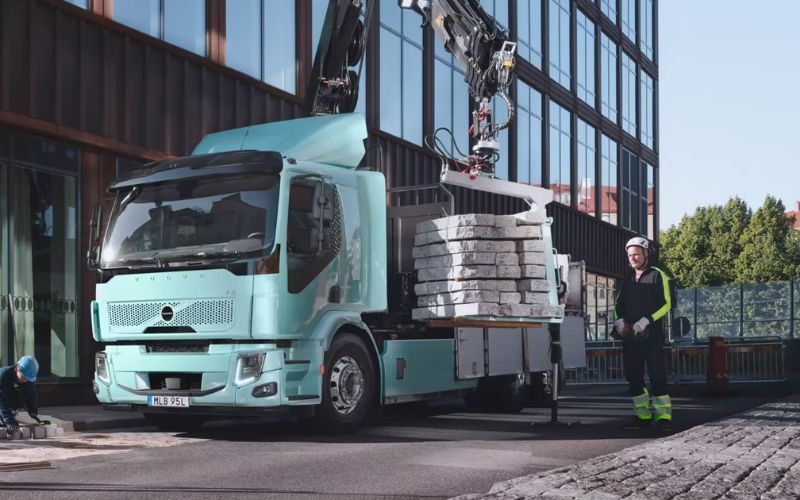
The Volvo FM Electric for heavier loads. Image courtesy of Volvo Trucks
The new FL Electric variant is deliberately modest in scope. It is intended for operators who do not need maximum range or power but want to reduce emissions and noise without sacrificing payload.
Why the 14-Ton FL Electric Matters
Volvo states it configures electric trucks around actual operational needs. Offering a lower-weight FL Electric with a smaller battery aligns with that philosophy.
In city fleets, extra battery weight is not theoretical. It shows up in payload numbers and operating costs. The FL Electric more closely reflects how urban routes actually operate, making it easier for operators to move away from diesel without reworking their entire day. The same battery technology is shared across several Volvo electric models, from the FL to the FE, suggesting an effort to streamline production and support.
Volvo currently has eight battery-electric truck models in production and has reported delivering more than 5,000 electric trucks globally. The company plans to begin production of the 14-ton FL Electric in the second half of 2026.
As electric truck adoption shifts from pilot projects to broader deployment, incremental additions like the Volvo 14-ton FL may prove as important as headline-grabbing long-haul models. For many cities, decarbonizing transport starts not on highways, but on the narrow streets where trucks stop, idle, and turn all day long.