Facebook
 Google
 GitHub
 Linkedin
How Advanced Technologies Are Reshaping EV Battery Manufacturing
Emerging technologies like Artificial Intelligence, digital twins, and advanced battery chemistries are shaping the future of EV battery manufacturing, transforming production processes, improving battery performance, and ensuring sustainability.
As the electric vehicle (EV) market continues to grow rapidly, with expectations to reach $537.53 billion by 2033, one of the most pressing challenges for automakers is ensuring the safety, reliability, and affordability of EV batteries. Advances in battery technology play a critical role in meeting these demands and ensuring the successful mass adoption of EVs. To this end, emerging technologies like Artificial Intelligence (AI), digital twins, and advanced battery chemistries are helping shape the future of EV battery manufacturing, transforming production processes, improving battery performance, and ensuring sustainability.
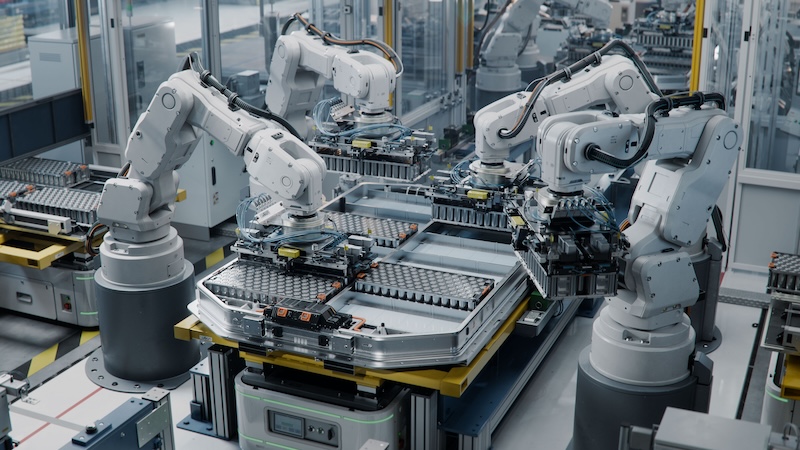
Image used courtesy of Adobe Stock
Advanced Battery Chemistries: A Path to Safer, More Efficient EV Batteries
Battery chemistry is the foundation for EV performance, safety, and reliability. Traditional lithium-ion batteries, particularly those using Nickel-Manganese-Cobalt (NMC) chemistry, have been the standard in the EV market. However, manufacturers are starting to shift towards newer, more promising chemistry.
A promising alternative to traditional lithium-ion batteries is lithium-ion phosphate (LFP). While LFP batteries offer a lower energy capacity compared to NMC, they are significantly more stable, durable, and affordable. This makes them an attractive option for manufacturers aiming to reduce production costs while ensuring long-term performance and safety. Additionally, LFP batteries offer a longer lifespan, making them an environmentally sustainable choice for both manufacturers and consumers. Over the past few months, LFP batteries are closer and closer to taking the lead in terms of global market share with 45% in 2024.
Another emerging chemistry is the solid-state battery (SSB). Unlike conventional lithium-ion batteries, which use a liquid electrolyte, solid-state batteries replace this liquid with a solid electrolyte. This innovation not only enhances safety by reducing the risk of fire and thermal runaway, but it also improves energy density. The result is an EV battery with higher energy storage capacity, longer vehicle range, and a reduced risk of failure. Solid-state batteries can also be 33% smaller and 40% lighter than standard NMC lithium-ion batteries if we compare energy density. This explains the interest in SSB in aviation applications.
Manufacturers are exploring more sustainable production methods, such as dry battery electrode manufacturing, which reduces reliance on toxic solvents and drastically lowers energy consumption. This innovation is critical as automakers strive to meet environmental sustainability goals and reduce the carbon footprint of their production processes.
Artificial Intelligence: Enhancing Quality Control and Predictive Maintenance
The complexity of EV battery production necessitates the use of advanced quality control and maintenance strategies. AI is starting to play a central role in this process, providing helpful guidance so manufacturers can enhance performance while reducing waste.
In traditional battery manufacturing, human-performed quality checks are subjective, prone to errors, and time-consuming. AI-powered visual inspection systems address these challenges by providing faster, more accurate, and objective assessments of battery quality. Leveraging machine learning algorithms, AI detects potential flaws that might be overlooked by the human eye, ensuring a higher level of precision and improving the overall reliability of each battery.
Moreover, AI is crucial in predictive maintenance. By collecting and analyzing data from EV battery usage patterns, AI systems can predict the battery's state of health (SOH), identify potential issues early on, and suggest optimal charging strategies. This predictive approach helps manufacturers proactively address problems before they impact battery performance or safety.
In addition to improving production processes, integrating AI and digital twins into battery development plays a vital role in managing the lifecycle of EV batteries. By tracking data on battery usage, performance, and charging patterns, AI can predict when batteries will reach the end of their life and provide insights on optimal reuse, repurposing, or recycling strategies.
Digital Twins: Revolutionizing R&D and Production Efficiency
As the EV industry moves towards scaling production, digital twins are proving to be another indispensable tool. A virtual replica of a physical system like a battery or production line, a digital twin allows engineers and manufacturers to simulate, test, and analyze various scenarios without the need for expensive or time-consuming physical prototypes.
In battery development, digital twins are used to simulate and optimize battery performance by experimenting with different electrode designs, material properties, and other parameters. This process allows engineers to identify the most efficient and effective design choices while reducing the need for physical testing, which can be costly and time-intensive.
Moreover, digital twins are essential for improving production processes. Manufacturers can use virtual models of their production lines to optimize workflows, predict potential bottlenecks, and identify areas where automation can be increased. By refining the manufacturing process in a virtual environment, manufacturers can reduce scrap rates, minimize downtime, and accelerate time-to-market, ensuring that EV battery production scales efficiently to meet rising demand.
Bridging the Gap Between Innovation and Efficiency
While digital twins are helping pave the way for more scalable production, there are still challenges to overcome. Scaling battery production is not easy or straightforward. Battery manufacturers cannot simply scale battery production without recalibrating processes and adjusting chemistries. This complexity requires a thoughtful approach and a balance between innovation and efficiency. Emerging technologies like AI, digital twins, and advanced chemistries are accelerating this process.
Scaling Production for the Mass Market
As EV adoption grows, so too does the need for effective battery disposal and recycling. By using a data-driven approach to battery circularity, manufacturers can recover and reuse valuable materials, such as cobalt and lithium, in new batteries. This helps mitigate concerns about resource scarcity, reduces the environmental impact of mining, and supports a sustainable EV ecosystem.
To remain competitive in the global EV race, U.S. automakers must prioritize research and development in cutting-edge battery technologies, such as solid-state and LFP batteries, along with advanced manufacturing techniques. By embracing these innovations and committing to smart manufacturing and sustainability, the industry is paving the way for the next generation of EVs—safer, more efficient, and equipped to meet the demands of an evolving market.
Related Content