Facebook
 Google
 GitHub
 Linkedin
Snow Job: Airports to Clear Runways With Heavy-Duty EVs
Electric and hybrid snow blowers could soon be used at more than 35 airports.
While light-duty cars have made significant strides in transitioning to electric vehicles, the electrification of heavy-duty vehicles is crucial for broader environmental benefits. Heavy-duty vehicles, such as snow blower vehicles, buses, and trucks, contribute significantly to global greenhouse gas emissions. However, challenges such as limited battery technology for heavy loads, less power output, and infrastructure development for charging need attention.
In partnership with Chang Robotics and Roush, Kodiak Technologies released a heavy-duty battery electric vehicle (BEV) and a series hybrid BEV (HEV) that has garnered interest from airports.
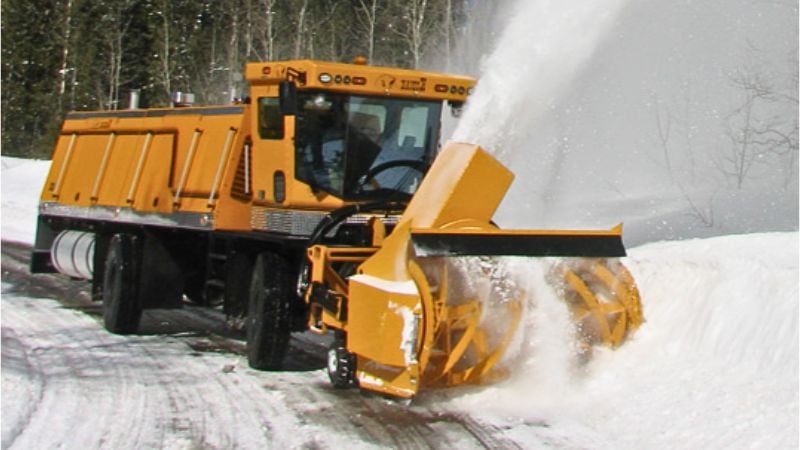
A Kodiak snowb lower. Image used courtesy of Kodiak America
Diesel Powered Snow Blowers
Transitioning from diesel-powered snow blowers to electric alternatives is surprisingly non-trivial. The standard diesel-powered snow blower emits pollutants such as nitrogen oxides (NOx), particulate matter (PM), and greenhouse gases like carbon dioxide during operation. In fact, the Department of Environmental Quality reports that operating a four-stroke gas-powered snow blower for one hour can produce emissions equivalent to driving a car for 339 miles.
Despite deleterious environmental impacts, diesel engines are known for their higher torque and greater power output. This makes them well-suited for heavy-duty snow removal, especially in challenging conditions such as deep snow or icy surfaces. For designers of heavy-duty equipment, the challenge lies in balancing the sustainability of electric solutions with the power and output offered by diesel engines.
Eco-Friendly Snow Removal
Kodiak Technologies, in collaboration with Chang Robotics and Roush, has recently tackled the challenge of developing the world's most powerful industrial BEV. Specifically, the new lineup comprises a heavy-duty BEV and a series HEV, boasting instantaneous power output surpassing twin 15-liter turbo-diesel engines.
With an eye on airport applications, the snowblowers are designed to achieve FAA compliance minimum criteria for moving 7,000 tons of snow per hour at 25 mph. Kodiak’s solution can move 8,300 tons of snow hourly at speeds up to 25 mph.
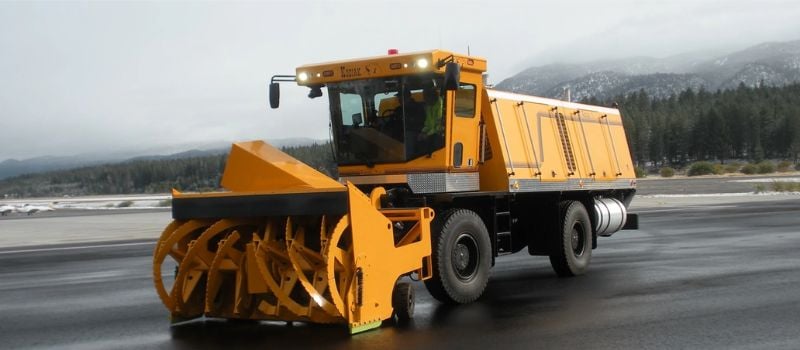
Hybrid snow blower. Image used courtesy of Kodiak Technologies
In contrast to BEVs, incorporating a series hybrid option enables flexibility in power sources to extend the range and battery longevity when needed, particularly in areas lacking infrastructure for megawatt charging standards. Notably, the HEV design allows alternative fuels such as hydrogen, propane, biodiesel, or petrol-diesel to power the vehicle.
This model was recently showcased as a design and business case presentation at the FAA Snow Symposium summit in Buffalo, New York. After the launch, over 35 airports are in discussions to be the initial adopters of the ultra-powerful vehicles, expected to debut in early 2025.
Beyond Airports
In addition to airports, reports indicate public and government entities intend to adopt similar strategies. With support from federal and municipal incentives aimed at subsidizing infrastructure and initial expenses, the transition to more sustainable solutions for heavy-duty equipment could receive a serious catalyst in the wake of Kodiak’s new releases.