Facebook
 Google
 GitHub
 Linkedin
SiC Patents Ramp in High-Power Applications
Innovations in silicon carbide are impacting electric vehicles, renewable energy, and more.
The silicon carbide (SiC) patent landscape ended 2024 with strong activity as the technology expanded its role in high-power applications like renewable power grids, electric vehicle fast-charging systems, and industrial inverters. SiC materials are attracting high adoption levels for their superior efficiency and durability over conventional silicon semiconductors.
French intellectual property consultancy KnowMade reported that over 900 new SiC patent families and 400 granted patents were recorded in the fourth quarter of 2024. SiC’s thermal and electrical properties offer significant advantages over silicon-based semiconductors. Patent filings suggest a growing interest in high-voltage applications, substrate quality improvements, and efficiency gains.
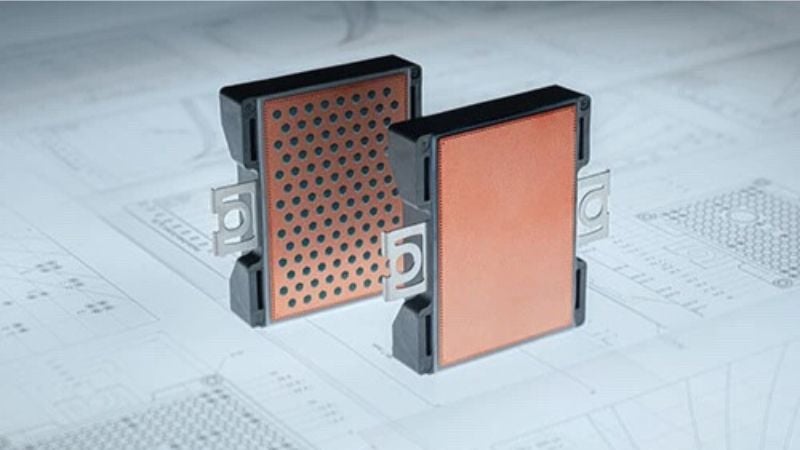
Wolfspeed introduced these 2300 V SiC power modules last year, targeting fast-charging, renewable, and energy storage applications. Image used courtesy of Wolfspeed
Trends in SiC
The latest SiC Patent Monitor tracks several IP filings involving bulk wafers, epitaxial substrates, and SiC modules. Key contributors included Japanese manufacturers Sumitomo Electric and NGK Insulators, and Chinese automakers like NIO and FAW.
Meanwhile, about 100 patents expired or were abandoned last quarter. No new IP litigation was recorded in the U.S., and Europe saw no opposition proceedings. This could be seen as a sign of relative stability in SiC patent enforcement.
Although last quarter welcomed two dozen patent newcomers, long-established players still dominate the market. Many industry giants boosted their SiC portfolios last year. Wolfspeed and Infineon launched products targeting EV charging and renewable energy customers, with the former unveiling a high-power SiC module and the latter releasing its second-generation CoolSiC MOSFETs. ROHM introduced SiC Schottky barrier diodes for onboard charging systems, while STMicroelectronics announced its fourth-generation SiC MOSFETs for EV traction inverters.
SiC for Automotive Applications
SiC’s high efficiency and thermal stability make it an attractive material in automotive power electronics, helping manufacturers extend EV range and improve drivetrain efficiency.
Chinese auto giant NIO secured a European patent for SiC trench MOSFET technology, a key component in EV powertrains that provides increased efficiency and driving range. European companies also contributed new IP last quarter, with Bosch enhancing SiC FET short-circuit strength and Nexperia optimizing SiC Schottky diode on-resistance and surge performance.

NIO's next-generation electric drive systems incorporate a SiC power module. Image used courtesy of NIO
In circuit applications, KnowMade notes that German automotive giant ZF patented a method for driving parallel SiC-MOSFET and silicon-IGBT switches based on real-time current load detection.
In the U.K., BMW, CSA Catapult, and the University of Warwick partnered for a high-current monitoring system to measure a SiC device’s temperature or current under extreme vibrations or mechanical stress. This device could be a crucial development for rugged automotive and industrial applications.
To maximize SiC device performance and durability, companies are also pursuing innovations in packaging technologies. U.S.-based Onsemi introduced electroless plating technology for SiC devices. Japan’s Mitsubishi Electric disclosed a new design to mitigate heat issues in SiC MOSFETs connected with silicon IGBTs, eliminating the need for additional temperature and current sensors.
California-based Navitas Semiconductor is expanding its gallium nitride expertise into the SiC space, patenting a current-balancing solution that could improve efficiency and reliability in high-power SiC modules.
SiC Material Enhancements
KnowMade highlights substantial progress in SiC wafer technology, with NGK Insulators developing a novel composite SiC substrate designed to reduce warpage and cracking by optimizing Raman shift and base plane dislocation density. These improvements could enhance structural integrity and material uniformity, supporting higher performance and reliability in demanding applications like EVs and renewable energy systems.
China-based SICC also published IP targeting 3D stress distribution in large-diameter SiC wafers. Sumitomo Electric made four notable contributions to epitaxial substrate technology, with new solutions to mitigate particle contamination on SiC wafer surfaces, detect defects like bumps and carrots, improve recombination efficiency, and prevent stacking faults from spreading to other layers.