Facebook
 Google
 GitHub
 Linkedin
Solving SiC Power Component Size Challenges in xEV Inverters
Silicon carbide power components are increasingly popular in electrical drive systems, but achieving low losses in a compact size can be difficult.
This article is published by EEPower as part of an exclusive digital content partnership with Bodo’s Power Systems.
Mobility is a key part of daily life. The rapid move to carbon-neutral and energy-efficient means of transport is making an important contribution to a greener future. The development of electric drives that are more compact, efficient, and lighter has a key part to play here—not only in promoting greater interest and use of the next generation of electric vehicles (xEV) but also in hitting environmental targets such as carbon neutrality. Improved drive inverter efficiency is extremely important in this regard, particularly for electric vehicles, as this extends the range and reduces the onboard battery's size.
The importance of silicon carbide in the automotive industry is undisputed. Sales figures from the last few years confirm that the transformation towards electric mobility continues to drive growth, particularly in the European and Asian automotive industries. ROHM supports this transformation sustainably through multiple confirmed cooperations with vehicle and traction inverter manufacturers.
The Brownfield Approach
ROHM will reduce the development cycle of its SiC generations to two years to support the progress of innovation in the automotive industry. However, components will not be phased out because of this. Thanks to ROHM’s production capacities, older generations can continue to be produced. Depending on the products' life cycles, the requirements regarding component availability for long-term industrial applications can still be met.
ROHM adopts the “brownfield” approach to ensure success when producing newly developed products. Thanks to retrofitting and modernization of existing factories, such as the Miyazaki facility, production of 8-inch substrates is already set to begin this year. This reduces the construction time of production sites by two years over a new building since the infrastructure already in place can be used. ROHM will then be able to increase the production of modules by a factor of 30 over conventional SiC housing modules. Production will run on the 8-inch substrates from the fifth generation of SiC MOSFETs, increasing production capacities significantly.
In addition, ROHM and Toshiba have announced a cooperation to manufacture power semiconductors. The Japanese Ministry of Economy, Trade and Industry (METI) supports this plan to ensure a stable and secure supply of semiconductors. Both companies are investing intensively in producing silicon carbide (SiC) and silicon (Si) power semiconductors to improve their supply capacities and make optimum use of one another’s production capacities.
Solving SiC Power Component Size Challenges
However, ensuring low losses while maintaining a compact size represents a major challenge for SiC power components. ROHM solves this dilemma with the TRCDRIVE pack.
The TRCDRIVE pack for SiC modules developed specifically for traction inverter applications features a reduced size thanks to a unique structure that maximizes the heat dissipation surface. Integrating ROHM’s 4th generation SiC-MOSFETs with low ON resistance offers industry-leading power density, 1.5 times higher than conventional SiC modules. At the same time, it significantly contributes to the miniaturization of xEV inverters.
The TRCDRIVE pack modules from ROHM are half-bridge modules with 4th generation SiC FETs designed for high current density and low switching losses. These modules support the automotive industry in driving technological change and supplying highly efficient drives.
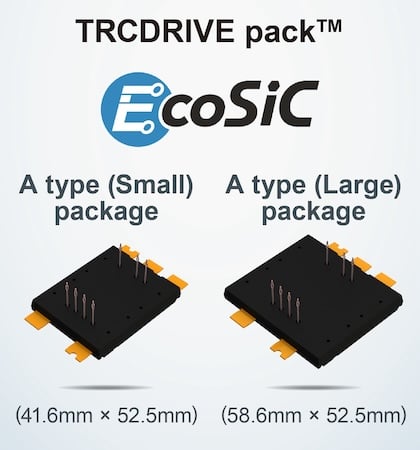
Figure 1. TRCDRIVE pack is a compact module offering high current density with heat dissipation on one side that has been developed for controlling traction inverters and is based on ROHM’s proprietary module technology. Image used courtesy of Bodo’s Power Systems [PDF]
The TRCDRIVE pack excels through its performance. A one-sided, highly thermally conductive housing ensures easy installation and a high current density. An optimized internal arrangement allows a very low inductance of just 5.7 nH. This is made possible by a two-layer busbar structure, which maximizes the current path. Thanks to a very low ON resistance (RDS(on)), an industry-leading current density of 19.1 Ampere/cm² can be achieved. The modules are available for voltages of 750 V and 1,200 V.
Offering power of up to 300 kW and outstanding power density, the module contributes to satisfying the most important requirements of traction inverters in terms of miniaturization, greater efficiency, and lower development costs. The modules have control signal terminals with press-fit pins, facilitating easy connection by simply plugging into the gate driver board from above.
By March 2025, the TRCDRIVE pack will be integrated into twelve models in various housing sizes (small/large) and mounting patterns (TIM: heat deflection plate/Ag sintering). ROHM is also developing a 6-in-1 product with an integrated heat sink, facilitating a fast design process for drive inverters and early market launch of models tailored to handle many design specifications.

Figure 2. TRCDRIVE pack product range. Image used courtesy of Bodo’s Power Systems [PDF]
ROHM offers extensive support at the application level, including using its in-house motor testing equipment. The company makes a large number of auxiliary materials available. These include simulations and thermal designs that facilitate rapid evaluation and introduction of TRCDRIVE pack products. Two evaluation kits are available: double pulse and tests for 3-phase full-bridge applications to facilitate evaluation under conditions similar to practical inverter circuits.
The evaluation kit for double pulse tests comes with pre-welded, screw-retained external connections, eliminating the need for additional welding of the terminals. No special capacitors are required, which in turn allows evaluations to be performed in various standard environments. The device driver board is supplied with 24 V as standard, while the maximum switching frequency is 20 kHz. The operating voltage is also independent of the withstand voltage of the respective capacitor/component.

Figure 3. Two evaluation kits facilitate quick evaluation and introduction of TRCDRIVE pack products. Image used courtesy of Bodo’s Power Systems [PDF]
The evaluation kit for 3-phase full-bridge applications also comes with pre-welded, screw-retained external terminals, pre-welded capacitors, and an integrated cooling system. Further specifications include a gate driver board power supply (typically 24 V), a switching frequency of up to 20 kHz, and an operating voltage of up to 900 V.
Efficiency and Reliability
Although electric vehicles are generally considered sustainable, ensuring that their components are also designed sustainably is still important. ROHM was the world’s first provider, starting mass production of SiC MOSFETs in 2010. These components are marketed under the EcoSiC brand and cover an extensive range, including bare chips, discreet components, and modules.
EcoSiC stands for silicon carbide products with enhanced efficiency and reliability, particularly those used in high-performance applications such as electric vehicles, industrial equipment, and systems for renewable energies. With the introduction of EcoSiC, ROHM is positioning itself as a provider of advanced and sustainable technologies that target higher switching frequencies, lower losses, and environmentally friendly properties. The EcoSiC logo symbolizes the connection between the ecosystem and technological excellence. It is part of the superordinate “Power Eco Family” concept, which aims to maximize the efficiency and compactness of electronic applications. Production of the EcoSiC modules is already being performed on a CO2-neutral basis.
Takeaways
With its TRCDRIVE pack range, ROHM has developed compact modules with heat dissipation on one side that offer a high current density. These modules have been optimized for xEV traction inverters and are based on ROHM’s proprietary module technology. The modules contribute to overcoming the most important challenges in miniaturization, greater efficiency, and lower development costs. ROHM will continue to expand its range of SiC MOSFETs in various housings and with even lower ON resistances. The objective is to reduce power consumption in various devices, contributing to achieving societal objectives such as environmental protection.
This article originally appeared in Bodo’s Power Systems [PDF] magazine.